Donald Trump wanted a spectacular birthday party for the American semiquincentennial but instead got a ghost town on the National Mall. The highly publicized Great American State Fair, intended as a 16-day crown jewel for the Freedom 250 initiative, is floundering due to a toxic mix of heavy partisan branding, sudden artist boycotts, and logistical breakdowns. Behind the scenes, the president is reportedly furious over television footage showing rows of empty seats and vast expanses of green grass where adoring crowds were supposed to stand.
The administration engineered this event to showcase national unity and populist triumph. It backfired. By transforming a historically nonpartisan milestone into what critics and attendees describe as a prolonged campaign rally, the organizers alienated the very public they sought to attract.
The Mirage of Forty Five Thousand Attendees
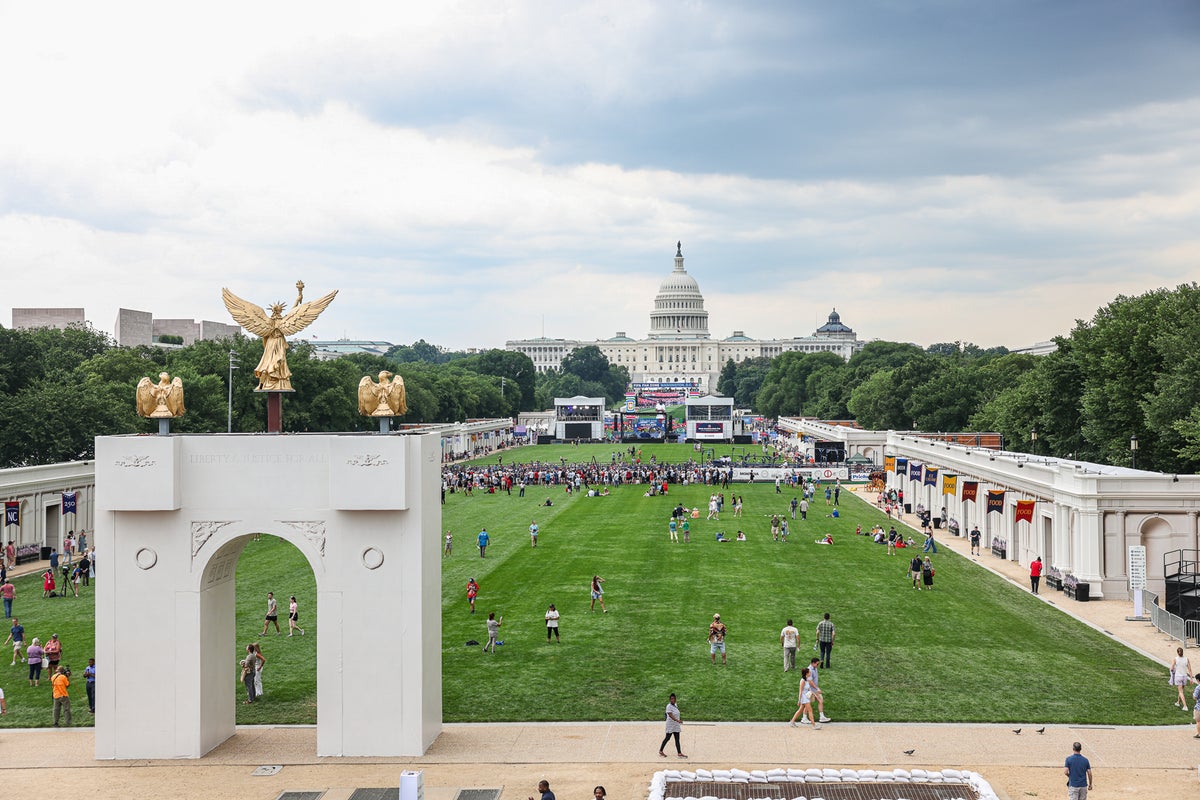
White House officials claimed the opening night speech drew a packed crowd of 45,000 spectators. The visual evidence tells a completely different story. Aerial photographs taken from the top of the Washington Monument reveal a scattering of small groups separated by acres of empty turf.
Supporters argued that the crowds grew as the evening progressed, but independent observations from journalists on the ground confirmed the opposite. People walked away. Entire blocks of seating remained vacant even as the opening chords of patriotic music echoed across the mall. The scale of the miscalculation became undeniable when Trump himself took to social media to demand recognition for the event, a clear sign of growing frustration within the West Wing.
This was not a simple failure of public relations. It was an organizational failure. Experienced event planners understand that drawing massive crowds to an outdoor venue in the sweltering Washington heat requires massive bipartisan appeal and corporate backing. The planners lacked both.
When the Entertainment Walks Out
A major festival relies heavily on its headliners to sell tickets and generate foot traffic. The initial promotional materials promised a wide variety of popular musical acts designed to draw diverse crowds.
Then came the cancellations. Acts like the Commodores, Martina McBride, and Young MC pulled out of the lineup in rapid succession once the overtly political nature of the fair became clear. Performers realized that appearing on the National Mall stage would be interpreted as an endorsement of the administration rather than a celebration of American history.
+-------------------+-----------------------+-----------------------+
| Scheduled Act     | Original Status       | Ultimate Outcome      |
+-------------------+-----------------------+-----------------------+
| The Commodores    | Headliner             | Canceled appearance   |
| Martina McBride   | Headliner             | Canceled appearance   |
| Bret Michaels     | Featured Performer    | Canceled appearance   |
| Lee Greenwood     | Supporting Act        | Performed as scheduled|
+-------------------+-----------------------+-----------------------+
With the mainstream stars gone, organizers had to scramble for replacements. The final lineup relied heavily on familiar campaign fixtures like Lee Greenwood. While these performers appeal to a dedicated segment of the population, they do not possess the broad draw required to fill the National Mall for more than two weeks straight.
Power Failures and Melted Ice Cream
The problems extended far beyond the empty seats in front of the main stage. The fairgrounds suffered immediate infrastructure failures that turned the visitor experience into an ordeal.
On the morning after the opening ceremonies, the temporary structure built to house the grand food hall lost electrical power. Refrigeration systems shut down completely. Hundreds of gallons of high-priced ice cream melted into sludge in the summer heat, forcing vendors to close their doors during peak hours.
"We came all the way from Maryland expecting a massive national festival," said Josh Brulé, a local resident who visited the fairgrounds during the first week. "Instead, it felt smaller and less organized than our regular county fair up in Gaithersburg. The energy just wasn't there."
Even the physical attractions drew criticism. A small-scale replica of a proposed 250-foot-tall Independence Arch stood on display, surrounded by thin crowds and apathetic onlookers. A nearby 110-foot Ferris wheel offered views of an largely empty park rather than the bustling crowds organizers had envisioned.
The Cost of Politicizing National Identity
The root cause of the empty fairgrounds lies in the fundamental shift of the America 250 celebration. Historically, major national anniversaries are managed by nonpartisan committees to ensure participation from all fifty states and citizens of every political persuasion.
The administration sidelined the official, nonpartisan America 250 organization in favor of its own group. This move prompted several state governments to decline participation entirely, leaving the state pavilions looking sparse and incomplete. Instead of a celebration of fifty unified states, visitors found an environment heavily focused on specific administration policies, including themed days dedicated to specific political movements.
* State Pavilions: Multiple states refused to fund official exhibits due to the political framing.
* Corporate Sponsors: Major brands quietly backed away from funding the 16-day event to avoid controversy.
* Local Demographics: The District of Columbia and its surrounding suburbs lean heavily independent or progressive, creating an uphill battle for a highly conservative event.
The Illusion of a Perfect Launch
The administration continues to insist that the event is an unprecedented success. Public statements paint a picture of packed venues and universal acclaim, contrasting sharply with the still photographs of performers singing to nearly empty fields.
This gap between official rhetoric and observable reality has created friction within the planning committees. Staff members privately point fingers over who approved the lengthy 16-day format, which requires an immense, sustained influx of visitors to look successful on television. A shorter, more concentrated three-day festival would have concentrated the crowd and avoided the embarrassing spectacle of empty lawns.
Organizers are now pinned to the upcoming July 4th weekend, hoping that traditional holiday crowds will salvage the attendance numbers and fill the gaps before the fair concludes on July 10. If the numbers do not rise significantly during the holiday, the ambitious Freedom 250 kickoff will be remembered not as a grand national birthday party, but as an expensive lesson in the limits of political stagecraft.