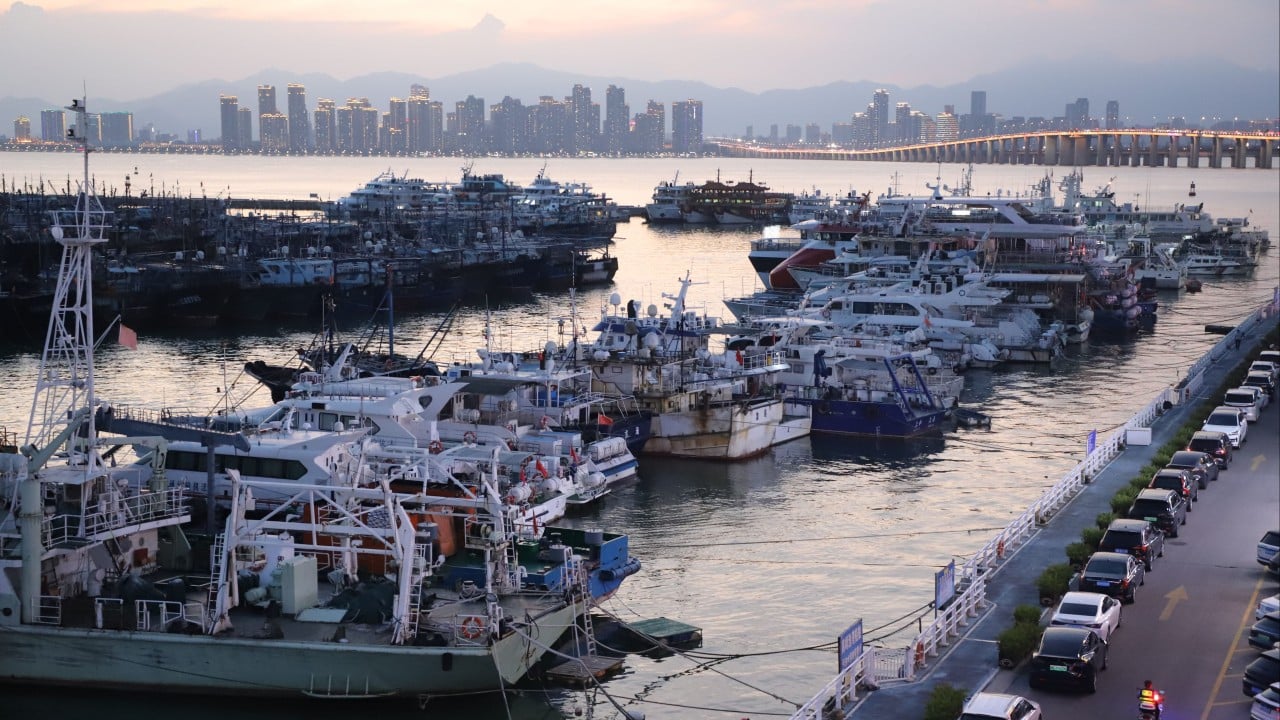
Super Typhoon Bavi has forced the cancellation of more than 400 international and domestic flights across Taiwan, Hong Kong, and eastern China, leaving thousands of passengers stranded and exposing structural vulnerabilities in regional aviation. While weather reports emphasize that the storm has technically weakened from its peak Category 5 status, the reality on the tarmac tells a different story. A tropical system does not need record-shattering sustained winds at its core to completely dismantle modern airline schedules. The cascading logistical failures currently unfolding across East Asian hubs demonstrate that the industry remains highly fragile when confronting regional weather patterns.
The Illusion of a Weakened Storm
A common mistake in mainstream reporting is focusing solely on a typhoon's central pressure or maximum sustained wind speed near the eye. When a storm system moves out of the open Pacific and approaches major landmasses like Taiwan or the eastern coast of mainland China, its internal structure begins to change. The peak winds might drop, but the overall wind field frequently expands.
For a commercial airline dispatcher, a broader storm is often more dangerous than a compact, intense one.
A wider wind field means that peripheral wind shear and convective bands impact a much larger geographic area. Flight routes that would normally skirt the outer edge of a localized storm must now be completely rerouted. When major carriers like Cathay Pacific, Singapore Airlines, and Eva Air alter their flight paths simultaneously, air traffic control corridors become severely congested. This congestion forces longer flight times, increased fuel burn, and unexpected technical stops that throw crew schedules into disarray.
Furthermore, ground operations at major airports face strict safety thresholds that have nothing to do with whether an aircraft can technically fly through a storm. Modern commercial passenger jets are marvels of engineering capable of handling significant turbulence, but the equipment used to service them on the ground is not.
Most major airlines enforce a hard stop on baggage loading, fueling, and catering operations once sustained ground winds cross a specific limit, often around 40 to 45 knots. If ground crews cannot safely work on the tarmac, an aircraft cannot be prepared for departure, regardless of how clear the upper atmosphere might look. Once a hub airport stops turning aircraft around, the gates fill up, arriving flights are forced to divert, and the entire network grinds to a halt.
The Financial Math behind Preemptive Groundings
Airlines no longer wait for the first raindrops to hit the terminal windows before making the decision to cancel flights. The current wave of preemptive cancellations across East Asia reflects a calculated financial strategy designed to mitigate long-term operational damage.
Every time a flight is canceled before an aircraft leaves its origin point, the airline avoids a massive financial penalty.
Consider the alternative scenario. An airline attempts to operate a scheduled flight from Singapore to Taipei during a shifting typhoon. As the aircraft approaches its destination, wind shear or localized microbursts render landing impossible. The flight is forced to divert to an alternate airport, perhaps Hong Kong or Okinawa, assuming those fields are clear.
Once the aircraft lands at a diversion airport, the financial bleed accelerates dramatically. The airline must pay unplanned landing fees, arrange hotel accommodations or food vouchers for hundreds of passengers, and manage a crew that may quickly exceed its legal duty hours. More importantly, the physical aircraft is now trapped in the wrong city, completely missing from its next scheduled leg.
By canceling flights 24 to 48 hours in advance, carriers keep their assets where they belong. It is far cheaper to keep an aircraft parked safely on the ground at a secure hub outside the storm zone than to have it scattered across secondary airports in the region. This strategy minimizes immediate financial losses, but it shifts the burden directly onto the consumer, who must navigate the complex realities of rebooking during peak travel seasons.
The Crew Bottleneck Nobody Is Talking About
While passengers focus on aircraft availability and airport terminal closures, the real breaking point in any major weather disruption is crew scheduling. International civil aviation regulations mandate strict rest periods for pilots and cabin crew to ensure safety. These laws are absolute, and weather delays do not grant exemptions.
When a storm like Bavi disrupts a regional network, flight crews are frequently displaced. A pilot scheduled to command a morning flight out of Shanghai might be stuck in Manila because their incoming aircraft was delayed by weather the night before. Because airlines run highly optimized networks with minimal redundancy, a shortage of qualified crew members in one specific city can cause cancellations thousands of miles away.
The Fragility of Regional Supply Chains
The disruption caused by this storm extends far beyond vacationers and business travelers. The airspace over Taiwan and eastern China represents one of the densest air cargo corridors on earth. High-value components, particularly semiconductors and advanced electronics, rely heavily on the belly space of passenger flights and dedicated freighter networks to meet tight manufacturing schedules.
When hundreds of flights are canceled, these supply chains stop moving instantly. Warehouses at major airports begin to overflow within hours as manufacturing facilities continue to pump out goods that cannot be shipped. The backlog created by a three-day storm can take up to two weeks to clear entirely, as cargo carriers prioritize high-paying contracts and perishable goods over standard freight. This reality forces regional manufacturers to carry higher inventory costs to buffer against predictable weather patterns.
Airlines and airport authorities will continue to adjust their operations as the storm moves inland and dissipates. Yet, the systemic vulnerabilities revealed by this event will remain unchanged until the industry invests in more resilient ground infrastructure and flexible scheduling models.
Travelers caught in the current disruption should monitor airline channels directly rather than relying on generalized airport arrival boards. The structural recovery of these flight networks will take time, long after the physical winds of the storm have faded.