Visibility dropped from 80 meters to barely 10 meters in seconds. When you're doing 130 km/h on a European highway, 10 meters gives you less than a third of a second to react before you hit a wall of twisted steel.
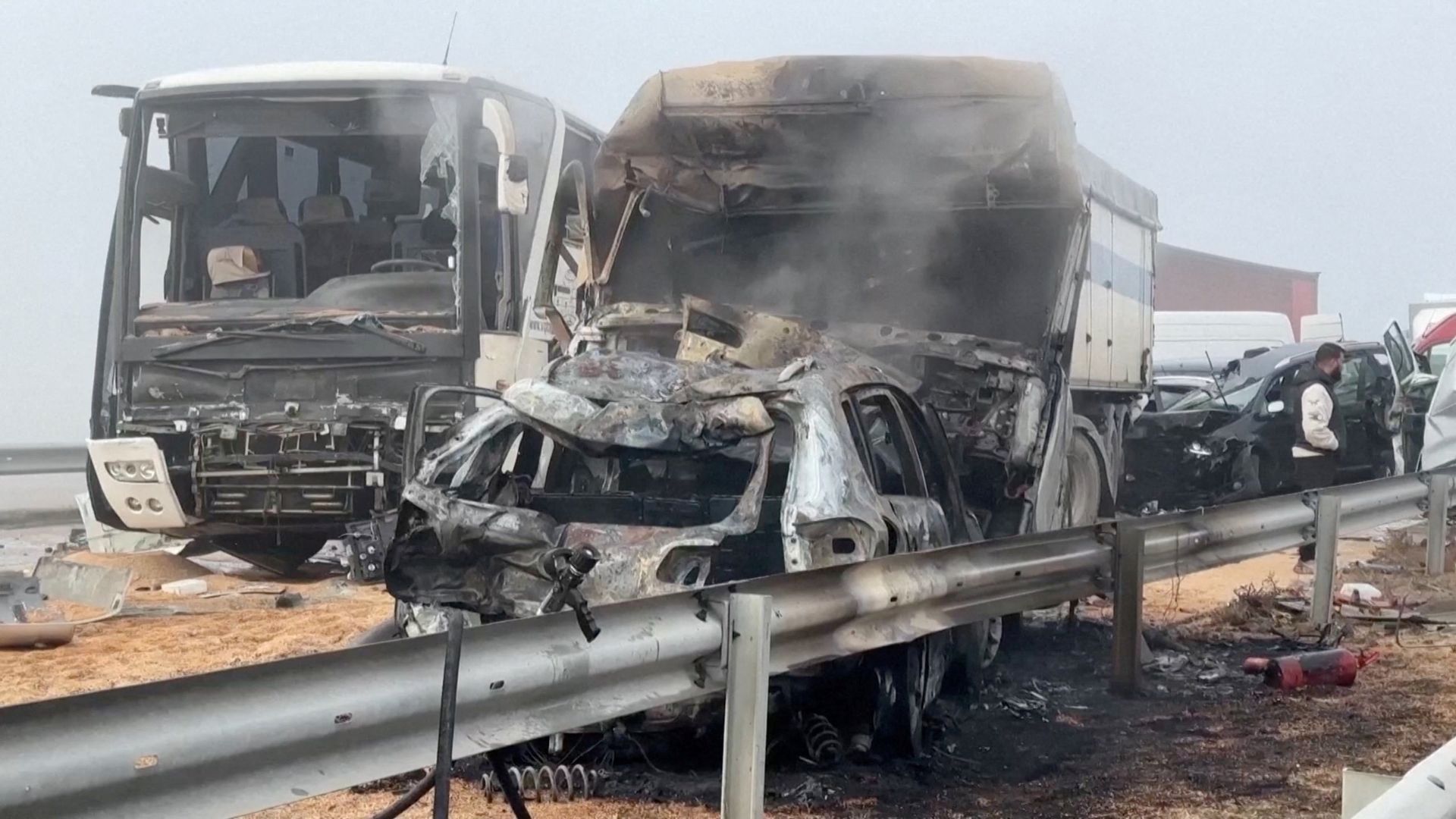
That's the grim math behind the November 10, 2026 disaster on Bulgaria's Trakia motorway near Yambol. Most news reports reduced the tragedy to a simple weather story—thick autumn fog rolled in, drivers couldn't see, and 86 vehicles smashed into each other across both carriageways. At least 12 people died and roughly 50 others ended up in hospitals with serious injuries.
Blaming the fog alone misses the point entirely. Weather doesn't kill a dozen people on a modern highway by itself. A chain-reaction crash of this scale happens when sudden zero-visibility conditions collide with chronic infrastructure gaps, an aging vehicle fleet, and driver habits that ignore basic physics.
How the Trakia Motorway Chain Reaction Unfolded
The Trakia motorway (A1) is Bulgaria's primary east-west artery, connecting the capital Sofia directly to the Black Sea port of Burgas. Because Bulgaria sits as a critical land bridge between Central Europe and Turkey, this corridor carries an enormous volume of heavy commercial freight alongside daily commuters.
On Tuesday morning, November 10, two separate mass collisions erupted almost simultaneously on opposite sides of the highway near the Zimnitsa and Kabile junctions, around kilometers 289 and 294. Yambol sits roughly 185 miles east of Sofia and just 31 miles north of the Turkish border, placing the crash site right in the throat of international transit traffic.
According to Bulgaria's Interior Ministry, drivers encountered a sudden, localized wall of dense fog. One moment, forward visibility sat around 70 to 80 meters. Moments later, it collapsed to roughly 10 meters.
The geometry of a multi-lane pileup is brutal once the first two vehicles lock together:
- The initial impact blocks the lanes. A car or truck brakes hard in the fog, loses traction, or clips a barrier, leaving an unlit obstacle sideways across high-speed asphalt.
- Heavy freight becomes a battering ram. Loaded semi-trucks and grain haulers need far greater stopping distances than passenger cars, and in 10-meter visibility, even an alert trucker can't scrub off enough kinetic energy.
- Secondary crashes trap survivors. People who survive the first hit often step out of their vehicles in panic, only to be struck by the next wave of cars arriving blind at highway speeds.
Drone footage broadcast by Bulgarian television captured the sheer scale of the wreckage—dozens of passenger cars, vans, and heavy lorries wedged tightly against each other between the Zimnitsa and Kabile exits. One driver told Nova TV he heard a red lorry braking hard behind him seconds before it slammed into his rear bumper, launching his car into the guardrail while dozens more vehicles piled in around them. A passenger on a bus caught in the wreckage described windows shattering as grain from a ruptured trailer poured inside over trapped travelers.
Emergency crews had to shut down the Trakia motorway in both directions for hours while rescue teams cut survivors out of crushed cabins and cleared heavy freight. The scale of the loss prompted President Iliana Yotova to cut short her trip to the Paris Peace Forum and return immediately to Sofia.
Why Bulgaria Leads the European Union in Road Deaths
If you think the Yambol pileup was a freak statistical anomaly, look at the numbers published by the European Commission just two weeks before the crash.
In 2025, Bulgaria recorded 456 road fatalities—a rate of 71 deaths per million inhabitants. That isn't just slightly above average. It is the single highest road fatality rate in the entire European Union, well above the EU-27 average of 43 deaths per million. Compare Bulgaria's 71 per million to Sweden at 19 or Denmark at 24, and you realize a driver in Bulgaria faces more than triple the statistical risk of dying on the road. Even worse, European Commission tracking for the first half of 2026 showed Bulgarian road deaths trending sharply upward again compared to the same period in 2025.
Transport analysts and Bulgarian road safety advocates point to three structural failures driving this crisis:
- An aging vehicle fleet lacking modern crash avoidance. As the European Union's lowest-income member state, Bulgaria has one of the oldest car fleets on the continent. Roughly half of the vehicles registered in the country are more than 20 years old. Those older cars don't have automatic emergency braking (AEB), radar-assisted adaptive cruise control, or modern high-output LED fog lighting. When a 22-year-old sedan enters a 10-meter fog bank, its stopping distance and structural survival cell are decades behind current European safety standards.
- A chokepoint for international transit freight. Bulgaria acts as the primary overland funnel between Greece, Turkey, and the rest of the EU. Thousands of heavy trucks transit the Trakia motorway daily under tight delivery schedules, mixing high-mass commercial rigs with local passenger traffic on stretches that lack automated weather-warning gantries.
- Chronic speed enforcement gaps. On paper, Bulgarian motorways cap passenger cars at 140 km/h—one of the highest default speed limits in Europe. In practice, drivers routinely push past that limit even when atmospheric conditions deteriorate, outdriving their headlights and sightlines long before they reach a hazard.
What Most Drivers Get Wrong About Highway Fog
I've driven through sudden river-valley and plain fog across Eastern Europe, and the most dangerous moment isn't when you're already deep inside the whiteout. It's the three seconds right before you enter it.
Most drivers make two fatal mistakes when they see fog ahead. First, they rely on their daytime running lights or automatic headlight sensors. In bright, diffused daylight fog, your car's light sensor thinks it's sunny outside—so it leaves your taillights completely off. To the driver behind you, your car is invisible until they're 15 meters off your bumper.
Second, people fixate on the taillights of the car directly ahead of them. Psychologists call it visual tunneling, or "moth-to-flame" tracking. If the driver in front of you is still doing 110 km/h into a blind wall, following their red lights guarantees you'll share their exact stopping distance—zero.
Practical Steps If You Hit Sudden Zero Visibility on a Motorway
You can't control highway infrastructure or the truck driver behind you, but you can keep yourself from becoming part of a chain reaction when visibility collapses:
- Switch on your low beams and rear fog lamp manually. Don't trust auto-lights in daytime mist or fog. Never use high beams—they bounce off water droplets straight back into your eyes and blind you further.
- Ease off the accelerator immediately without slamming the brakes. Sudden panic braking in a fog bank invites the exact rear-end impact that triggered the Yambol pileup. Scrub speed smoothly so drivers behind see your brake lights early.
- Watch the right-hand road edge line, not the center. Looking at the solid white shoulder line keeps your spatial orientation anchored and prevents you from drifting into adjacent lanes.
- If you crash, get behind the guardrail fast. Staying inside a disabled car in live motorway lanes during a fog pileup is a coin flip with death. Check for oncoming traffic, exit away from the roadway, climb over the steel barrier, and move well upstream of the wreckage so a secondary impact doesn't throw debris into you.
The Trakia motorway will be repaired, cleared, and reopened to full freight traffic. Unless Bulgaria pairs its high-speed transit corridors with variable speed signs, fog detection sensors, and stricter vehicle inspection enforcement, another autumn morning near Yambol will produce the exact same headlines.