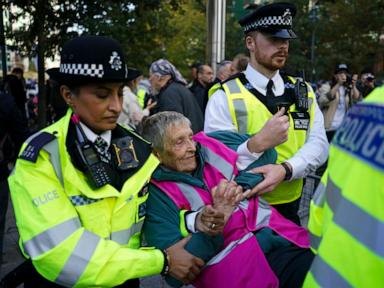
Standing outside the US Embassy in Nine Elms during a high-tension demonstration isn't just about holding a placard anymore. If you cross a very specific legal line under UK counter-terrorism laws, the Metropolitan Police won't just ask you to move along—they'll put you in handcuffs.
That's exactly what played out when dozens of demonstrators were arrested outside the American diplomatic compound in south-west London. The core issue wasn't the right to protest foreign policy or express solidarity with Palestinians. It was the display of support for a proscribed organization, which carries severe criminal penalties under British law.
Most news coverage glosses over the legal mechanics behind these mass arrests, treating them like standard public order scuffles. They aren't. Understanding why police moved in requires looking at how the Terrorism Act 2000 operates on the ground, what actually triggers an arrest, and why the distinction between lawful dissent and proscribed support catches so many protesters off guard.
Why Police Arrested Dozens Outside the US Embassy
When the Metropolitan Police deploy public order units to Nine Elms, they operate under strict legal thresholds. During the demonstration outside the US Embassy, officers detained dozens of individuals specifically on suspicion of supporting a proscribed organization.
In the UK, expressing support for a banned group isn't a minor public nuisance offense. Under Section 12 and Section 13 of the Terrorism Act 2000, inviting support for a proscribed group—or simply wearing clothing, carrying flags, or displaying symbols that arouse reasonable suspicion of membership or support—is an arrestable criminal offense.
Police spotters and intelligence officers monitor crowds closely for specific banners, emblems, and chants. Once officers identify symbols linked to banned entities such as Hamas or Hezbollah, the legal threshold for arrest is met immediately. Officers don't need to prove that a protester committed violence or intended to incite an attack. Displaying the prohibited symbol in public is enough.
The Legal Line Between Protest and Proscription
Britain protects the right to peaceful assembly under Articles 10 and 11 of the European Convention on Human Rights, incorporated into domestic law through the Human Rights Act 1998. You can criticize the UK government, condemn US foreign policy, and march through central London with hundreds of thousands of people entirely legally.
Everything changes the moment a banned organization enters the picture.
The Home Secretary maintains an official list of proscribed terrorist groups or organizations. Once a group lands on that schedule, the law treats any public endorsement of it as a national security offense.
Here's where people get tripped up. Many demonstrators assume that expressing ideological sympathy or displaying historical resistance imagery falls under protected political speech. British courts disagree. Under Section 13 of the Terrorism Act, wearing an item of clothing or carrying an article in a way that arouses reasonable suspicion that you support a proscribed group is a strict-liability style offense in practice—your personal political interpretation doesn't shield you from arrest.
What Actually Triggers an Arrest on the Street
If you've ever watched Metropolitan Police public order operations in London, you'll notice they rarely charge blindly into a massive crowd unless there's immediate violence. Instead, they use targeted snatch squads and post-incident arrests.
- Visual markers: Flags, headbands, patches, or printed placards bearing the insignia of banned organizations are the fastest way to draw police intervention.
- Explicit chants: Led slogans that directly praise or call for support of a proscribed group give officers grounds under Section 12.
- Digital amplification: Live-streaming or posting images of prohibited symbols from the protest grounds creates permanent evidence that police routinely use to make arrests days or weeks later.
The arrests outside the US Embassy followed this exact enforcement pattern. Officers identified individuals displaying prohibited material, isolated them from the wider crowd, and detained them under counter-terrorism powers rather than standard Public Order Act provisions.
Why the US Embassy Location Raises the Stakes
Protesting outside a foreign embassy carries a completely different security posture than marching down Whitehall. Under the Vienna Convention on Diplomatic Relations, the host nation—in this case, the United Kingdom—has a binding international duty to protect diplomatic missions from intrusion, damage, or disturbance of the peace.
The US Embassy in Nine Elms was specifically designed with standoff distance, bollards, and perimeter security in mind. Because it's a high-profile diplomatic target, the Metropolitan Police Parliamentary and Diplomatic Protection command maintains a constant armed and unarmed presence around the site.
When a protest forms at the embassy gates, police establish rigid containment zones. Any breach of those perimeters, combined with the presence of proscribed group imagery, triggers a rapid operational response. Commanders won't tolerate ambiguity near a Tier 1 diplomatic facility.
Common Misconceptions About UK Protest Laws
Watching footage of mass arrests online leads to a lot of bad legal assumptions. Social media commentary usually swings between two extremes: either claiming the police are banning all pro-Palestinian speech, or claiming protesters can say whatever they want without consequence. Both takes are wrong.
Misconception 1 Carrying Any Palestinian Flag Is Illegal
Completely false. Tens of thousands of people carry the Palestinian national flag at demonstrations across Britain every month without being arrested. The flag represents a people and a state, not a proscribed organization. Arrests happen when individuals bring flags, banners, or symbols associated specifically with banned militant groups.
Misconception 2 You Have to Be Caught on the Spot
Wrong again. The Metropolitan Police rely heavily on retrospective facial recognition, body-worn video, and public tips. Even if someone slips out of a crowd outside the US Embassy without being detained on the day, police frequently circulate CCTV stills and arrest suspects weeks later at their homes.
Misconception 3 Police Only Use Counter-Terror Laws for Violent Acts
Not true. Counter-terrorism legislation in the UK was deliberately drafted to criminalize the ecosystem of support around banned groups—fundraising, recruitment, and public validation—long before any violent act occurs. Supporting a proscribed organization is treated as a standalone crime, entirely separate from violent disorder or assault.
What Happens After a Proscribed Support Arrest
Being arrested under the Terrorism Act isn't like getting a caution for obstructing the highway. Suspects are taken to designated custody suites, interviewed under caution by specialist counter-terrorism detectives, and have their electronic devices seized for forensic examination.
The Crown Prosecution Service Special Crime and Counter Terrorism Division reviews these files. If charged under Section 12, a conviction carries a maximum sentence of up to 14 years in prison. Even a conviction under Section 13 for displaying a prohibited symbol carries up to six months imprisonment, a substantial fine, and a permanent criminal record that blocks international travel—especially to the United States.
Anyone planning to attend politically sensitive demonstrations in London needs to understand the exact boundaries of British public order and counter-terrorism law before stepping onto the street. Verify the legal status of every symbol, banner, and slogan you bring, stay clear of restricted diplomatic perimeters, and know your rights through independent legal observers like Netpol or Liberty so you don't end up facing serious criminal charges over a preventable mistake.


