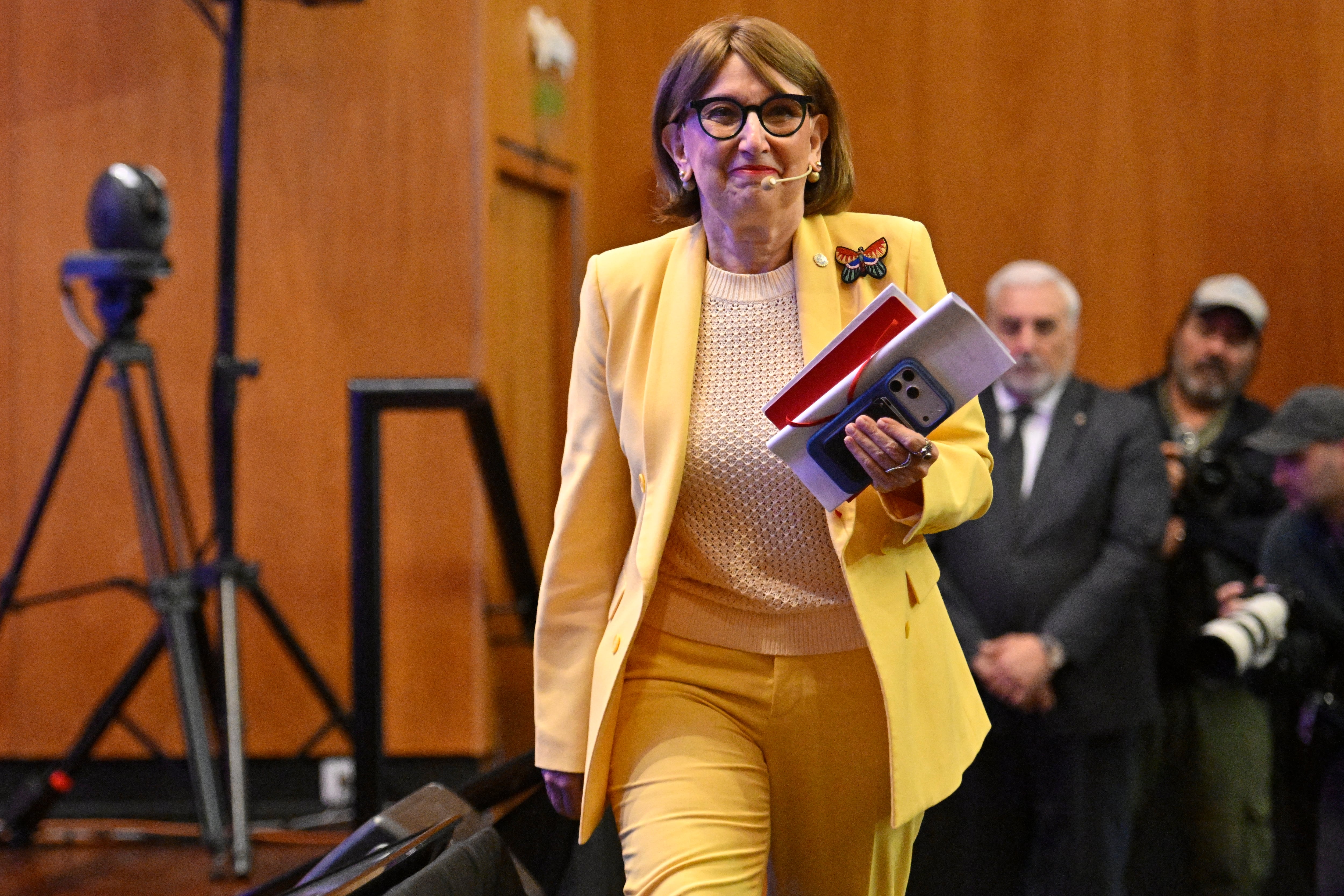
Rebeca Grynspan is winning the race to lead the United Nations. She has the highest vote totals. She has the momentum. She has the diplomatic pedigree.
And none of it matters.
Mainstream coverage of the 2026 UN Secretary-General race reads like a horse race between frontrunners and long shots. Reporters tally informal straw poll numbers—11 encouragement votes here, 12 there, 10 in the latest round—and treat Rebeca Grynspan as the clear favorite. They point to the controversial late entrance of the United Arab Emirates’ Lana Nusseibeh, note the human rights backlash against Abu Dhabi, and conclude that Grynspan’s steady pluralities prove she is cruising toward the 38th floor of Turtle Bay.
That analysis mistakes noise for signal. It treats a Security Council straw poll like a democratic primary where the candidate with the most votes wins.
In reality, the UN Secretary-General selection process is not an election. It is a hostage negotiation among five nuclear-armed states. Counting total encouragement votes while ignoring permanent member vetoes is like bragging about winning the popular vote in a boardroom where one shareholder owns 51 percent of the stock.
The Math That Makes Frontrunners Irrelevant
To understand why the conventional wisdom around Grynspan’s "lead" is broken, look at the actual mechanics of Article 97 of the UN Charter. A candidate needs two things to be recommended by the Security Council to the General Assembly: at least nine affirmative votes out of fifteen, and zero vetoes from the Permanent Five—the United States, Russia, China, France, and the United Kingdom.
Notice the asymmetry. Ten elected members can shower a candidate with praise, and it carries the exact political weight of a wet napkin if a single permanent member drops a red ballot.
During the color-coded straw polls—the only ballots that separate the five veto-wielding powers from the ten rotating members—Grynspan’s mirage evaporates. In the October 16 ballot, and again in the November color-coded round, Grynspan drew two discouragement votes from permanent members. Diplomatic reporting points directly to Washington and Moscow as the sources of that resistance.
Let that sink in. The supposed "undisputed frontrunner" is simultaneously facing opposition from the United States and Russia.
When a competitor article celebrates Grynspan "expanding her lead" because she picked up extra votes from rotating council members, it is reporting on the diplomatic equivalent of garbage-time points. Rotating members serve two-year terms. They trade favors, posture for regional solidarity, and cast cheap "encourage" votes knowing full well the P5 will do the dirty work of killing candidates they dislike.
I have watched multilateral selection battles play out from the inside for two decades. Every single cycle, observers fall for the exact same trap: they confuse early straw-poll pluralities with consensus. In 2006, Shashi Tharoor consistently ran second behind Ban Ki-moon with strong support across the Council, right up until the United States dropped a single veto and ended his campaign in an afternoon. In 2016, Susana Malcorra and Vuk Jeremić looked competitive on paper until P5 red ballots wiped the board clean, paving the way for António Guterres—a candidate who wasn't even running at the start of the process.
Why Late Challengers Like Nusseibeh Exist
The lazy narrative around Lana Nusseibeh, the UAE’s Minister of State and former UN ambassador who jumped into the race late in October 2026, frames her candidacy as a tone-deaf vanity play. Critics point to the 61,000-signature petition opposing her, the backlash over Abu Dhabi’s alleged arming of the Rapid Support Forces in Sudan, and the diplomatic fallout from hosting Vladimir Putin in 2023. In the latest color-coded ballot, she reportedly took discouragement votes from China, France, and Britain.
Case closed, right? Controversial late challenger flames out; Grynspan marches on.
Wrong. You don't enter a UN Secretary-General race in late October—less than two months before António Guterres’s term expires on December 31—expecting to coast in on popular acclaim. Late entrants in deadlocked UN races serve a completely different strategic function: they are stress tests and spoiler vehicles.
When a race stretches past 100 days, becoming the longest succession deadlock in UN history, P5 capitals start looking for exit ramps. Neither Washington nor Moscow wants to be the first to blink on Grynspan. Meanwhile, Argentina’s Rafael Grossi—head of the International Atomic Energy Agency and the consistent runner-up—is staring at three P5 discouragement votes. Guyana’s Carolyn Rodrigues-Birkett has two. Turkey’s late nominee, Feridun Sinirlioğlu, couldn't even clear three affirmative votes in his debut.
Every single top-tier candidate is blocked by at least two permanent members.
In that environment, Abu Dhabi didn't throw Nusseibeh into the ring because they missed the memo on Sudan or European geopolitics. They entered because the entire existing field is locked in mutually assured destruction. When the frontrunners are paralyzed by great-power vetoes, a late entrant with deep bilateral ties across Washington, Moscow, and Beijing can position themselves as a transactional compromise—or, at minimum, force the P5 to show their cards and break the logjam. Even if Nusseibeh’s own path is blocked by London, Paris, and Beijing, her presence reshuffles the bargaining chips on the table.
The Geographic Rotation Myth
Ask most casual observers why Grynspan is inevitable, and they will cite two unwritten rules of Turtle Bay: it is Latin America and the Caribbean’s turn under regional rotation, and it is past time for the UN to appoint its first female Secretary-General.
Both arguments are morally compelling. Neither has ever stopped a veto.
Let’s look at the actual historical record of "unwritten rules" at the United Nations:
- In 1981, Africa demanded its turn and backed Tanzanian Foreign Minister Salim Ahmed Salim. The United States vetoed him sixteen times. Latin America’s Javier Pérez de Cuéllar got the job instead.
- In 1996, the United States unilaterally vetoed Boutros Boutros-Ghali’s second term, breaking the long-standing precedent of two-term incumbents, before eventually settling on Kofi Annan.
- In 2016, Eastern Europe was universally acknowledged as the only regional group that had never held the top post. Seven credible Eastern European candidates—including Irina Bokova, Kristalina Georgieva, and Danilo Türk—entered the race. The Security Council bypassed the entire region and handed the job to Western Europe’s António Guterres.
Regional rotation is a talking point for General Assembly speeches, not a binding constraint in the Security Council consultation room. The P5 do not care about symmetry. They care about predictability, deference, and ensuring the next Secretary-General will not use the bully pulpit of Article 99 to embarrass them over Ukraine, Gaza, Taiwan, or Sudan.
Grynspan’s exact strengths on paper—her tenure leading UNCTAD, her willingness to document the economic toll of occupation in Palestinian territories, her outspoken multilateralism—are precisely why Washington views her with suspicion. Conversely, her alignment with Western institutional norms makes Moscow wary of handing her the keys to the Secretariat. Being acceptable to ten small and medium powers while alienating two superpowers is not a winning formula. It is a recipe for an indefinite stalemate.
What Everyone Is Getting Wrong About the 2026 Deadlock
If you are trying to predict who sits in the Secretary-General’s chair on January 1, 2027, stop watching the raw tally of "encourage" votes. You are asking the wrong question.
The real question is not who has the most support. The real question is who has the lowest veto intensity.
In Security Council horse-trading, there is a massive difference between a "soft" veto and a "hard" veto. A soft discouragement vote is tactical: a permanent member drops a red ballot to extract concessions on senior UN under-secretary-general appointments—specifically, who runs Peacekeeping (traditionally France), Political Affairs (traditionally the US), Humanitarian Affairs (traditionally the UK), or Economic and Social Affairs (traditionally China).
A hard veto is ideological or existential. No amount of horse-trading over deputy posts will convince Washington to accept a candidate it believes will actively undermine its foreign policy, nor will it convince Moscow or Beijing to accept someone they view as an enforcement arm of Western sanctions.
Right now, the public discourse treats all negative votes as equal. They aren't.
- Rebeca Grynspan holds the highest floor of support (10 to 12 votes), which gives her leverage to demand concessions if the P5 decide to deal. Her vulnerability is that peeling off both Washington and Moscow simultaneously requires two separate diplomatic breakthroughs while the clock ticks down toward December 31.
- Rafael Grossi brings deep operational credibility from managing nuclear inspections in Iran and Ukraine at the IAEA. Yet three permanent members discouraged him in the latest color-coded poll—meaning his crisis-management resume is actively hurting him among powers that prefer a quieter, more pliable administrator.
- Lana Nusseibeh represents pure transactional diplomacy. While human rights groups and European capitals balk at the UAE’s regional footprint, Abu Dhabi’s financial weight and willingness to broker prisoner swaps and backchannel talks give her a distinct geopolitical lane—even if three P5 red ballots currently block her path.
The Dark-Horse Scenario Nobody Wants to Admit
Here is the uncomfortable truth that diplomatic correspondents rarely spell out until the final week of December: when every declared frontrunner carries multiple P5 vetoes past the 100-day mark, the winning candidate is often someone who isn't even on the ballot yet.
Imagine a scenario where the Security Council holds two more straw polls between late November and mid-December. Grynspan stays at 10 or 11 affirmative votes, still blocked by two permanent members. Grossi stays stuck at 8 or 9, blocked by three. US Ambassador Mike Waltz’s public call for low-polling candidates to drop out goes ignored, or clears out only the bottom tier—Ecuador’s María Fernanda Espinosa, Uganda’s Olara Otunnu, and Tonga-nominated Ivonne A-Baki—without changing the P5 math at the top.
At that point, the P5 face a binary choice: either one superpower publicly folds and lifts its veto on Grynspan, or the Council quietly solicits a "compromise" late-late entrant—a low-profile technocrat, perhaps a female diplomat from Latin America or a neutral middle power, whose primary qualification is having never offended Washington, Moscow, or Beijing.
To be clear, betting against the frontrunner carries real risk. Grynspan is a seasoned political operator who served as Vice President of Costa Rica and navigated consensus-driven UN agencies for years. If Washington decides that blocking the first female and first Central American Secretary-General carries too high a diplomatic cost across the Global South, US resistance could soften overnight in exchange for key Secretariat appointments. A deal is still possible.
How to Actually Read the Endgame
If you want to know when this race is actually over, ignore the press releases celebrating pluralities and watch three specific indicators over the next four weeks:
- Color-coded ballots only. Any straw poll that mixes permanent and elected votes is political theater. Until the Council runs consecutive color-coded rounds and a candidate’s P5 discouragement count drops from two to zero, there is no frontrunner—only a placeholder.
- Silence from the P5 ambassadors. When Washington, Moscow, or Beijing prepares to lift a veto, they stop briefing reporters about why a candidate is unacceptable. Sudden radio silence from a previously hostile mission is the loudest signal that a backroom trade on Under-Secretary-General portfolios has been struck.
- New nominations after December 1. Unlike a domestic election, there is no statutory filing deadline for the UN Secretary-General. If member states suddenly float a fresh name in early December, it means Grynspan’s lead wasn't a victory march—it was a funeral procession for the entire 2026 field.
Stop counting to nine. Start counting down from five. Until that veto tally hits zero, Rebeca Grynspan isn't leading the United Nations—she is just standing first in line at a locked door.


