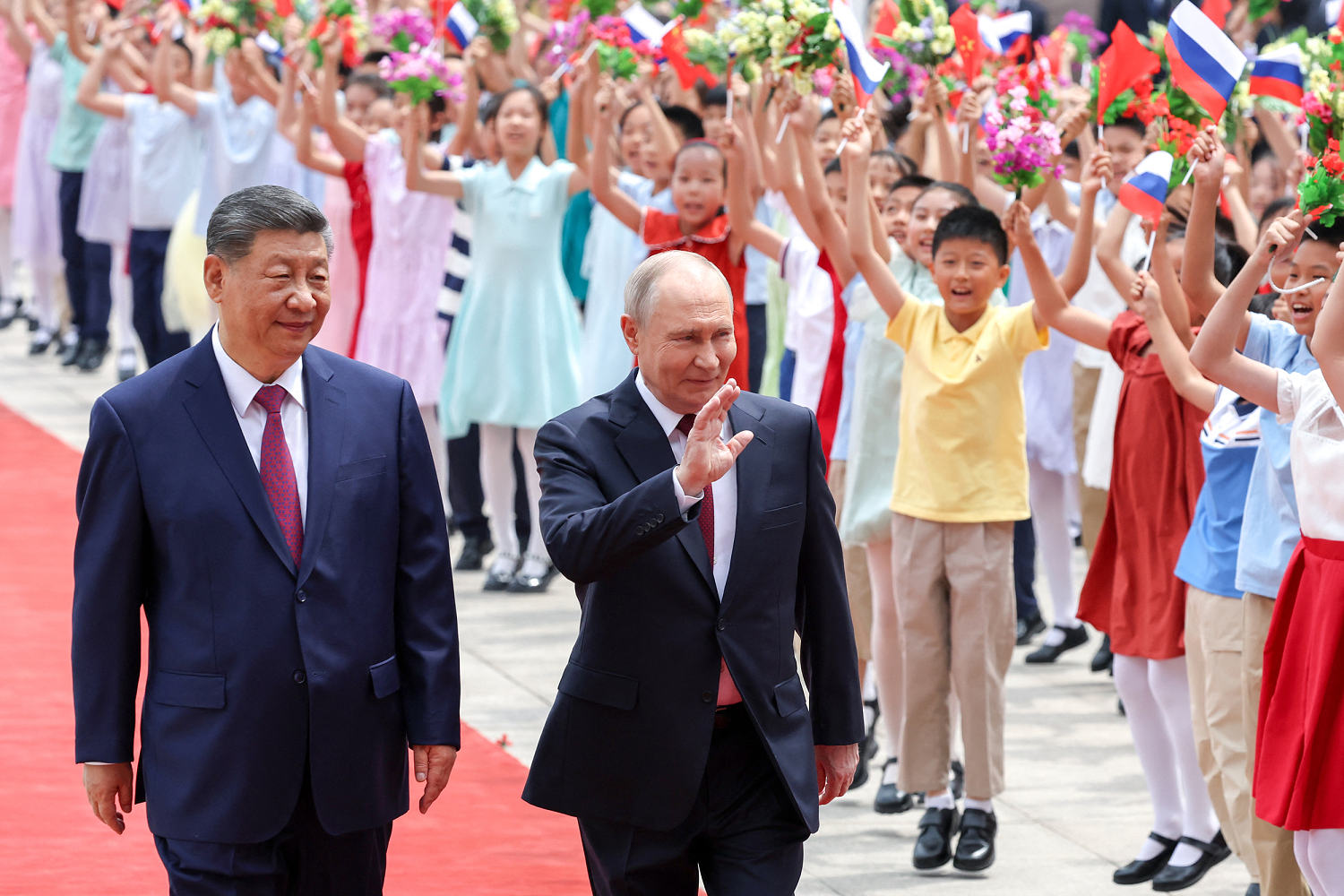
The brass band in Beijing played with an intensity that felt almost desperate, its rhythm echoing across the stone expanses of Tiananmen Square. Under a May sky, Vladimir Putin stepped onto the crimson carpet. Beside him stood Xi Jinping, a man whose quiet posture always seems to suggest he knows exactly how many cubic meters of gas are flowing through the earth at any given second. There were hugs. There were children waving plastic flowers. There were state dinners laden with duck and dumplings, and toasts raised to a friendship that both leaders declared had no limits.
It was a masterclass in political theater. But theater requires a suspension of disbelief, and once the music faded, the silence left behind was chilling.
Behind the choreographed warmth of this state visit lay a stark, unyielding reality. One man had come to sell fire. The other was content to let him freeze until the price was right.
The Mirage of the Master Plan
To understand what happened in Beijing, you have to look past the television cameras and focus on a map of the Siberian wilderness. Deep beneath the permafrost lies the Yamal Peninsula. For decades, this frozen tongue of land was the beating heart of Russia’s economic empire. It pumped billions of cubic meters of natural gas westward, fueling German factories, heating Italian homes, and filling the Kremlin’s war chest.
When the geopolitical landscape fractured, those Western pipelines were severed. The gas needed somewhere else to go.
Enter Power of Siberia 2.
The proposed pipeline is a massive, ambitious engineering project designed to slice through Russia, cut across Mongolia, and empty directly into the energy-hungry industrial hubs of northern China. It is meant to carry 50 billion cubic meters of gas a year. That is almost exactly the volume Russia used to send to Europe through the now-defunct Nord Stream pipeline. On paper, it is a perfect mathematical swap. Russia loses a customer in the West, Russia gains a customer in the East. Balance is restored.
But geography is not destiny, and arithmetic is not diplomacy.
Putin arrived in Beijing needing this pipeline to be a certainty. He needed a signed contract, a firm commitment, a celebratory photo op with a golden pen. Instead, he got polite nods, vague promises of continued cooperation, and a flight home to Moscow with an empty briefcase. The pipeline remains a ghost on a map.
The Asymmetry of Need
Power dynamics are rarely about who has the bigger army or the louder rhetoric. They are about who can afford to wait.
Consider a small-town market. If you are the only butcher in town and the winter is coming, you hold the cards. But if a massive supermarket opens down the street, and you have a truck full of meat that will spoil by midnight, you are no longer a businessman negotiating a fair trade. You are a supplicant begging for a liquidation sale.
Russia is that butcher. China is the supermarket.
Before the current geopolitical isolation, Russia had leverage because it could play Europe and Asia against each other. If Brussels complained about prices, Moscow could hint at turning the taps toward Tokyo or Shanghai. Today, that optionality is gone. The Western market is dead for the foreseeable future. China knows this. Beijing reads the financial tickers, tracks the shipping lanes, and understands that Russia has exactly one major buyer left for its pipeline gas.
Xi Jinping is under no pressure to hurry. China’s economy, while massive, is transitioning. It is investing heavily in domestic coal, expanding its renewable grid at a staggering pace, and importing vast amounts of Liquefied Natural Gas (LNG) from Qatar, Australia, and the United States. China wants Russian gas, certainly, but it wants it on terms that look less like a partnership and more like a capitulation.
The sticking point is simple, brutal, and entirely transactional: price and volume.
Reports from inside the closed-door sessions suggest that Beijing is demanding to buy Siberian gas at heavily discounted domestic Russian prices. These are prices subsidized by the state, meant for Russian citizens, not for export profit. Furthermore, China is refusing to commit to buying the full 50 billion cubic meter capacity of the pipeline. They want the option to buy only what they need, when they need it, leaving Russia to bear the multi-billion-dollar cost of constructing the infrastructure.
It is a lopsided deal that would turn Russia’s crown jewel energy sector into a low-margin utility provider for Chinese industry. Putin, despite his weak hand, cannot bring himself to sign away Russia's economic sovereignty so cheaply. And so, the deadlock holds.
The Quiet Weight of the Yuan
The failure to secure the pipeline deal reveals a broader, deeper shift in the relationship between Moscow and Beijing. The two nations often talk of a multipolar world, a strategic alignment against Western hegemony. But inside the banks and trading houses of Russia, that alignment feels less like a partnership of equals and more like a slow, systemic absorption.
Step away from the Kremlin and look at the everyday economic life of Russia today.
When Western car manufacturers pulled out of the country, Chinese brands like Haval, Geely, and Chery moved into the empty showrooms. Walk into an electronics store in St. Petersburg, and the shelves are dominated by Xiaomi and Huawei. More importantly, because Western financial systems like SWIFT are blocked, Russian banks have become utterly dependent on the Chinese yuan.
This is not just an abstract financial metric. It affects how a nation breathes.
Russian companies trying to buy machinery components or consumer goods from overseas must settle their accounts in yuan. But Chinese banks, terrified of triggering secondary sanctions from the United States and Europe, have begun tightening the screws. They are delaying payments, demanding exhaustive documentation, and sometimes rejecting Russian transactions altogether. Even during Putin’s visit, as the leaders smiled for the cameras, Russian businessmen in the delegation were quietly cornering their Chinese counterparts in hotel lobbies, pleading for a solution to the banking gridlock that is choking their supply chains.
The irony is thick. In trying to break free from the dominance of the US dollar, Moscow has inadvertently tied its financial fate to the whims of the Chinese Communist Party.
The Sound of the Door Closing
There is a distinct psychological toll that comes with watching your options narrow. For decades, Russia viewed itself as a bridge between East and West, a Eurasian titan that could look in both directions and command respect from both.
Now, the western outlook is walled off by sanctions, distrust, and a generational shift away from Russian dependency. The eastern outlook is dominated by a neighbor that is bigger, richer, and possessed of a terrifyingly long memory.
China does not do charity. Its foreign policy is governed by a cold, calculated view of its own long-term national interest. Beijing watches Russia’s current predicament with a mix of opportunistic satisfaction and cautious restraint. They are happy to buy discounted Russian oil, happy to flood the Russian market with Chinese consumer goods, and happy to use Russia as a diplomatic shield on the global stage. But they will not jeopardize their own access to Western markets or sacrifice their financial stability to bail out Moscow’s balance sheet.
The images broadcast by state media at the end of the summit showed Putin’s motorcade speeding toward the Beijing airport through streets that had been cleared of traffic. It was a smooth, efficient departure.
But back in the Kremlin, the spreadsheets remain unchanged. The gas is still in the ground. The West is still not buying. And the only man who can buy it is sitting in Beijing, sipping tea, waiting for the price to drop even further.