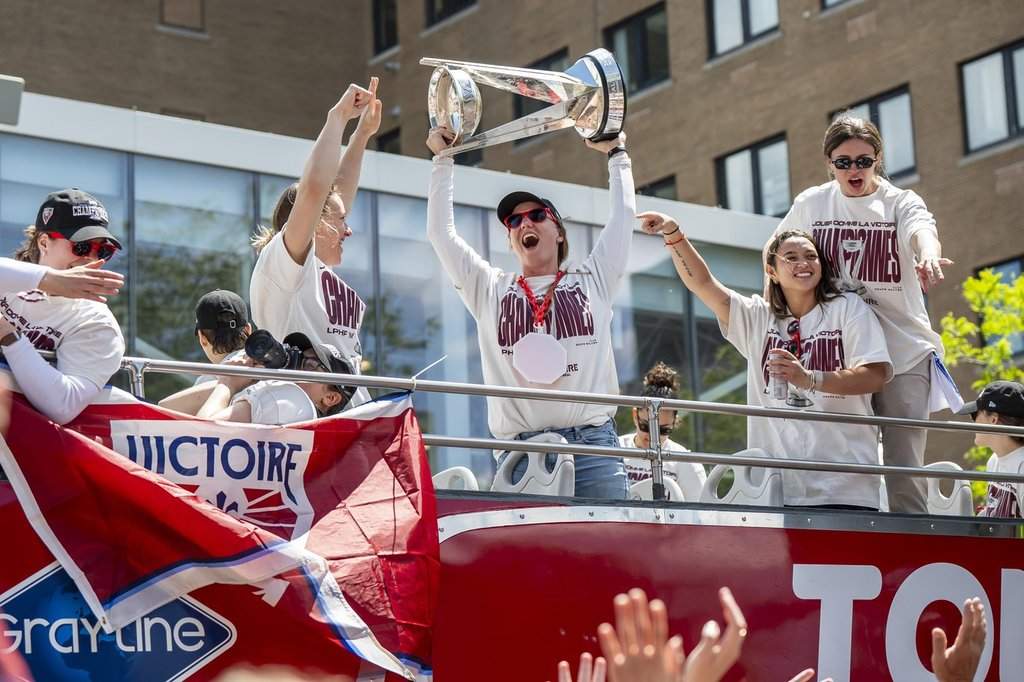
The plastic barriers along Boulevard de Maisonneuve were never meant to hold back this much weight. For decades, the structural engineering of a Montreal hockey parade was calculated against a very specific kind of masculine euphoria. It was measured in the deep, gravelly roars of men who had watched Rocket Richard or Guy Lafleur, men who expressed their devotion through beer-soaked baritone chants.
But on this particular afternoon, the frequency was entirely different. It was higher. Shrill. It vibrated in the chest bones of everyone standing on the concrete. When the flatbed trucks finally rumbled into view, carrying twenty-three women and a three-foot-tall silver cylinder called the Walter Cup, the sound that tore through the downtown core wasn’t just a celebration. It was a release of oxygen from a room that had been starved of it for generations.
To understand why thousands of people stood four-deep in the stinging late-spring wind, you have to look past the box scores of the Professional Women’s Hockey League championship series. You have to look at the hands.
Marie-Philip Poulin, the captain whose name is spoken in Quebec with the kind of reverence usually reserved for saints, stood near the front of the lead float. If you looked closely at her knuckles, you could see the faint, pale tracks of old scars—not just from slashes on the ice, but from the invisible friction of spent years. For over a decade, women like Poulin played in gyms that smelled of stale floor wax. They changed in arenas where the hot water cut out after twenty minutes. They played before crowds that could be individually counted by a bored usher.
Then, in a single winter, everything shifted. The Montreal Victoire didn’t just win a trophy; they validated a decades-long argument.
The Weight of the First Time
Every sports town has its ghosts. Montreal’s ghosts happen to wear Canadiens red, and they occupy twenty-four distinct spots in the rafters of the Bell Centre. That history is a beautiful thing, but it is also heavy. It creates an atmosphere where secondary efforts are ignored and only excellence is tolerated.
When the PWHL launched its inaugural season, the skeptics were loud. They pointed to the graveyard of previous leagues—the CWHL, the NWHL, the PHF. They said the business model was a fantasy. They argued that the public’s appetite for women’s hockey was limited to a two-week window every four years during the Winter Olympics.
Consider what happens next when that logic meets reality.
The Victoire didn't play in a suburban outpost. They packed the Place Bell in Laval. They sold out the Bell Centre itself, setting a world record for the highest attendance at a women's ice hockey game with 21,105 fans screaming until their throats were raw. This wasn't charity. It wasn't a civic duty. It was a secular mass.
The game that clinched the title wasn't pretty. True championship hockey rarely is. It is an exercise in pain tolerance and positional discipline. The puck bounces off shinguards; the ice turns to slush under the heavy television lights; the nervous energy in the building becomes so thick it feels like trying to breathe underwater. When the final horn blew, signaling that Montreal had captured the maiden Walter Cup, the celebration wasn’t a neat, choreographed leap. It was a collapse. A collective, exhausting surrender to gravity by women who had been holding their breath since they were six years old.
The View from the Curb
On the corner of Metcalfe Street, an eleven-year-old girl named Sophie stood on top of a newspaper distribution box. Her father held her by the waist of her oversized gray Victoire jersey.
Hypothetically, Sophie represents the target demographic the league's marketing executives discuss in boardroom meetings on Bay Street and Wall Street. They talk about "market penetration" and "youth engagement." But those words are useless at ground level. Sophie didn't care about the league’s corporate backing or its television distribution rights. She was staring at Laura Stacey.
Stacey, the powerhouse forward who plays with a terrifying, locomotive-like intensity, was leaning over the side of the truck. Her face was smudged with dried sweat and leftover championship champagne. She wasn't waving with the distant, practiced royalty of a professional athlete who has done this a dozen times. She was laughing with a wide, unvarnished disbelief.
For the older generation in the crowd—the women in their sixties who played in old-timers' leagues using their brothers' discarded, oversized equipment—the parade was a form of historical restitution. They looked at the giant video screens displaying the words Victoire de Montréal and saw something that felt like a personal apology from the sporting world.
The real transformation, however, belongs to the kids who don't know the old layout. To Sophie, there is nothing experimental about this. There is no novelty. She does not know a world where women don’t sell out NHL arenas. She doesn't remember the era of the volunteer linesmen and the fifty-dollar game stipends. To her, this is simply how hockey looks. It is elite, it is brutal, and it belongs to her city.
The Architecture of the Win
Behind the noise of the parade lies a cold, mathematical reality. You do not win a championship in a six-team league through sentimentality. The PWHL's first season was a meat grinder. Without the traditional cushion of weak expansion franchises, every single night was a tactical war.
The Victoire’s roster was constructed like a high-end watch—built for durability under high pressure. While Poulin provided the emotional gravity, the championship was secured in the unglamorous zones of the ice. It was won in the dirty three feet in front of the crease where defensemen like Erin Ambrose took cross-checks to the ribs just to clear a line of sight for the goaltender.
It was won by the depth players who log four minutes a night but spend two hours blocking shots with their laces.
During the playoff run, the team’s internal mantra became a public secret: Rien sans peine. Nothing without pain. It is an old Quebec proverb that fits the geography of the province perfectly. It speaks to the winters that start in November and don’t truly break until May. It speaks to the style of play that Coach Kori Cheverie demanded—a suffocating, transition-heavy system that required the forwards to skate twenty percent more distance than their opponents every single shift.
When critics wondered if the intensity of international hockey could be replicated in a domestic league, the Victoire answered with a style of play that left the ice stained with literal red ink. Teeth were lost. Shoulders were separated. The medical staff worked out of tackle boxes filled with extra tape and local anesthetics.
The City that Answers Back
Montreal is a city that requires its heroes to speak to it directly. It is not enough to be talented; you must be willing to carry the specific cultural weight of the place.
As the parade wound its way toward the final stage at Place des Festivals, the language of the crowd blurred. French and English slogans melted into a singular, rhythmic roar. Players who had grown up in Ontario, Minnesota, or Sweden were leading call-and-response chants in flawless Montreal French. They had learned the specific cadence of the city's joy.
The Walter Cup itself sat on a pedestal at the center of the main stage. It is a modern piece of silver, sleek and angular, designed by Frank Gehry. It doesn't look like the Stanley Cup; it doesn't carry the centuries of dents and misspelled names. It is clean. It is a blank slate.
When Poulin took the microphone, the crowd didn’t let her speak for nearly three minutes. Every time she raised the metal to her mouth, the wall of sound hit her back, forcing her to smile and look down at her boots. She didn’t offer a polished corporate speech. She didn't thank the sponsors.
Instead, she talked about the cold mornings at the outdoor rinks in Beauceville. She talked about her mother driving her through snowstorms before the sun was up, back when the idea of a girl making a living playing hockey was not an ambition, but a delusion.
"We wanted to give you something to hold onto," she said, her voice catching on the microphone. "But you gave us the ground to stand on."
The parade eventually dispersed into the late afternoon gray. The flatbed trucks drove away, leaving behind a street littered with silver confetti and crushed coffee cups. The plastic barriers were dismantled and stacked into the backs of city maintenance trucks.
But the air in downtown Montreal felt permanently altered. The city’s long, monochromatic winter of hockey had finally ended, replaced by a new season that didn't rely on the memory of old men. The names on the silver were fresh, the ink was dry, and the ice was waiting for October.