The air inside an international airport carries a specific, metallic tension. It is a soup of jet fuel, expensive perfume, and the low-frequency hum of thousands of people vibrating with anxiety. Most of us are just trying to find Gate B12. But for one goldendoodle tied to a cold metal pole near the check-in counters, the world had shrunk to the length of a frayed nylon leash.
She sat there as the tide of rolling suitcases pulsed past her. She didn't bark. She didn't lung. She simply watched the glass sliding doors where her person had vanished.
When we talk about travel "horror stories," we usually mean a five-hour delay in Des Moines or a lost suitcase containing a bridesmaid’s dress. We rarely talk about the moment a human being decides that a living, breathing creature is a logistical error that needs to be deleted.
The Calculus of Departure
To understand how a pet ends up abandoned at a terminal, you have to look at the invisible pressure cooker of modern air travel. It starts with a ticket. Then a policy change. Then a realization at the 11th hour that the crate is two inches too small or the vaccination records are missing a stamp.
Imagine the scene—not as a monster acting out of pure malice, but as a person unraveling. You are at the counter. The agent shakes their head. "The dog can't fly," they say. Behind you, a line of 200 agitated travelers begins to huff. Your life is on the other side of that flight—a new job, a dying relative, a fresh start. The dog is a 50-pound complication in a world that only accepts carry-ons.
In that split second, empathy short-circuits. Logic twists. A desperate mind convinces itself of a lie: Someone will find her. Someone will want her. She’s a good dog. She’ll be fine.
This isn't an excuse; it’s an autopsy of a moral failure. The traveler walked away. The dog stayed. The leash remained taut, a red line connecting a vanished past to an uncertain future.
The Man in the Blue Uniform
Officer Michael Hammons wasn't looking for a heartbreak that morning. Airport policing is often a tedious cycle of directing traffic, checking abandoned bags for explosives, and managing the occasional irate passenger who had too many mid-day IPAs.
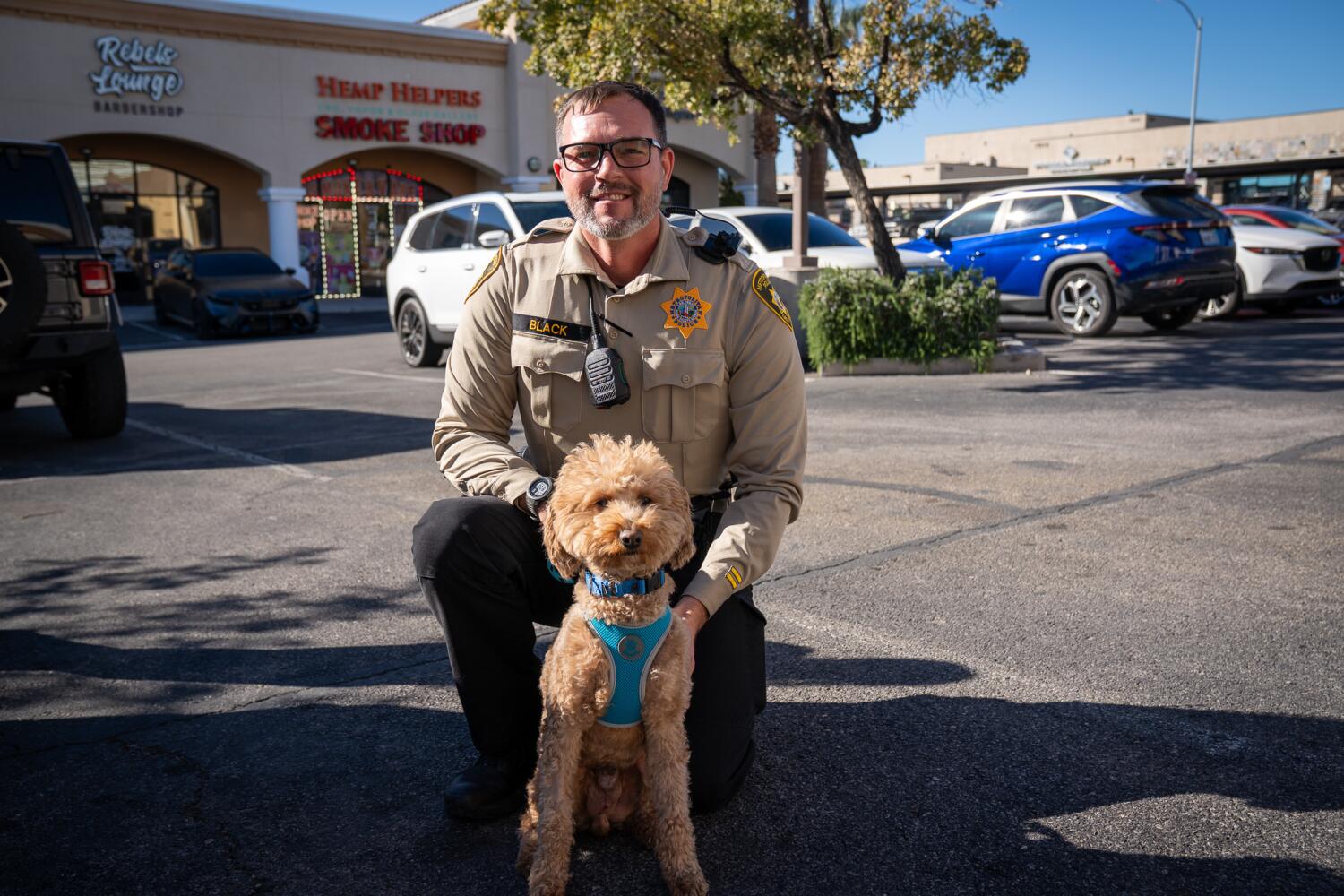
He saw the goldendoodle. She was a cloud of matted tan fur, remarkably calm for a creature whose entire support system had just evaporated.
There is a specific kind of silence that surrounds an abandoned animal in a crowded place. It’s a vacuum. Hundreds of people walked by, likely assuming the owner was just in the restroom or grabbing a latte. We are trained to mind our own business, to assume the best of others because the alternative is too heavy to carry while we're rushing to catch a connection.
But Hammons stopped. He didn't just call animal control and wait for a van to whisk her away to a high-kill shelter. He looked at the dog and saw the stakes.
The logistics of pet travel are, frankly, a nightmare. The Federal Aviation Administration and individual airlines have created a labyrinth of shifting size requirements and temperature restrictions. It costs hundreds, sometimes thousands, of dollars to move a pet across borders. For the vulnerable, the poor, or the disorganized, the barrier to entry is a wall they cannot climb.
When the system fails, the animal pays the tax.
The Invisible Weight of the Leash
We like to think of our pets as family, but the law frequently disagrees. In the eyes of most statutes, a dog is property—no different from a discarded laptop or a left-behind umbrella. This creates a dangerous psychological loophole. If a dog is just "stuff," then leaving it behind is merely a messy disposal.
But the biology of the animal tells a different story. Dogs are masters of time and sequence. They understand "stay." They understand the promise of a return. When that return doesn't happen, the cortisol levels in a canine brain spike to levels that mirror human grief.
The goldendoodle at the airport wasn't just "found property." She was a witness to a total collapse of the human-animal bond.
Officer Hammons began the work of untangling the mess. He checked the microchip. He made the calls. He navigated the bureaucracy that had likely paralyzed the dog's owner. But more importantly, he sat with her. He offered the one thing the airport environment denies us all: presence.
The Cost of Convenience
This incident serves as a vibrating alarm for the way we treat the living world in our quest for mobility. We live in a "frictionless" era. We want our food delivered in twenty minutes, our movies streamed in seconds, and our lives moved across the globe with a few clicks on a smartphone.
Animals, however, are full of friction. They have bladders. They have fears. They require paperwork that can’t be bypassed with a premium subscription.
When we treat travel as a right and pet ownership as a hobby, we create the conditions for the red leash at the terminal. We see it in the "pandemic puppy" phenomenon—thousands of animals bought for comfort during lockdowns, only to be surrendered to shelters when the world reopened and the office called us back. The airport abandonment is just the most extreme, public version of that same disposable mindset.
The story of the airport dog has a "happy" ending, at least in the traditional sense. Hammons didn't just process the case; he ensured the dog found a path to a home where she wasn't a secondary priority. He became the bridge between the betrayal at the check-in desk and a life of actual safety.
But the "happily ever after" shouldn't let us off the hook.
The Resonance of the Abandoned
Consider the sheer willpower it takes to walk through a security gate knowing your dog is still tied to a pole. Every step toward the terminal is a choice. Every beep of the boarding pass scanner is a nail in the coffin of a relationship.
The traveler was eventually identified. There were excuses, stories of missed connections and impossible choices. But the facts remain etched in the security footage: a woman walking away, and a dog's head turning, tracking her until the very last moment she was visible.
We are a species defined by our attachments. Our ability to care for those who cannot care for themselves is the only thing that keeps us from being just another data point in the airport’s transit statistics. When we break that bond, we lose more than just a pet. We lose the thread of our own humanity.
Next time you walk through a terminal, look past the flashing neon signs for duty-free gin and neck pillows. Look at the corners. Look at the people sitting alone. Look at the shadows under the benches.
The world is full of people trying to get somewhere else, often leaving the best parts of themselves behind to make the weight limit.
The goldendoodle is gone from that terminal now. The pole is empty. But the image of that red leash remains—a reminder that in the rush to reach our destination, we must never become the kind of people who leave the soul of the journey tied to a cold metal post.
She waited until she couldn't see the door anymore, and then she finally lay down on the linoleum, her chin resting on her paws, staring at the space where a person used to be.