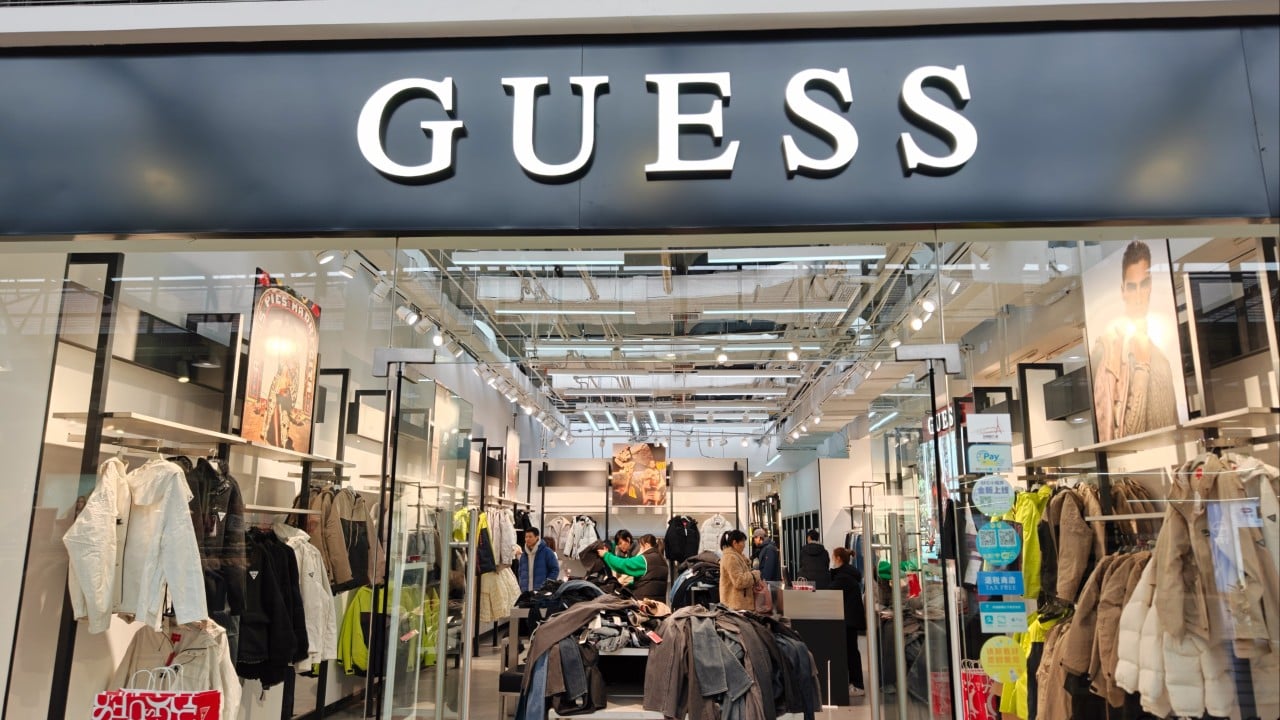
The neon lights of Shanghai’s Nanjing Road don’t just illuminate the pavement; they hum. It is a vibrating, electric symphony of ambition. For decades, a specific splash of red and white sat at the center of that chorus. The triangle. The question mark. Guess.
To walk past those glass storefronts in 2014 was to witness a specific kind of American dream being sold to a generation of Chinese consumers who were hungry for status. But if you walk those same streets today, the air feels different. The triangle is gone. The mannequins, once draped in acid-washed denim and provocative lace, have been packed into crates. Guess has officially pulled the plug on its physical presence in mainland China.
This isn't just a corporate restructuring. It is a ghost story about the death of a certain kind of prestige.
The Girl in the Rhinestone Denim
Let’s talk about Mei. She is a fictional composite, but she represents millions of women who came of age during China’s retail explosion. In 2010, Mei saved three months of her salary from a junior accounting job to buy a pair of Guess jeans.
Why? Because back then, that logo was a passport. It whispered of California sun, of Hollywood glamour, and of a world that felt infinitely more exciting than a grey office in Shenzhen. When she wore those jeans, she wasn't just wearing denim; she was wearing an identity. She was part of a global club.
But identity is a fickle currency.
Over the last five years, Mei stopped looking at the Nanjing Road windows. Her phone became her storefront. The "retail rethink" that Guess executives mention in their press releases is a polite way of saying they lost the war for Mei’s attention. She no longer wants to be a "Guess Girl" in the Western sense. She wants to be herself, supported by brands that understand her specific cultural nuances, her lightning-fast digital habits, and her desire for "Guochao"—the trend of "China Cool" that prioritizes domestic pride over imported labels.
The Math of Vanishing Footprints
The numbers behind the exit are staggering, yet they tell only half the story. To maintain a physical store in a Tier-1 Chinese city is an exercise in financial bravery. Rents are predatory. Labor costs are rising. But the real killer isn't the cost of the floor; it’s the silence of the foot traffic.
Consider the mechanics of the modern Chinese purchase. A consumer sees a coat on a livestream at 11:30 PM. They click a button. The coat arrives at their door by 10:00 AM the next morning. In this ecosystem, a sprawling, two-story flagship store is no longer a sales hub. It is an expensive museum.
Guess realized, perhaps too late, that they were paying millions of dollars to maintain museums for a brand that younger shoppers viewed as a relic of their parents’ aspirations. The decision to shut all mainland stores is a white flag. It is an admission that the old-school model of "build it and they will come" has been decimated by the algorithm.
The Invisible Stakes of the Pivot
When a giant like Guess retreats, it leaves a vacuum. But it also reveals a terrifying truth for every other Western brand currently clinging to the Chinese market.
Success in China used to be about distribution. If you could get your product onto the shelves of the right malls, you won't just survive; you'd thrive. Now, success is about relevance. The stakes aren't just about inventory; they are about cultural fluency.
The "retail rethink" implies that Guess will move toward a digital-first model, perhaps leaning on platforms like Tmall or JD.com. But moving from a physical store to a digital one is like moving from a theater stage to a crowded street corner. You are no longer the only show in town. You are competing with ten thousand other brands, all of them shouting for the same three seconds of a user’s scroll time.
The tragedy for Guess isn't that they can't sell clothes. It’s that they lost the "Question Mark." The mystery is gone. When everyone can see everything instantly, the allure of the "American Lifestyle" evaporates. It becomes just another item in a digital cart.
A Changing of the Guard
The departure of Guess is a symptom of a much larger shift in the global tectonic plates of commerce. We are seeing the end of the era of Western Brand Hegemony.
For thirty years, being "International" was enough. You could bring a brand from Los Angeles or Paris, set it down in Beijing, and watch the queues form. That era died somewhere between the rise of Douyin and the global pandemic.
Local Chinese brands are now nimbler. They don't have to wait for a headquarters in Switzerland or California to approve a design. They see a trend on Tuesday, manufacture it on Wednesday, and have it in a customer's hands by Friday. Guess, with its long supply chains and centralized decision-making, was playing a game of checkers against a computer running grandmaster-level chess.
The Human Cost of the Crates
Behind the corporate jargon of "optimizing the portfolio" are the people who folded the shirts.
Thousands of retail employees are now looking for new roles. For many of them, working at an international brand was a point of pride. It was a "good job." Now, they are watching the signage come down. They are seeing the physical evidence of a shifting economy—one that values the delivery driver more than the shop assistant.
The stores are being emptied. The mannequins are naked. The lights are being flicked off, one by one, across the mainland.
It is easy to look at this as a simple business failure. A lack of ROI. A strategic misfire. But if you look closer, you see the exhaustion of a brand that simply couldn't keep up with the heartbeat of a nation that moves faster than any other on earth.
The question mark that defined the brand for decades has finally been answered. The answer wasn't "yes" or "no." It was "we’ve moved on."
Mei walks past the old Nanjing Road location now. The space is already being gutted. Maybe it will become a pop-up for a local designer. Maybe it will become a high-tech coffee shop. She doesn't stop to look. She has a notification on her phone. A new brand, one she’s never heard of but whose aesthetic feels like it was designed specifically for her morning mood, has just launched a limited drop.
She clicks. She buys. She forgets the triangle ever existed.
The red logo is gone, not because it was broken, but because the world it inhabited has simply ceased to be. The glass is dark. The symphony continues, but the melody has changed, and Guess is no longer in the orchestra.