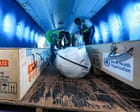
The air inside a biocontainment isolation pod does not feel like normal air. It is heavy, scrubbed by high-efficiency particulate filters, and constantly pulled under negative pressure so that not a single molecule of breath can escape into the outside world. To look out from inside the plastic walls of that tent is to see the world through a thick, distorting lens.
For one American physician, that plastic view became reality over the Atlantic.
He had been working in the North Kivu province of the Democratic Republic of the Congo. It is a region of breathtaking green hills, fractured by decades of conflict, where health workers fight two wars simultaneously: one against armed militias, and another against the Zaire ebolavirus. He was there to save lives. Instead, a needle stick, a torn glove, or a microscopic lapse in a chaotic clinic changed everything.
He became the patient.
When the specialized evacuation plane touched down at Frankfurt Airport in Germany, the tarmac was cleared. There were no welcoming committees, no standard customs queues. Instead, a convoy of highly secure ambulances wrapped in protective sheeting waited under the gray European sky. The doctor was transferred directly to the isolation unit at Frankfurt University Hospital, one of the few places on Earth equipped to handle a pathogen that liquefies cellular walls and causes the human immune system to turn violently upon itself.
We often view global health crises through statistics. We read about transmission rates, mortality curves, and containment protocols. But the reality of a viral outbreak is measured in the sound of a zipper sealing a bio-secure body bag, the smell of chlorine bleach sprayed onto rubber boots, and the terrifying isolation of a medical professional who knows exactly what is happening to his own body.
The Mechanics of an Invisible Threat
Ebola is not a ghost, though it behaves like one. It is a filovirus, a microscopic strand of RNA wrapped in a protein coat that resembles a tangled thread.
Consider how a standard virus, like the common cold, operates. It enters the body, hijacks a few respiratory cells, and causes irritation. Ebola acts entirely differently. It targets the very sentinels of our immune system—dendritic cells and macrophages. These cells are supposed to sound the alarm when an invader arrives. Ebola silences them.
Once inside, the virus replicates at an astonishing speed, turning the body’s defense mechanisms inside out. It triggers a massive, systemic inflammatory response known as a cytokine storm. Imagine every fire alarm in a skyscraper going off at once while the sprinkler system floods the building with fuel instead of water. The lining of the blood vessels begins to leak. Internal organs fail.
Statistically, the Zaire strain of the virus carries a mortality rate that has historical peaks near 90 percent, though modern supportive care has dragged that number down closer to 50 percent. Still, those are terrifying odds for anyone, let alone a clinician who has watched patients die of the exact same symptoms just days prior.
The decision to fly this infected doctor from the eastern Congo to Germany was not a simple logistical exercise. It was a high-stakes poker game against time and biology.
The Democratic Republic of the Congo has been the historic epicenter of Ebola since the virus was first identified near the Ebola River in 1976. The outbreak in North Kivu was particularly treacherous because it occurred in an active conflict zone. Health workers faced distrust from local communities, rumors spread by misinformation, and direct attacks from rebel groups. Treating a patient requires a level of focus that is nearly impossible to maintain when you are listening for gunfire outside the clinic walls.
When an international health worker falls ill under these conditions, the global medical apparatus shifts into a rare, defensive posture. The cost of a single aeromedical evacuation inside a specialized biological containment transport aircraft can easily reach hundreds of thousands of dollars. It requires international clearance, diplomatic coordination, and a crew willing to fly in close proximity to one of the deadliest pathogens known to science.
The Border Between Safety and Contagion
Why Germany? Why not bring the doctor straight back to the United States?
The answer lies in the geography of readiness. Frankfurt University Hospital houses one of Europe’s premier specialized isolation units for highly contagious diseases. The facility operates like a submarine within a hospital. It features separate ventilation systems, autoclaves that sterilize waste at massive temperatures before it can enter the municipal sewage system, and a multi-stage decontamination lock for staff.
The medical team entering that room does not wear standard surgical masks. They wear heavy, positive-pressure suits connected to an independent air supply.
Living inside those suits is an exhausting ordeal. The plastic visors fog up with sweat. Communication is reduced to muffled shouts or hand signals. A single tear in the fabric means immediate quarantine and the terrifying possibility that you have just invited the virus into your own home. The doctors and nurses caring for this American colleague knew the risks intimately. They accepted them anyway.
This level of care highlights a stark, uncomfortable disparity in global medicine. While a single Western doctor can be airlifted across continents to a facility with unlimited electricity, experimental therapeutics, and 24-hour monitoring, the local nurses and community health workers in North Kivu often fight the same disease with dwindling supplies of personal protective equipment and unreliable power grids.
The virus, however, does not care about national borders, funding discrepancies, or the color of a passport. It looks only for a host.
Fear is the most contagious element of any outbreak. When news breaks that an Ebola patient has landed in a major Western city, panic tends to ripple through the public. We saw it in 2014 during the West African epidemic, when the arrival of infected patients in America and Europe triggered media frenzies and demands for border closures.
But public panic misjudges how the virus spreads. Ebola is not influenza. It does not hang in the air of a crowded subway car or pass through a casual cough. It requires direct contact with bodily fluids—blood, vomit, sweat. In a modern hospital with strict infection control protocols, the risk of secondary transmission to the general public is effectively zero.
The real danger is not that the virus will escape the walls of the Frankfurt isolation ward. The real danger is what happens if we let fear dictate our response to global health.
The Human Capital of Global Health
To understand why people risk their lives in the red zones of the Congo, you have to look past the clinical data.
Medical humanitarians are a rare breed. They leave comfortable practices, air-conditioned offices, and safety to step into environments where the air smells of dust and illness. They do it because they believe in a simple, radical premise: that a human life in a remote village in North Kivu possesses the exact same inherent value as a life in Manhattan or Berlin.
When one of these workers gets sick, the psychological blow to the entire mission is immense. It rattles the teams on the ground. It forces organizations to question whether the risk is too high.
If the international community stops sending doctors, epidemiologists, and logisticians to contain outbreaks at their source, the fires do not simply burn out. They grow. In an interconnected world where a person can board a plane in rural Africa and land in Europe less than 24 hours later, an outbreak anywhere is a threat everywhere. Containment is an act of self-preservation for the rest of the world, disguised as charity.
The American doctor in Frankfurt became the center of a clinical battleground. Treatment for Ebola has evolved beyond just hydration and luck. Doctors now deploy experimental monoclonal antibodies—engineered proteins designed to bind to the virus and flag it for destruction by the body’s remaining immune defenses. These therapies, developed through years of painstaking research, offer a lifeline that did not exist a decade ago.
Yet, even with the best medicine science can muster, the human body must do the heavy lifting. The patient lies in a bed, surrounded by the constant hum of monitoring machines, fighting an internal war of attrition. Every hour that passes without organ failure is a minor victory. Every drop in viral load is a reason to hope.
The plane that carried the doctor away from the Congo left behind a landscape that remains vulnerable. The red dirt roads of North Kivu still see teams of workers in yellow suits walking through villages, trying to convince skeptical families to let them vaccinate their children. The work continues because it must.
Somewhere in Frankfurt, behind multiple layers of reinforced glass and negative-pressure steel doors, a man looks out at a sterile room, waiting for his blood to clear, carrying the invisible weight of a frontier most people will only ever see in their nightmares.