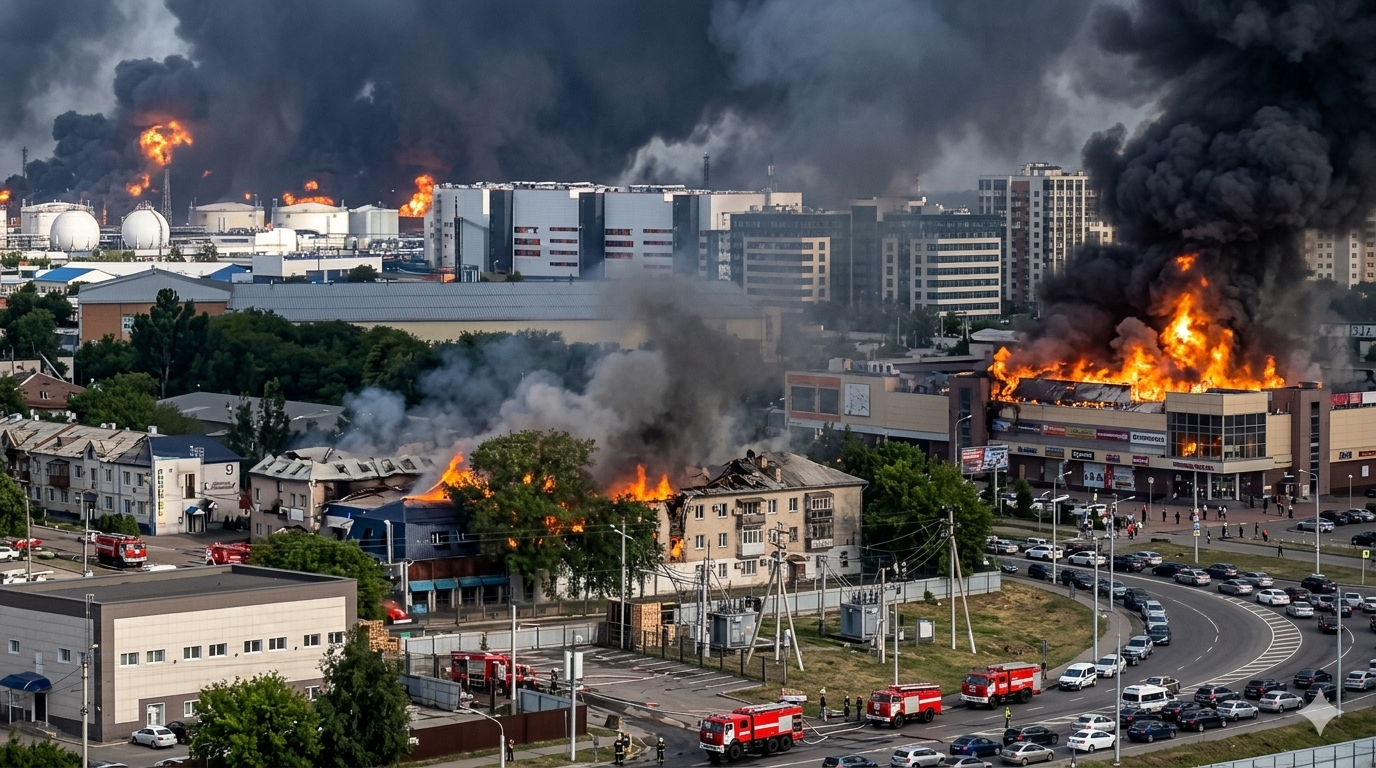
Long-range attrition campaigns succeed not by total physical destruction, but by forcing an adversary into unsustainable economic and operational trade-offs. The sustained aerial bombardment of the Moscow Oil Refinery in Kapotnya—culminating in a massive, multi-wave strike utilizing an estimated 180 to 200 unmanned aerial vehicles (UAVs)—signals a structural shift in the conflict's attrition mechanics. By bypassing four layers of integrated air defense to strike the primary refining infrastructure of the Russian capital, the Ukrainian long-range strike campaign targets a specific operational bottleneck: the domestic fuel supply chains that anchor both civilian stability and military mobilization.
To analyze the strategic weight of these strikes requires moving past standard headlines and assessing the strict mechanical, economic, and logistical friction coefficients imposed on the Russian state.
The Triad of Refining Vulnerability
Oil refineries are highly centralized, specialized, and compact industrial environments. The Kapotnya facility occupies just 284 hectares but processes approximately 11 million metric tons of crude oil annually, meeting roughly 40% of gasoline and 50% of diesel demand for the Moscow metropolitan region. This high concentration of processing volume within a limited spatial footprint creates an asymmetric target profile.
The systemic vulnerability of this infrastructure rests on three structural pillars:
- The Atmospheric and Vacuum Distillation Bottleneck: Initial processing relies entirely on massive crude distillation units, specifically the ELOU-AVT-6 complex at Kapotnya. These units separate raw crude into foundational distillate fractions. Because these towers operate under high temperature and pressure regimes, they feature extensive exposed pipe networks, heat exchangers, and fractionating columns that cannot be effectively armored against kinetic impact.
- The Secondary Cracking Interdependency: Downstream units—such as the G-43-107 catalytic cracking facility, visbreaking sectors, and methyl tert-butyl ether (MTBE) synthesis loops targeted in the June 18 strikes—rely directly on a continuous feed from the primary distillation units. Damaging the core distillation capacity automatically idles the high-margin secondary cracking units, grinding finished fuel manufacturing to a halt even if those downstream units escape direct physical damage.
- The Capital Equipment Replacement Cycle: Fractionating columns, industrial catalysts, and specialized compressors are not off-the-shelf commodities. They require long lead times for bespoke metallurgical fabrication and engineering. Western sanctions create a severe friction point here; components that previously could be replaced in weeks via European supply chains now require complex sanction-evasion routing or domestic reverse-engineering, extending facility downtime from days to quarters.
The Cost Function of Saturation and Layered Air Defense
The defensive architecture protecting the Moscow region relies on a deeply integrated, multi-tiered network. Point-defense systems like the Pantsir-S1 are paired with medium-range S-350 systems and long-range S-400 battalions to form concentric interception rings. Yet, the penetration of this airspace by multiple hybrid strike platforms reveals a math problem that favors the attacker.
Every air defense system possesses a hard radar tracking ceiling and a finite target engagement capacity, defined as the maximum number of simultaneous targets a single fire-control radar can illuminate and engage. When an offensive force launches an asymmetric swarm—combining lower-cost long-range drones with specialized precision assets like the Bars hybrid drone-cruise missile—the defensive network faces immediate radar saturation.
This operational bottleneck yields two distinct cascading effects:
- The Interception Cost Asymmetry: Firing multi-million-dollar surface-to-air missiles to down long-range drones costing tens of thousands of dollars creates an unsustainable fiscal and inventory burn rate.
- The Geographic Allocation Dilemma: To guarantee the protection of critical infrastructure in the interior, military planners must pull mobile air defense assets away from the active front lines or tactical logistical hubs in the border regions. Protecting Moscow directly softens the defensive posture protecting frontline military assembly areas.
Logistical Cascades and Capital Market Distortions
The immediate tactical consequence of disabling the Kapotnya refinery is the complete fracturing of localized fuel distribution. Refineries operate with minimal on-site storage relative to their daily output, relying on continuous pipeline, rail, and road transport networks to move finished products to terminal depots.
[Crude Oil Input]
       │
       ▼
[ELOU-AVT-6 Primary Distillation] ──(Damaged/Halted)──┐
       │                                              │
       ▼                                              ▼
[Secondary Cracking: G-43-107, MTBE]          [Downstream Supply Vacuum]
       │                                              │
       ▼                                              ▼
[Regional Distribution Network]               [Forced Seaborne Fuel Imports]
When a plant supplying 40% of a mega-city's fuel idles operations, the supply vacuum cannot be filled by simply increasing production elsewhere. Russia’s pipeline architecture is largely rigid, built to transport specific product grades from dedicated production nodes to specific regional hubs. Diverting supply requires utilizing rail networks that are already heavily burdened by military transport demands.
The systemic friction quickly spills over into the broader economy:
- The Shift to Maritime Import Dependence: Rather than operating as a pure exporter, the Russian energy sector has been forced to contract for seaborne fuel imports to manage regional deficits. This converts an established hard-currency revenue generator into a net logistics expense.
- Capital Flight and Infrastructure Risk Premiums: The sudden closure of major international transport corridors, exemplified by the total suspension of operations and passenger evacuations at Sheremetyevo, Vnukovo, and Zhukovsky airports during the strikes, imposes severe secondary costs. Commercial aviation cancellations, logistical delays on the Moscow Ring Road, and skyrocketing insurance premiums for industrial assets within an 800-kilometer radius of the Ukrainian border fundamentally alter domestic corporate risk calculations.
The Strategic Outlook
The structural reality of this attrition model dictates that Ukraine will continue to expand the geographic scope and mass of its long-range strike operations. The deployment of longer-range hybrid systems indicates that previous assumptions regarding sanctuary zones inside western Russia are obsolete.
The Russian state faces an unviable trilemma: it must either accept rolling domestic fuel shortages and capital-region infrastructure vulnerabilities, divert top-tier air defense assets away from the active theater of war to build a domestic iron dome, or burn through finite financial reserves to subsidize alternative logistics chains. Because none of these choices yield a net military advantage, the refining friction coefficient will remain a primary driver of operational degradation across the entire conflict ecosystem.

