Language in modern political spaces rarely travels quietly. It lands with a heavy, concussive force, shaping the boundaries of what citizens are expected to accept as normal discourse. When abstract conflicts thousands of miles away suddenly collide with domestic geography, the distance between policy debate and personal security vanishes entirely.
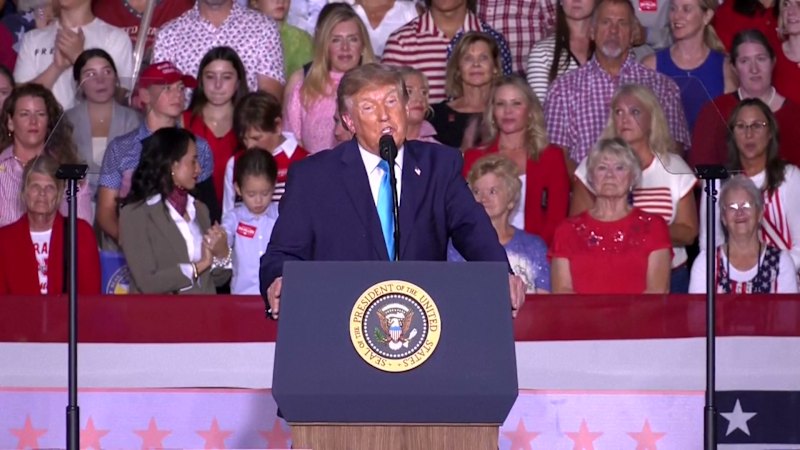
Consider the atmosphere inside a packed arena during a political rally. The lights glare, the sound system thumps with baseline rhythm, and an audience gathers to hear certainty delivered from a podium. In these settings, phrasing tends to stretch. Hyperbole acts as currency. But there is a distinct threshold where political posturing intersects with the vulnerability of millions of people who call specific coastal zip codes home.
During an address in Nebraska, former and current political tensions flared as the discussion turned toward the economic friction of ongoing foreign conflicts and gas prices. In attempting to frame the costs associated with a confrontation involving Iran, statements were made that immediately reverberated far beyond the venue walls. Mentioning major American population centers like Los Angeles and San Diego in the context of geopolitical collateral created an instant fracture in public reaction.
For the millions residing in those urban corridors—stretching from the sprawling neighborhoods of Southern California to critical military hubs like Naval Base San Diego—the reaction was visceral. Cities are not abstract concepts on a strategic map. They are layered networks of families, schools, workplaces, and quiet residential streets. When high-level rhetoric treats those populations as variables in a transactional equation of national security, the impact is intensely personal.
Elected officials and local leaders lost little time pushing back against the phrasing. California Governor Gavin Newsom and regional mayors characterized the remarks as dangerous and detached from the reality of governing a diverse populace. Defenders of the administration later argued that the commentary was being stripped of its intended context—that the underlying point was to emphasize the preventative nature of foreign policy actions designed to neutralize potential long-term threats before they materialize.
Yet, the friction remains. Words carry weight because they signal priorities. When political discourse normalizes the casual mention of major domestic population centers facing catastrophic risk, it alters the baseline of public trust. Citizens rely on leadership to project an absolute commitment to their safety, without condition or qualification.
The debate highlights a deeper, recurring challenge in contemporary public life. As political messaging becomes sharper and more polarized, the human element is frequently flattened into a rhetorical device. Behind every headline about foreign entanglements and domestic fallout are individuals trying to navigate their daily lives, far removed from the arenas where speeches are drafted and delivered.
Navigating these moments requires looking past the immediate media storm to examine why certain phrases strike such a deep nerve. Safety is the foundational promise of any civic contract. When that promise feels qualified by political calculus, the anxiety it generates lingers long after the arena lights have dimmed and the crowd has dispersed.
US President Trump Says 'Let Them Take Out' Los Angeles, San
This video provides footage and context regarding the remarks made about major American cities during the political rally.