The water did not knock. It did not pause to announce its arrival, nor did it offer the courtesy of a rising tide that gives a family time to look upward and wonder. It came as a wall, a sudden, heavy breath of mud and stone that tore through roofs before the people inside had finished tying their shoes.
We forget how fragile the high places are until they break.
Down in the valleys, where the rivers usually hum a steady, predictable song, the monsoon rains had been swelling for days. To a tourist looking out from a café in Kathmandu, the clouds might have seemed poetic, draped across the mountains like a heavy wool blanket. But poetry does not hold back seven hundred and fifty lives. Poetry does not account for the sheer, crushing weight of water born from melting glaciers and relentless skies, rushing downward through gorges that act like funnels of destruction.
Numbers are slippery things. Seven hundred and fifty dead. More than three thousand missing. These figures roll off the tongue of a news anchor with practiced solemnity, yet they are entirely hollow until you picture a single kitchen table. Imagine a cracked ceramic cup sitting beside a half-eaten loaf of flatbread. Imagine the chair pulled back just an inch, left that way because the person who sat there ran for the ridge and never came back.
Scale is the enemy of empathy. When a disaster touches three thousand families, our brains tend to blur the edges, turning human beings into statistics. But let us narrow the lens.
Consider a village tucked into the folds of the Himalayas, where the road is not paved with asphalt but with the stubborn memories of stone paths walked by generations. Kedar knew every turn of that path. For sixty years, he had watched the river below grow angry during the wet months, yet it had never climbed this high. He was a man who trusted the mountain because the mountain had always been his ancestor, his protector, his provider of cold water and fertile soil.
When the roar began, Kedar thought it was thunder. Then came the vibration, a deep, bone-rattling thrum that traveled up through the soles of his feet.
By the time he opened his wooden door, the muddy brown tide was already lapping at his doorstep. There was no time to save the grain sacks. There was no time to untie the goat. There was only the frantic scramble upward through the dripping pine trees, his grandchildren clinging to his jacket like desperate barnacles, their small boots slipping in the wet red clay.
They made it to the ridge. Many did not.
Across the border in Tibet, the story wore the same gray face of sudden ruin. Glacial lakes, swollen beyond their ancient boundaries by unseasonal heat and torrential downpours, burst their natural dams. When a moraine dam lets go, it is not a gentle overflow. It is a detonation. Millions of cubic meters of water, ice, and debris race down the slopes at terrifying speeds, erasing bridges, flattening stone houses, and turning livestock into drifting debris before anyone can send a radio signal.
We talk about climate change as if it were a distant horizon, a philosophical debate played out in air-conditioned conference rooms thousands of miles away. But ask Kedar if climate change is abstract. Ask the mother searching the banks of a swollen river for a scrap of a pink sweater belonging to her six-year-old daughter.
The earth is shifting beneath our feet, and the rivers are keeping score.
Infrastructure in these remote regions has always fought a desperate war against geography. How do you build a bridge that can withstand a torrent carrying boulders the size of delivery trucks? How do you evacuate settlements clinging to sheer cliffs where the only way in or out is a narrow suspension bridge swaying over a dizzying abyss?
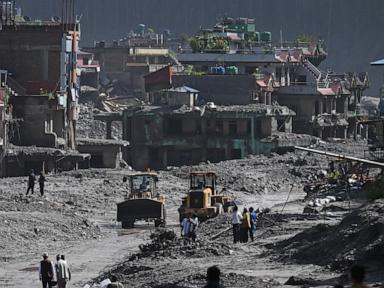
Rescue teams try. Helicopters brave the swirling fog, rotors slicing through thick gray soup, searching for tiny dots of color against the vast, mud-stained slopes. But the landslides have blocked the arteries. Roads are gone, swallowed entirely by the mountainside. Communication lines are snapped. Every village cut off by the deluge becomes an island, isolated not by blue water, but by impassable seas of earth and stone.
The silence that follows a flood is heavier than the water itself.
It is the silence of missing voices. It is the quiet realization that the landscape you loved, the familiar green slopes that nurtured your grandparents, can turn on you in a single night without warning.
When the sun finally breaks through the monsoon clouds days later, it illuminates a landscape stripped of its innocence. The river has carved a new bed, wide and raw, erasing property lines, ancient shrines, and the quiet markers of human history. Survivors wander the banks with hollow eyes, staring at the debris, turning over branches and stones as if looking for a misplaced key, though they know what is buried underneath.
The water recedes, but the grief stays behind, soaking deep into the soil.
And somewhere downstream, the current keeps moving, carrying away the wreckage, indifferent to the names of the lost, waiting quietly for the next heavy sky.