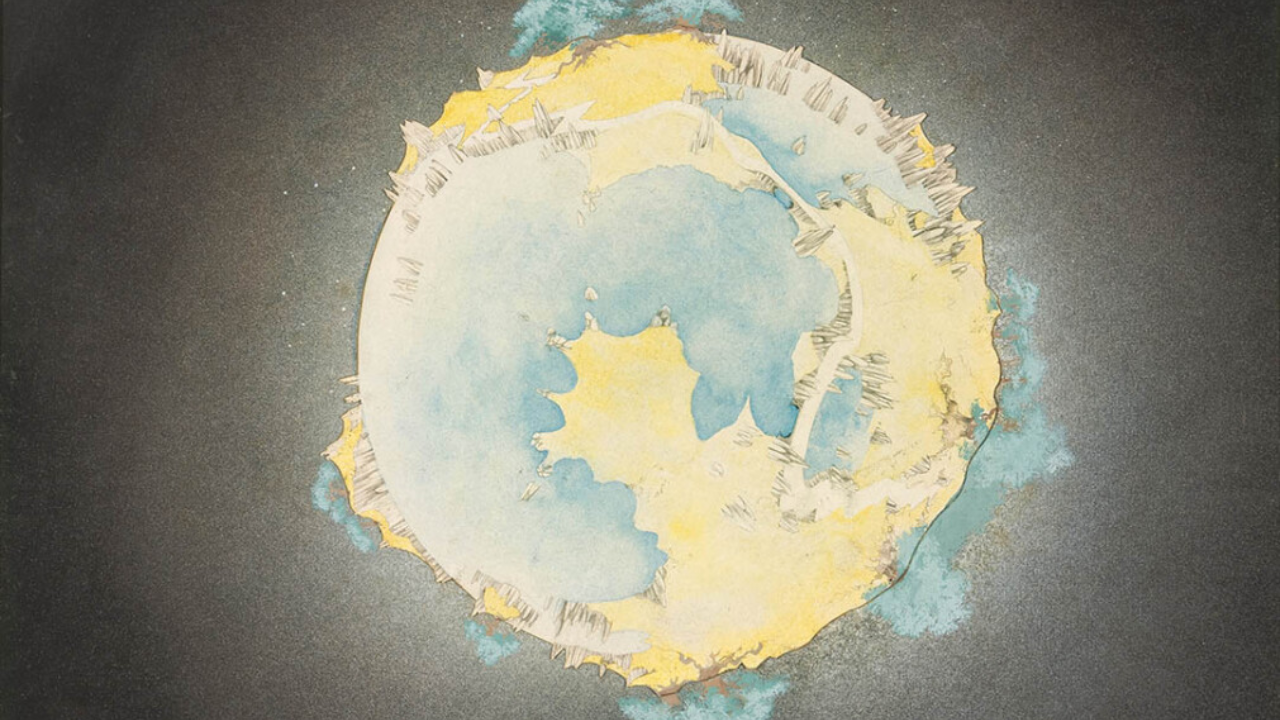
Half a century is a long time for a masterpiece to vanish without a trace. Yet for fifty years, the original cover painting for Yes’s 1971 progressive rock landmark Fragile sat completely out of public view, presumed lost to the chaotic shuffle of 1970s music industry archiving. Now, Roger Dean’s iconic acrylic-on-board artwork is finally heading to auction with an estimate hitting £75,000—and honestly, if you understand the intersection of classic rock history and fine art collecting, that number might actually look like a bargain.
Most casual music fans look at Fragile and see a cool sci-fi planet floating in space. Collectors and art historians see something entirely different. They see the exact moment when album packaging stopped being disposable cardboard and became permanent, gallery-grade world-building.
What Actually Happened to the Fragile Artwork
For decades, the fate of the Fragile cover was one of those persistent vinyl-collector mysteries. Back in the early 1970s, record labels didn't treat original cover paintings like museum pieces. They treated them like commercial production assets. Once the printing plates were made at the press, original boards were routinely tossed into storage closets, left behind in agency offices, or handed off to executives as wall decor.
The Fragile painting disappeared shortly after the album's release in November 1971. Even Roger Dean himself didn't have it in his personal archive, despite famously retaining ownership of many of his later works.
When an original piece of this caliber resurfaces after five decades, the art market reacts fast. Why? Because provenance in rock memorabilia is notoriously murky. Half the "original" sketches floating around private collections lack verifiable paper trails. Having the genuine, physical board that launched one of the most recognizable visual identities in music history is a once-in-a-generation event for progressive rock enthusiasts.
The Anatomy of a Sci-Fi Masterpiece
If you've only ever seen Fragile on a tiny smartphone screen via a streaming app, you're missing the entire point of Dean's brushwork. Look closely at a 12-inch gatefold sleeve—or better yet, the original painting—and the sheer detail jumps out at you.
The artwork depicts a miniature, lushly vegetated planetoid floating in a deep, indigo void. Tiny trees cling to rocky outcrops, water cascades off the edge into nothingness, and a delicate, wooden sailing ship—an early precursor to the flying vessels that would dominate Dean's later work—drifts nearby. On the back cover, the planet cracks apart, spilling its oceans and landmasses into space.
That visual narrative wasn't an accident. Yes had just brought Rick Wakeman into the fold, cementing their classic lineup of Jon Anderson, Chris Squire, Steve Howe, Bill Bruford, and Wakeman. The music was ambitious, fractured, and symphonic. Dean translated that exact sonic tension into paint. He didn't illustrate a song; he built an entire ecosystem that matched the band's sprawling compositions like "Roundabout" and "Heart of the Sunrise."
Why £75,000 Makes Total Sense in Today's Market
Some people balk at paying £75,000 (roughly $95,000 to $100,000 USD depending on exchange rates) for an album cover. That reaction usually comes from folks who still think of rock art as commercial illustration rather than fine art.
The market has moved way past that snobbery. Over the last decade, original 20th-century album cover art has exploded in value, driven by aging Gen-X and Boomer collectors with serious disposable income who grew up staring at these sleeves while wearing headphones.
Consider what else sells in that bracket. Rare first-pressing vinyl records can fetch five figures. Vintage guitars played on classic sessions routinely clear six or seven figures. Yet there are thousands of guitars and thousands of vinyl pressings. There is only one original Fragile painting.
When you compare Dean's work to other blue-chip album art sales, the £75,000 valuation looks remarkably grounded:
- Storm Thorgerson and Hipgnosis's original design artifacts for Pink Floyd regularly command massive premiums whenever rare pieces hit Sotheby's or Bonhams.
- Original comic book cover art from the Silver Age—another medium once dismissed as "kids' stuff"—now routinely clears $100,000 to $500,000 per page.
- Frank Frazetta's fantasy paintings, which share massive DNA with Dean's aesthetic, have sold for millions.
Dean occupies a unique sweet spot. He isn't just an illustrator who worked with a famous band. He essentially acted as Yes's sixth member, designing their classic bubble logo (which debuted on Close to the Edge a year later), crafting their stage sets, and establishing a visual language that defined an entire genre of music.
The Common Misconceptions About Roger Dean's Work
If you spend enough time around art dealers or vintage vinyl forums, you'll hear the same tired myths repeated over and over. Let's clear a few of them up.
Myth 1: He Used Airbrushes for Everything
Because Dean's skies and gradients look impossibly smooth, people assume he relied heavily on airbrushing. He didn't. Dean worked primarily with watercolor, gouache, acrylics, and fine brushes. Those subtle shifts in color on the Fragile backdrop come from meticulous layering and blending by hand, not mechanical spraying.
Myth 2: Fragile Featured the Classic Yes Logo
Check your record collection. The famous flowing, organic "Yes" bubble logo isn't on the Fragile cover. On Fragile, the band's name appears in a relatively restrained, stylized serif font tucked neatly at the top. Dean didn't unveil the iconic curved logo until 1972's Close to the Edge. Fragile was the visual prologue—the proof of concept before he went full-scale into surrealist typography.
Myth 3: Record Labels Always Kept the Originals
Actually, Dean was one of the first artists in the music business smart enough to fight for his copyright and retain his original paintings. Early in his career, before he had the leverage to dictate contracts, pieces slipped through the cracks. That's precisely why Fragile went missing for 50 years, whereas later works like Tales from Topographic Oceans or Relayer remained tightly controlled.
How Roger Dean Changed Album Packaging Forever
Before 1971, most rock album covers were portraits of the band looking moody against a brick wall, or maybe a psychedelic collage. Dean introduced architectural thinking to sleeve design. Trained as a furniture and industrial designer at the Royal College of Art in London, he approached an LP cover as a three-dimensional object rather than a flat square.
He thought about how the front connected to the spine, how the spine flowed into the back cover, and what happened when you opened the gatefold. With Fragile, the story literally wraps around the cardboard. The intact floating world on the front fractures on the reverse, accompanied by an eight-page booklet bound right into the center of the gatefold.
That holistic approach to packaging directly influenced everything from Iron Maiden's Eddie to Tool's intricate packaging decades later. Even James Cameron has openly acknowledged the influence of Dean's floating islands and bioluminescent landscapes on the visual design of Pandora in Avatar. When a single album cover leaves fingerprints on both progressive rock and the highest-grossing film of all time, calling it "just a record sleeve" misses the mark entirely.
What Serious Collectors Look for in Original Album Art
If you're eyeing the auction block—or just trying to understand how experts authenticate and value pieces like this—you have to look past the surface image. Auction specialists scrutinize specific physical markers before slapping a £75,000 estimate on a board.
First, there's production wear. Genuine 1970s cover art almost always shows traces of its life in the print shop. You want to see registration marks in the margins, faint pencil notes from the art director, or tiny bits of masking tape residue around the edges where overlays were taped down for typography. Clean, sterile edges on a 50-year-old painting are actually a red flag.
Second, surface stability matters hugely. Acrylic and gouache painted onto illustration board can warp or crack if stored in damp basements or hot attics for half a century. Given that Fragile vanished into private hands for five decades, condition reports detailing the flatness of the board and the vibrancy of the blues and greens will dictate whether bidding stops at £75,000 or blows past £120,000.
Third, cultural weight trumps technical perfection. Dean painted arguably more complex compositions later in the 1970s—Yessongs and Relayer are staggering in their intricacy. Yet Fragile carries the emotional weight of a breakthrough moment. It was the first time the public saw the marriage of Yes's music and Dean's imagination. In the collectibles world, "firsts" always carry a massive multiplier.
How to Start Collecting Classic Album Art Without Spending £75,000
You don't need hedge-fund money to own a piece of this history. While original paintings from landmark 1971 albums belong in museum vaults or top-tier private collections, there are smart ways to get into the market right now.
- Target signed, limited-edition silkscreens and giclée prints. Roger Dean actively oversees high-grade archival prints of his classic covers through his official studio. Unlike cheap poster reprints, properly documented, hand-signed prints on heavy rag paper hold their value remarkably well and capture the color depth of the original boards.
- Hunt for original UK first-pressing gatefolds. If you want the closest thing to the 1971 tactile experience, skip modern remasters. Track down an original UK Atlantic plum-and-red label pressing of Fragile (catalog number 2401019) with the intact bound booklet. The heavy card stock used in early British pressings absorbs ink differently than modern glossy sleeves, giving the artwork a warmer, matte finish.
- Look at preliminary sketches and layout roughs. Even when finished cover paintings hit six figures, original pencil studies, color roughs, and typography mockups from 1970s designers often surface at specialist music auctions for a fraction of the price. They offer an intimate look at how an iconic cover evolved before the final brush touched the board.
Verify provenance before you spend a dime, demand high-resolution scans of the back of any board or print, and buy the artwork that actually meant something to you when you dropped the needle for the first time.