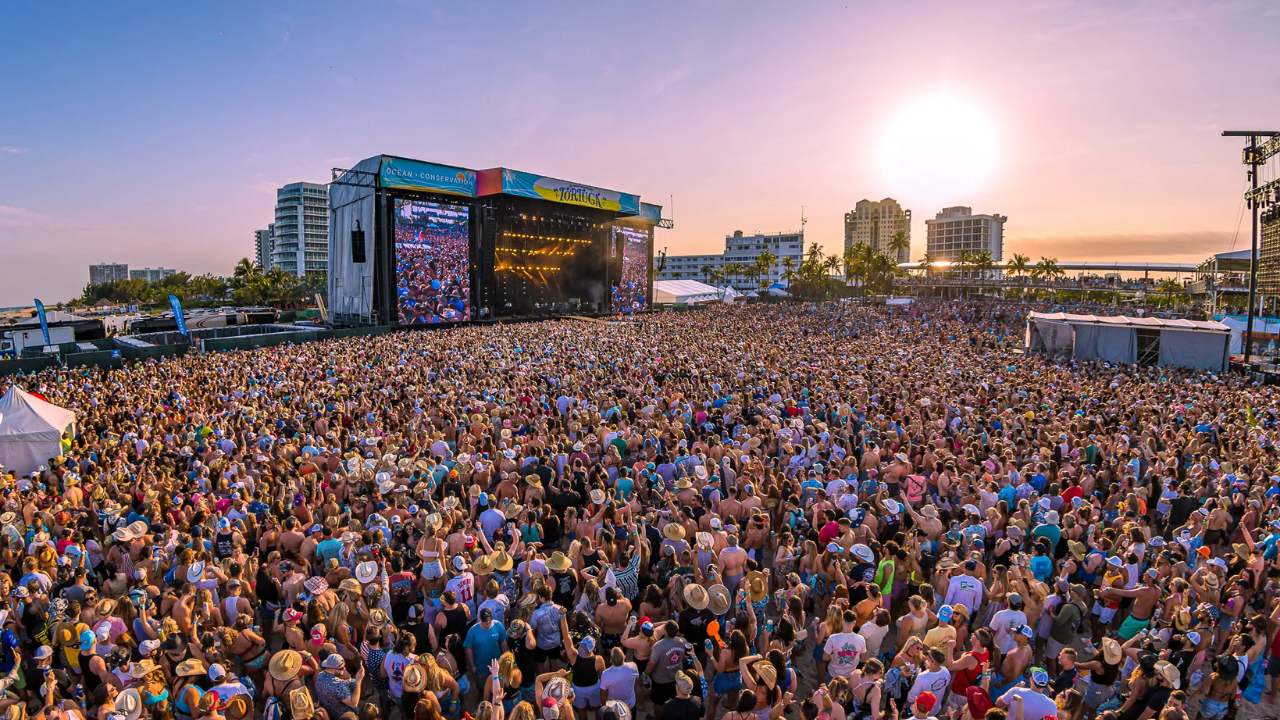
The wind off the Atlantic does not care about your beach chair. It does not care about your festival wristband, your neon sunglasses, or the thumping bassline fading into the roar of the surf. It just blows. Hour after hour, year after year, stripping the shore grain by dry grain, pulling the island back into the dark water.
If you stood on the sands of Fort Lauderdale in 2013, you could feel that desperation in the air. For another look, check out: this related article.
Most people see a beach as a permanent fixture, a giant sandbox laid out by a generous universe for vacation photos and lazy afternoons. It is not. A beach is a fleeing thing. Without something to anchor it, a coastline is just a liquid border waiting to be erased.
Thirteen years ago, the organizers of the Tortuga Music Festival looked at the eroding shoreline beneath their stages and decided to try an experiment. They didn't bring in heavy concrete seawalls or industrial drainage pipes. They brought in grass. Related analysis on this trend has been provided by Apartment Therapy.
Specifically, they brought in sea oats.
To understand why a handful of spindly, salt-stung grass stalks matters more than a million tons of imported concrete, you have to look down. Not at the horizon, but beneath the surface.
Imagine a city upside down. Beneath the dunes of Florida, a dense, tangled metropolis of roots spreads outward and downward, acting like living rebar. When a tropical storm rolls in, hauling massive walls of water toward the coast, a bare mound of sand simply liquefies and washes away. But a dune stitched together by sea oats holds its ground. The roots trap the blowing sand, binding it into a resilient hump that absorbs the initial punch of the tide.
When the festival first started planting those initial shoots in 2013, the effort looked almost quaint. Thousands of screaming fans came for the country music, but a dedicated subset of those people came with dirt under their fingernails. They planted sea oats by hand.
Back then, nobody knew if it would work on a scale impacted by tens of thousands of screaming festival-goers. Music festivals are notoriously hard on ecosystems. They leave behind compacted soil, trodden brush, and mountains of plastic. Tortuga flipped that script. They turned the audience into a restoration crew.
Year after year, the ritual repeated. The stages went up, the music played for three days, the crowds packed up their coolers, and the volunteers went to work in the wake of the exodus. They planted more sea oats. They rebuilt the bruised dunes.
Thirteen years is a blink in geological time, but on an eroding coastline, it is an eternity.
Walk that same stretch of beach today, and the transformation is staggering. The dunes are taller, wider, and sturdier than they were a decade ago. They form a natural rampart between the crashing waves and the coastal infrastructure behind them. Sea turtles, returning to nest in the dark hours of the summer nights, find high ground undisturbed by the wash of minor surges. The sand stays where it belongs.
There is a quiet poetry in this. We live in an age that demands high-tech interventions for every planetary ache. We look for algorithms to fix climate change and synthetic polymers to armor our shores. Yet, sometimes the most advanced technology on the planet is a native grass that has spent millions of years figuring out how to hold onto a rock spinning through space.
The festival proved something vital about how we interact with the places we love. We cannot just consume them. We cannot simply drop in for a three-day weekend, drink our fill of the atmosphere, and leave the cleanup to municipal governments or blind luck. If we want the places that give us joy to endure, we have to invest our own labor into their survival.
The music always stops. The crowds always go home. But the roots keep growing in the dark, holding the edge of the continent together against the endless, patient tide.


