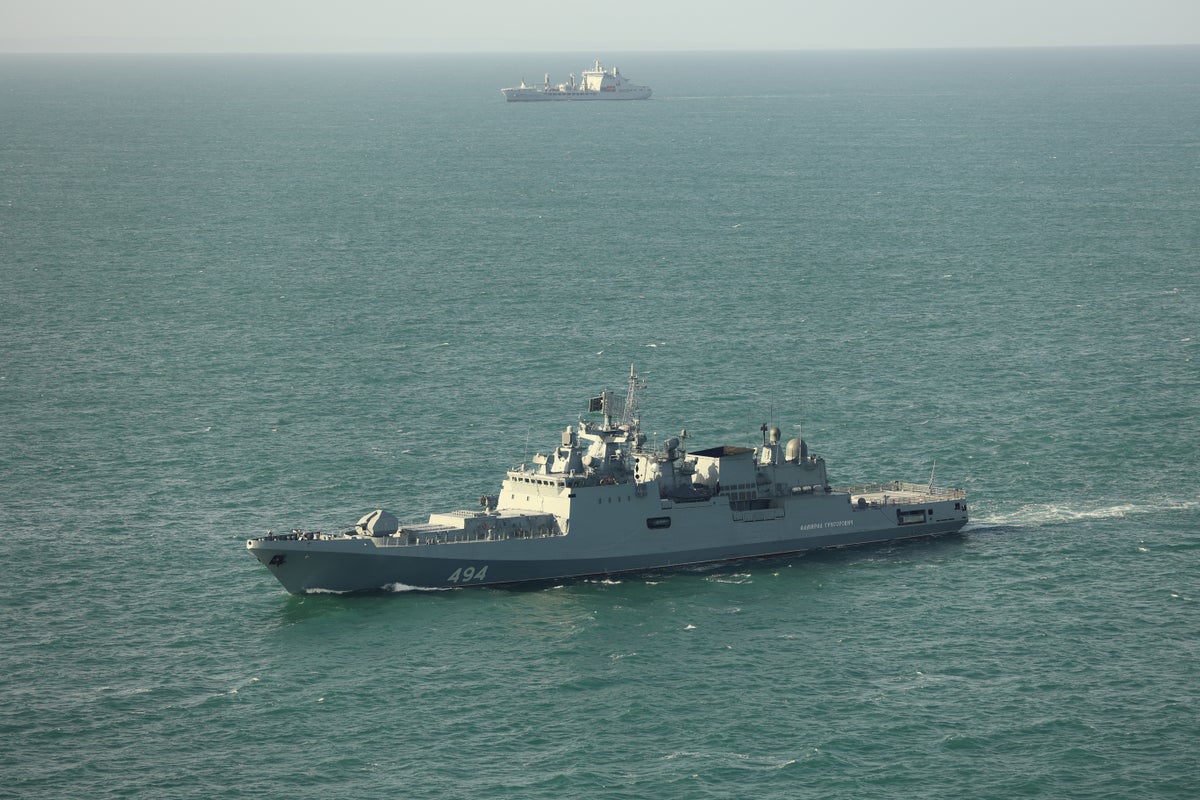
A retired British couple sailing a 40-foot pleasure yacht never expected to trigger a maritime standoff. But that's exactly what happened when their vessel drifted into the path of a heavily armed Russian frigate.
The incident, which saw the Russian warship Admiral Grigorovich fire live small arms warning shots into the air just 20 nautical miles south of the Isle of Wight, highlights just how volatile international waters have become.
While the Ministry of Defence claims the gunfire was simply a drastic attempt to avoid a collision in heavy fog, the reality points to a much deeper issue. Russian naval crews are growing increasingly paranoid, and civilian seafarers are caught right in the middle of it.
The Morning the Channel Turned Into a Flashpoint
Alan and Jane Kelvey were navigating their motorless sailing yacht, Bright Future, through the dense fog of the English Channel when the massive shape of the Admiral Grigorovich loomed out of the mist.
According to the Kelveys, the frigate blasted its horn five times—the standard maritime signal for "have you seen us?" The couple immediately altered their course by two degrees to port to show they were steering clear.
A minute later, the warship blasted its horn again. Then came the gunfire.
Russian sailors unleashed four to five rounds of small arms fire into the air. Moscow's defense ministry quickly put out a statement claiming the yacht was on a "dangerous course" and ignored radio calls and signal flares, closing within 150 meters of the warship. The Kelveys completely dispute that version of events, noting that no flares were fired and no radio contact was attempted. They were simply trying to clear the area in a boat with zero motor power.
The Royal Navy offshore patrol vessel HMS Mersey was already shadowing the Russian frigate when the shooting started. Soon after, a seaboat from HMS Tyne raced over to the Bright Future to ensure the couple was safe and uninjured. No damage was done to the yacht, but the psychological impact of being fired upon by a foreign military vessel in your own backyard isn't something that washes off easily.
Why Russian Captains Are Terrified of Small Boats
To understand why a state-of-the-art guided-missile frigate would resort to shooting at a civilian pleasure yacht, you have to look at the broader tactical environment. Russian captains are incredibly jumpy right now, and for good reason.
Over the last few years, Ukraine has revolutionized naval warfare by using cheap, explosive-laden sea drones to devastate Russia’s Black Sea Fleet. These uncrewed surface vessels (USVs) are small, low-profile, and incredibly fast. From a distance, or in heavy fog, a small civilian sailing yacht can easily mimic the radar signature or visual profile of an incoming threat.
Former Royal Navy captains and defense experts familiar with Russian naval doctrine point out that these crews are perpetually on high alert for asymmetric attacks. When a small boat approaches a loitering warship in a high-traffic lane like the English Channel, the commanding officer isn't thinking about retired vacationers. They're thinking about a potential security breach.
The Shadow Fleet Factor
The timing of this encounter makes it look like a direct retaliation, though defense officials insist it isn't. Just 48 hours prior to the shooting, British Royal Marine Commandos and National Crime Agency officers carried out a high-stakes raid in the Channel. They boarded and seized the Smyrtos, a sanctioned oil tanker suspected of operating within Russia's notorious "shadow fleet."
This shadow fleet consists of hundreds of aging, poorly maintained tankers used by Moscow to bypass international sanctions and keep the cash flowing for its war efforts. The seizure of the Smyrtos was the first UK-led operation of its kind, and its captain has already been jailed awaiting trial.
The Admiral Grigorovich wasn't just taking a leisurely cruise through the Channel. Its primary mission in recent months has been escorting these exact shadow fleet vessels through European waters. While the Ministry of Defence assesses the yacht incident as a contained, isolated navigational issue, the overarching geopolitical tension cannot be ignored. The Channel is no longer just a busy commercial highway; it's a front line for economic warfare.
What to Do If You Encounter a Warship at Sea
If you cruise the English Channel or any busy international shipping lane, encountering a military vessel is a distinct possibility. You cannot assume they see you, and you definitely cannot assume they know your intentions.
Here is how to stay safe and avoid a dangerous misunderstanding:
- Maintain a Wide Berth: Give any military vessel at least two nautical miles of clearance if possible. Never attempt to cross closely ahead of their bow.
- Broadcast on VHF Channel 16: If you see a warship approaching, hail them immediately. State your vessel name, position, course, and speed to make your peaceful intentions clear.
- Keep Your AIS Transponder Active: Ensure your Automatic Identification System is broadcasting so military radar can easily identify you as a civilian pleasure craft.
- Signal Early and Clearly: If you must alter course to avoid them, make a large, obvious turn that is easily visible on their radar and to their watchstanders. Small, incremental adjustments can look like evasive maneuvering or an intercept course.
The English Channel is becoming more crowded with military hardware, and the margin for error is shrinking fast. Keep your distance, communicate clearly, and give warships the widest berth possible.