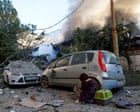
The warning sirens didn't just beep; they screamed. After days of explicit intelligence alerts from Ukrainian and Western officials, the expected hammer blow finally fell. Russian strategic bombers and missile batteries launched a massive, coordinated aerial assault across Ukraine, slamming the capital city of Kyiv alongside major hubs like Dnipro and Kharkiv.
This isn't just another predictable chapter in a long war. The sheer volume and complexity of the strike package demonstrate a calculated shift in Kremlin tactics. By combining waves of low-cost Shahed drones with complex ballistic and cruise missile salvos, the attack explicitly aims to exhaust Ukraine's rapidly depleting stockpile of air defense interceptors.
For the people on the ground, the abstract strategy translates into immediate, visceral horror. Here is what happened, why the timing matters, and what it tells us about where this conflict is heading.
A Night of Fire Across Multiple Cities
The assault began late in the evening as waves of loitering munitions crossed the border, keeping air defense crews active and fixed positions exposed. By the early hours of the morning, the heavy armor arrived. Strategic Tu-95MS and Tu-160 bombers released cruise missiles while land-based systems fired high-velocity ballistic weapons, including over 20 Iskander and Tsirkon missiles directed at Kyiv alone.
The capital took a brutal beating. While the Ukrainian Air Force managed to intercept dozens of incoming targets, the sheer volume meant that falling debris and direct impacts caused widespread destruction across eight separate districts.
- Kyiv: In the Podilskyi district, a "double-tap" strike caused a partial collapse of a nine-story residential building, trapping families under burning concrete. In the Holosiivskyi district, a local medical clinic suffered a direct hit, pancaking the second and third floors. At least four people died in the capital, with dozens more wounded, including small children.
- Dnipro: The central Ukrainian hub faced an equally terrifying night. Strikes hit residential sectors, killing at least six people. Tragically, a secondary strike targeted the area just as first responders arrived, killing a rescue worker who was digging through the rubble.
- Kharkiv and Zaporizhzhia: Kharkiv endured a combined onslaught of 15 drones and multiple missiles that ripped through private homes and a preschool grounds. To the south, Zaporizhzhia reported a staggering 20 distinct arrivals as Russian forces saturated the city's perimeter.
Emergency workers are still clearing concrete with their bare hands. The death toll sits at 11 across the nation, but that number is expected to climb as rescue crews dig deeper into the collapsed apartment blocks.
The Strategy Behind the Inundation
To understand why this specific raid is so alarming, you have to look past the tragic headlines and analyze the military math. Russia is no longer just trying to hit specific buildings; it is trying to break the math of Western defense supply chains.
Local military experts have pointed out that Russia's Defense Ministry is using mass drone swarms as sacrificial pawns. A Shahed drone costs a fraction of the price of a Patriot or NASAMS interceptor missile. By forcing Ukrainian batteries to engage hundreds of drones, Russia clears a path for its hyper-expensive, high-speed ballistic missiles like the Iskander and hypersonic Tsirkon.
Ukraine intercepted a massive percentage of the incoming threats, but "almost all" isn't good enough when dealing with ballistic ordnance. Ballistic missiles travel on a steep, high-speed trajectory. Even when hit by an interceptor, the thousands of pounds of burning metal and unexploded fuel still crash down into densely populated neighborhoods at supersonic speeds. The destruction we see in Kyiv's Solomianskyi and Podilskyi districts today is the direct result of this brutal physics reality.
The Air Defense Bottleneck
This escalation puts Ukrainian President Volodymyr Zelenskyy in a brutal position. For months, he has been pleading with international allies for more air defense systems, specifically Patriot batteries capable of cleanly knocking down ballistic threats.
The reality on the ground is stark. Ukraine's air defenses are working miracles daily, but they're facing a supply bottleneck. The West can't manufacture interceptor missiles fast enough to match the production rate of Russian drone factories and foreign ballistic missile shipments.
When a single night's raid features hundreds of targets spread from Kharkiv to Zaporizhzhia, Ukrainian commanders are forced to make impossible choices. Do they protect a thermal power plant, a military command hub, or a residential neighborhood? Every choice leaves something vulnerable.
Moving Beyond Retaliation Rhetoric
Moscow claimed these strikes were a retaliatory response to recent Ukrainian drone activity inside Russian-held territory. Don't buy the narrative. An aerial operation of this magnitude, involving coordinated deployment of strategic bombers, synchronized drone pathways, and precise missile programming, takes weeks of logistical preparation.
This wasn't a knee-jerk reaction. It was a planned, systematic attempt to break the spirit of civilian populations and degrade municipal infrastructure as summer begins. The timing is also deeply political, designed to project absolute strength and dominance following recent international geopolitical debates surrounding the war's trajectory.
The Next Critical Steps for Ukraine
Survival in the coming months depends on rapid tactical adjustments. Here is what needs to happen immediately on the ground and internationally.
Decentralize Crisis Housing
Kyiv currently maintains dozens of temporary apartments for residents displaced by these specific strikes. Local administrations must immediately expand these programs to other heavily targeted hubs like Dnipro and Zaporizhzhia. Cities need to pre-stage heavy rescue equipment outside of central zones to prevent first responders from being caught in double-tap attacks.
Diversify Low-Cost Intercept Methods
Ukraine cannot continue using million-dollar Western missiles to shoot down cheap drones. Expanding the network of mobile fire groups—pickup trucks equipped with searchlights, thermal optics, and heavy machine guns—is vital to saving elite air defense missiles for the incoming Iskander and Tsirkon threats.
Pressure for Unrestricted Counter-Battery Strikes
The ultimate solution to air raids isn't shooting down the missiles; it's destroying the launchers. Western allies must look at the burning apartments in Kyiv and realize that restricting Ukraine from striking the Russian airfields and launch sites where these strikes originate is a recipe for endless civilian casualties. Without the ability to eliminate the threat at the source, Ukraine remains trapped in a defensive war of attrition it cannot afford to play.