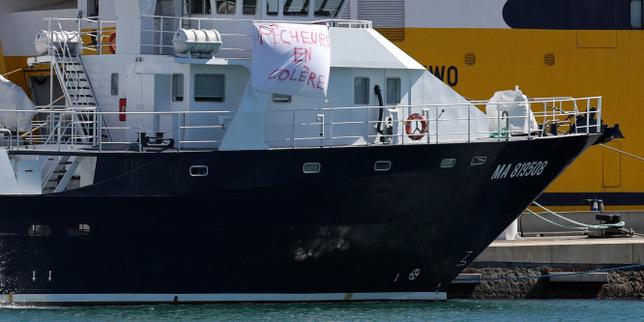
Dawn in Le Guilvinec does not arrive with a gentle yawn. It crashes against the granite breakwaters with the heavy, metallic scent of diesel, kelp, and ice. Long before the tourists wake to find croissants cooling on bakery counters, men in neon-orange oilskins are already breathing the salt air, their knuckles raw against frozen steel winches.
To understand what twenty-five million euros actually means, you have to stand on a rolling wooden deck while the Atlantic swell tries to snap your spine in half. You have to watch the fuel gauges drop hour by agonizing hour as trawlers push further out past the shelf, chasing fish that are retreating into colder, deeper waters.
For months, the price at the pump had become an invisible anchor dragging down every single haul.
When the Fuel Tank Becomes the Enemy
Every time a diesel engine roars to life in a French harbor, it burns a hole through the margin of survival. The arithmetic of modern fishing is brutal. A medium-sized trawler does not sip fuel; it devours it. When global energy markets convulsed, sending crude prices soaring to punishing heights, the men and women who put sole, hake, and monkfish on European plates found themselves working simply to pay for the privilege of working.
Imagine spending eighteen hours battered by freezing spray, hauling heavy nets through pitch-black troughs, only to dock and realize your entire catch barely covers the cost of the fuel you burned to get there.
That was the reality gripping France’s Atlantic and Mediterranean ports. It was not a crisis of skill or a lack of grit. It was a simple, suffocating squeeze of operational overhead. The vessels were ready. The crews were willing. The sea was indifferent. But the economics were fundamentally broken.
Then came Brussels.
The Brussels Intervention
In a quiet corridors of power far from the smell of fishmeal and salt spray, the European Commission made a rare, decisive move. They approved a twenty-five-million-euro emergency injection from the French state designed to do one thing: offset the punishing cost of marine diesel for commercial fishers.
Critics immediately sharpened their pencils. State aid is a thorny creature in the European Union, usually eyed with deep suspicion to prevent unfair market distortion. But this was triage. The European Commission recognized a simple truth that spreadsheets often miss: if you let the coastal fleet collapse, you do not just lose an industry. You lose the cultural heartbeat of entire maritime regions. You lose centuries of accumulated knowledge about the sea.
The twenty-five million euros did not flow as a blank check or a permanent subsidy. It arrived as a direct, targeted buffer against the exorbitant price spikes at the pump. For a skipper staring down bankruptcy, it meant the difference between untying the ropes for another voyage or selling the family cutter for scrap.
Consider what happens when a local fishing fleet dies. The fishmonger on the corner closes. The net-mender packs up his shop. The harbor, once a bustling theater of human labor and survival, turns into a parking lot for pleasure yachts. The heritage of the coast vanishes into quiet memory.
The Human Cost Behind the Statistics
We talk about state aid and European regulatory frameworks as if they are abstract chess pieces moved by bureaucrats in suits. But step aboard a vessel out of Boulogne-sur-Mer or Sète, and the abstraction dissolves instantly.
Meet Jean-Marc. He is a third-generation skipper whose grandfather survived wooden hulls and canvas sails, and whose father survived the collapse of the cod stocks. Jean-Marc knows every fathom of the seabed within fifty miles of his home port. He can smell a change in the weather twelve hours before the barometer drops.
Yet, last winter, Jean-Marc sat at his galley table with a calculator that told a terrifying story. His last three trips had operated at a net loss. Not because the fish weren't there, but because filling his tanks cost more than the fish were worth at the auction block.
"We aren't asking for a handout," Jean-Marc told me, his hands scarred and calloused from decades of hauling braided line. "We are asking for a bridge. If the bridge collapses, we all fall."
The twenty-five-million-euro package was that bridge. It didn't solve the long-term questions of stock management, climate shifts, or the inevitable green transition that every maritime nation must eventually face. What it did was buy time. It kept the engines running while broader conversations about sustainable propulsion and energy efficiency slowly ground forward.
Navigating the Storm Ahead
Subsidizing fossil fuels for an industry that contributes to global carbon emissions is an uncomfortable paradox. Every environmental economist knows the tension. On one hand, the world needs to decarbonize every sector, including maritime transport and commercial fishing. On the other hand, you cannot transition a starving population overnight.
The European Union's approval of this French state aid acknowledges this delicate tightrope. You cannot build electric trawlers tomorrow. You cannot replace heavy diesel engines with hydrogen fuel cells when the technology is still in its infancy and the ship is sinking today.
So the money arrived as a shock absorber. It kept the lights on in coastal communities where every fourth job is tied directly or indirectly to the harbor. It ensured that the supply chains feeding local markets remained intact while longer-term adaptations are engineered.
The sea remains a harsh, unpitying master. It does not care about European directives, state budgets, or macroeconomic policy. It demands respect, stamina, and sacrifice.
Out on the water tonight, somewhere off the coast of Brittany, a solitary navigation light cuts through the mist. The engine thrumming beneath the deck is burning fuel that was kept affordable by a hard-fought political decision in Paris and Brussels. The nets are down. The crew is waiting. The dawn will come again, cold, salty, and demanding.