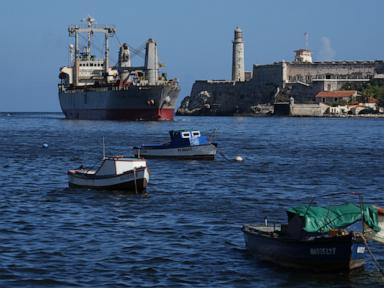
The rusted hull of a freighter does not care about geopolitics. It cares about the weight of water against steel, the sting of brine, and the precise moment a harbor pilot takes the wheel to guide thousands of tons of metal into a waiting slipway.
When the Mexican naval vessel Libertador cut its engines and drifted toward the docks of Havana, the sound of its heavy mooring lines hitting the concrete was loud. It was the sound of a lifeline snapping into place. On the surface, the event can be filed under standard diplomatic reporting: Mexico sends humanitarian aid to Cuba during a period of heightened diplomatic friction with the United States. But statecraft is a cold lens. It reduces human survival to chess pieces and treating a shipping manifest like a manifesto.
To understand what happens when a ship like this arrives, you have to step away from the press briefings in Washington and Mexico City. You have to stand on the concrete of the Malecón, where the spray from the Atlantic tastes like old copper, and look at what is actually inside those metal containers.
The Anatomy of Shortage
Imagine a kitchen where the lightbulb has been dead for three weeks because there are no replacements in the store.
This is not a metaphor. It is the daily calculus of a Havana neighborhood. The refrigerator hums erratically, a victim of the rolling blackouts that turn every evening into a guessing game. When the power goes, the heat moves in. It is a thick, humid weight that settles over everything. In these moments, the grand political arguments about embargoes and sovereignty dissolve into a much simpler question: Will the milk spoil before morning?
The Libertador arrived carrying barrels of diesel, tons of beans, flour, and medical supplies. To the analysts tracking satellite data, this is an strategic alignment between Mexican President Andrés Manuel López Obrador and the Cuban administration. They see a challenge to the decades-old American embargo, a diplomatic poke in the eye to Washington at a moment when migration and regional influence are being negotiated in secret rooms.
But to the people waiting in lines that snake around three city blocks before the sun rises, the ship is not an ideology. It is breakfast.
The economic reality of the island has become an exercise in subtraction. Over the last few years, the inflation rate has climbed steadily, eroding the purchasing power of the average state salary until it covers little more than a week’s worth of basic goods. The ration books, known as the libreta, cover less and less each month. Sometimes the rice is late. Sometimes the coffee never arrives at all.
When a country lives on the edge of a shortage, the arrival of 800 tons of food is a reprieve. But it is a temporary one, and everyone on the docks knows it.
The Invisible Network of the Caribbean
The Gulf of Mexico is a small, crowded bathtub. The distance between the tip of the Yucatán Peninsula and the western coast of Cuba is barely a hundred miles of open water. Historically, this stretch of sea has been a highway for everything from Spanish silver to smuggled rum, from revolution to refugees.
Consider the perspective of a merchant mariner who has spent thirty years watching these waters. They will tell you that the sea ignores borders. A storm that brews off the coast of Cozumel will dump its rain on the tobacco fields of Pinar del Río twelve hours later.
This geographical proximity creates a natural gravity that politics struggles to suppress. Mexico’s decision to send aid is rooted in a long-standing foreign policy doctrine of non-intervention and revolutionary solidarity, a stance that dates back to the 1960s when Mexico was the only Latin American nation to refuse to break diplomatic ties with Havana.
But there is a sharp difference between historical policy and immediate necessity.
The current tension between the United States and Cuba is not a static leftover from the Cold War. It is dynamic, shifting with every election cycle in Florida and every policy shift in Washington. When the U.S. government maintains Cuba on its list of state sponsors of terrorism, the financial ripples are immediate. European banks refuse to process transactions for Cuban medical entities. Shipping companies avoid Cuban ports because they fear being barred from docking in Miami or Houston for six months afterward.
This is the invisible wall. It is built of compliance paperwork, risk-assessment algorithms, and legal liability. It is far more effective than a line of warships.
The Weight of the Cargo
On the day the Libertador docked, the air was heavy with the scent of low tide and diesel exhaust. Crane operators, men with skin cured by the Caribbean sun and eyes narrowed against the glare, swung the massive hooks over the ship’s hold.
Every container lifted represented a specific calculation of survival.
- The Fuel: Diesel is the lifeblood of the island's fragile electrical grid. Without it, the thermoelectric plants fail, plunging entire provinces into darkness and silencing the fans that make the tropical heat bearable.
- The Flour: Bread is a staple that cannot be substituted. When the mills stop for lack of grain, the social fabric thins.
- The Medicine: Basic antibiotics and syringes are often scarcer than luxury goods. A simple infection becomes a family crisis.
It is easy to get lost in the statistics of aid. We read that a country received millions of dollars in assistance and our brains normalize the figure. It becomes an abstraction. To ground that number, you have to look at a single crate of cooking oil.
In Havana, a bottle of oil has become a luxury item, traded on the informal market for prices that seem absurd to an outsider. When that crate is unloaded, it represents hundreds of meals that can be cooked without the desperate hustle of searching the black market. It means a mother does not have to decide between buying soap or buying grease for the evening rice.
The tension between Washington and Havana is often framed as a battle of ideas—capitalism versus socialism, democracy versus authoritarianism. But on the piers of Havana Harbor, that framing feels hollow. The only ideology that matters is the one that fills the stomach.
The View from the Northern Shore
Three hundred miles to the north, in the air-conditioned offices of Washington, the arrival of the Mexican ship is viewed through a different telescope.
To American policymakers, the aid is not merely humanitarian; it is political oxygen. It allows a system they view as repressive to survive another day without making the structural changes they demand. The argument goes that by relieving the pressure caused by the embargo, Mexico is delaying the inevitable reckoning that could lead to a democratic transition.
It is a logical framework built on pressure points and leverage. If you tighten the screws enough, the machine must eventually break.
The flaw in this logic is that machines do not feel hunger. People do.
The individuals who bear the cost of this geopolitical leverage are not the officials living in the protected compounds of Miramar. They are the pensioners whose monthly checks cannot buy a single pound of pork. They are the young doctors who work twelve-hour shifts only to walk home because there is no fuel for the buses.
The debate over the efficacy of sanctions is old and weary. It has been running since the era of black-and-white television. Yet, the persistence of the Cuban shortage suggests that pressure does not always lead to collapse; sometimes, it merely leads to adaptation, a hardening of the shell, and a profound, generational exhaustion.
The Echoes in the Harbor
As the sun began to drop behind the fortress of El Morro, casting long, orange shadows across the water, the work on the Libertador continued. The cranes did not stop. The trucks kept moving, carrying their loads out into the city’s distribution hubs.
There was no grand celebration on the docks. No speeches were delivered to massive crowds. The arrival was handled with a quiet efficiency that spoke to the regularity of crisis.
A young man sitting on the sea wall watched the last containers being lowered onto flatbed trailers. He did not know the name of the Mexican president, and he did not care about the latest statements from the U.S. State Department. He was thinking about his grandmother, who had been waiting for three months for a specific heart medication that was supposed to be in one of those boxes.
He spat into the dark water, watched the ripples distort the reflection of the ship's lights, and pulled his collar up against the rising evening breeze.
The ship would stay for two days, unload its cargo, and turn back toward Veracruz. The sea would swallow its wake, leaving the harbor exactly as it had been before—placid, deep, and surrounded by a city that has learned to measure time not by years or decades, but by the arrival of the next boat.


