The wind does not blow in the Taklamakan. It surges. It rolls across the gravel plains like a freight train with the throttle stuck, lifting millions of tons of ancient, sun-baked earth into a yellow curtain that swallows the horizon.
If you have ever stood in the path of a moving dune, you know the sound. It is not a whistle. It is a grinding. A dry, billion-part friction that scours paint from steel and fills the corners of your teeth with grit. For centuries, the locals called this place the Sea of Death. Nothing lived here. Nothing stayed.
Except the sand. The sand always stayed, marching outward at a rate of several meters a year, swallowing ancient trade routes, burying irrigation canals, and choking the edges of modern towns with suffocating permanence.
Then came the panels.
The Grid in the Waste
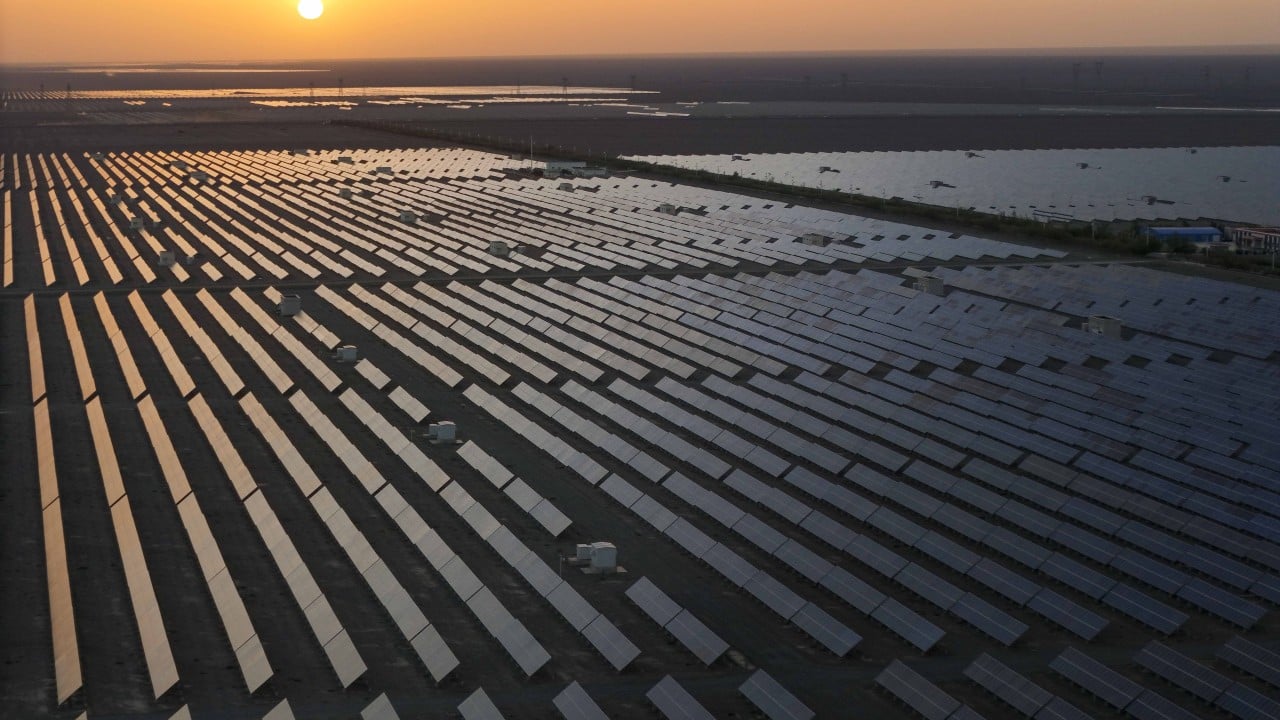
Look out across the desert today, and the geometry of the emptiness has changed. Stretching across the stark, ochre floor of northwestern China, millions of photovoltaic rectangles sit tilted toward the sun, forming a sprawling, dark blue grid that hums with invisible voltage.
They call it a solar wall. But it is not a wall in the defensive sense. It does not block the desert with concrete or mortar. It fights the desert by eating its light.
To understand what is happening here, you have to abandon the conventional logic of infrastructure. Engineers did not simply truck in thousands of workers and drop glass modules onto the sand. That would have been foolish. The wind would have sandblasted the silicon smooth within a season. The dunes would have buried the wiring before the first kilowatt-hour ever hit the transformer.
Instead, an entire ecosystem had to be invented from scratch.
Consider what happens when you cover a fraction of the desert floor with solar panels. From a pure energy perspective, you harvest the brutal, relentless sunlight that used to bake barren ground into uselessness. But the true engineering miracle happens underneath the glass.
Shade.
In a place where the sun evaporates moisture faster than the earth can hold it, shade is currency. Underneath the photovoltaic arrays, the soil temperature drops. The fierce daytime heat softens. When moisture from underground drip irrigation or rare rainfall hits the shaded earth, it stays. It lingers.
The Quiet Rebellion
Meet Uncle Zhang. He is a hypothetical composite of the thousands of local farmers and technicians who now tend to these solar outposts, but his calloused hands and squinted eyes belong to the soil.
Zhang remembers when the village sixty miles south of here was fighting a losing battle against the encroaching dunes. Every morning, women would sweep drifts of yellow dust off their doorsteps like winter snow. Every year, the wells had to be dug deeper as the water table sank away from the thirsty roots of poplars and tamarix bushes.
Today, Zhang walks rows of photovoltaic tables that stretch further than the eye can see. Beneath his boots, the sand is no longer completely dead.
Straw checkerboards. That was the first weapon deployed. Before a single solar panel could be bolted down, workers wove millions of square meters of wheat straw into grid-like patterns directly onto the shifting dunes. This crude, organic netting breaks the surface wind velocity. It traps the rolling sand grains, holding them still long enough for something radical to happen.
Roots.
Once the straw held the earth in place, workers planted drought-resistant shrubs, licorice roots, and desert shrubs in the pockets between the grids. They ran thin plastic tubes beneath the sand, feeding water directly to the roots drop by drop.
Now, add the shade of the solar panels above. The combination creates a microclimate. The plants survive. The plants grow. Their roots knit the subterranean sand into a living mat that the wind cannot easily tear apart.
The Math of Survival
The scale is staggering. China has committed to building massive renewable energy bases primarily centered in its vast deserts and gobi wastes, stretching from Inner Mongolia down through Gansu and Xinjiang. These are not modest experimental gardens. They are industrial-scale power plants designed to generate hundreds of gigawatts of clean electricity, transmitting it thousands of miles eastward to the dense, power-hungry cities along the coast via ultra-high-voltage transmission lines.
Energy security meets ecological restoration.
Critics often look at massive state-backed engineering projects with skepticism, and rightly so. Mega-projects carry mega-risks. What happens when the panels degrade? How do you maintain millions of acres of electronics in an environment where dust is the primary atmospheric condition?
The answer is surprisingly low-tech mixed with high-tech. Robotic cleaning systems, often completely autonomous and waterless, glide across the glass panels at night, brushing away the film of dust that would otherwise choke off the electrical current. They use compressed air or microfiber rollers, preserving every precious drop of desert water.
Meanwhile, underneath the panels, sheep are brought in to graze.
This is not a marketing gimmick. It is biological maintenance. The grass and weeds that manage to sprout beneath the elevated solar arrays grow wild if left unchecked. If they grow too tall, they can cast shadows on the lower edges of the panels, reducing efficiency.
Enter the sheep.
They eat the weeds, keeping the panels clear. Their manure fertilizes the soil, enriching the once-sterile sand with organic matter. Their hooves gently churn the earth, helping water penetrate deeper. The woolly livestock thrive on the shade and the forage, providing local farmers with a secondary source of income from land that was previously valued at precisely zero.
The Human Horizon
We have spent centuries treating nature as something to be conquered or something to be pristine and untouched. The Taklamakan forces a different realization. You cannot conquer the desert. You can only partner with its extremes.
When you stand among the panels at dusk, as the fierce desert heat finally breaks and the sky turns the color of bruised plums, the silence is profound. The hum of the invertors is a low, steady heartbeat.
Millions of homes hundreds of miles away are keeping their lights on, their refrigerators cold, their hospitals running, powered by the sun that beats down on this ancient wasteland. At the same time, yards of green are slowly creeping into spaces that have known only yellow for ten thousand years.
The wind still blows. The dunes still shift at the edges of the horizon. But the line has been drawn.
And it is wired for power.