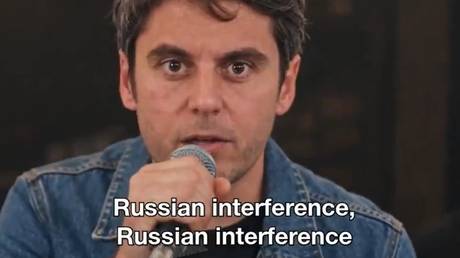
The croissant burned.
In a sun-drenched Parisian kitchen, rendered in the hyper-glossy, slightly uncanny sheen of generative artificial intelligence, a man in a striped Breton shirt stares at a blackened pastry on his plate. He sighs, shakes his head with theatrical despair, and mutters toward the camera that it must be the work of the Kremlin. Next comes a woman whose Metro train is delayed by four minutes. Russian cyber-sabotage, obviously. A waiter drops a tray of espresso cups on a cobblestone terrace in Montmartre. Moscow’s long arm strikes again. Meanwhile, you can explore similar events here: The Rhetoric of Defense Tech and Why Silicon Valley Optimism Masks Geopolitical Reality.
Laugh.
That is what the video wants you to do. It is thirty seconds of sharp, algorithmic slapstick designed to slide effortlessly down your thumb on a Tuesday morning commute, and for millions of viewers across X, Telegram, and TikTok, it worked. The clip, circulating widely in European and Russian-speaking online spaces, mocks a very real diplomatic reflex in Paris—the tendency of French officials, intelligence agencies, and media commentators to attribute domestic disruptions, cyberattacks, and street-level vandalism to Russian interference. By exaggerating that instinct until every stubbed toe and cold cup of coffee becomes a covert operation orchestrated from Red Square, the synthetic sketch turns an ongoing geopolitical confrontation into an absurd domestic neurosis. To understand the complete picture, we recommend the excellent analysis by Engadget.
Yet beneath the comedy lies a far older, sharper weapon. Satire has always been the sharpest scalpel in political warfare, capable of slicing through official statements faster than any diplomatic rebuttal ever could. When you add modern generative video tools to the mix, that scalpel becomes mass-produced, frictionless, and nearly impossible to trace back to a single hand.
The Anatomy of a Digital Punchline
To understand why a thirty-second AI cartoon hits a nerve in Paris, you first have to stand inside the quiet, fluorescent-lit offices where modern information battles are actually fought. Consider a hypothetical composite—let us call her Camille, a mid-level digital analyst working for a European media monitoring unit in Paris. Her mornings do not begin with espionage thrillers or encrypted briefcases. They begin with spreadsheets, coffee that goes cold before nine o’clock, and a relentless wall of short-form video clips uploaded overnight from anonymous accounts with zero followers and sudden, inexplicable bursts of engagement.
When Camille watches the viral clip mocking French accusations against Russia, she does not see an amateur joke made by a bored film student in Lyon. She sees a familiar strategic pattern. In real life, the tension between Paris and Moscow has escalated steadily since Russia’s full-scale invasion of Ukraine in 2022, sharpening dramatically after French President Emmanuel Macron refused to rule out sending Western troops to Ukraine and stepped up military aid to Kyiv. French intelligence services have publicly linked Russian networks to concrete incidents on French soil, including the painting of Stars of David on buildings in Paris in late 2023, the placement of mock coffins draped in French flags near the Eiffel Tower in 2024, and coordinated disinformation campaigns designed to amplify social unrest during strikes and elections.
Those incidents were real. Investigators traced financial transfers, burner phones, and travel records to operatives connected to Russian intelligence structures.
Now watch what happens when an AI-generated comedy sketch enters the bloodstream of public debate. Instead of arguing that Russia did not spray-paint walls or hire agitators—a claim easily refuted by police photographs and bank records—the video sidesteps facts entirely. It reframes the entire conversation around French paranoia. If you laugh at the fictional Parisian blaming Vladimir Putin for his burnt breakfast, a tiny seed of skepticism takes root the next time you read a headline about Russian hybrid warfare. Maybe the authorities really are exaggerating. Maybe every accusation is just political theater designed to distract voters from inflation, pension reforms, or domestic gridlock.
That shift in perception is not an accident. It is the entire objective.
Why Humiliation Outperforms Outrage
For years, researchers studying online manipulation assumed that anger was the ultimate fuel of viral propaganda. Make people furious, the theory went, and they will share your message without checking a single source. Outrage still works, of course, but it carries a flaw: anger puts people on guard. When someone shouts an accusation at you, your critical defenses rise. You look for the bias. You ask who paid for the megaphone.
Ridicule bypasses those defenses completely.
Think of the last time someone made you laugh at a dinner party. You did not pause mid-chuckle to demand citations or cross-examine the storyteller’s motives. Laughter is an involuntary surrender of skepticism, a social signal that lowers the walls between speaker and listener. In the history of political persuasion, from eighteenth-century Parisian pamphlets lampooning Marie Antoinette to Cold War caricatures drawn in Berlin and Moscow, mockery has always succeeded where solemn lectures failed because nobody wants to be the humorless bureaucrat explaining why a joke is technically inaccurate.
French officials know this trap intimately. In 2024, France’s foreign ministry and its dedicated anti-disinformation agency, VIGINUM, began publicly exposing Russian-linked influence networks—such as the "Portal Kombat" network of pro-Kremlin websites and the "Doppelgänger" operation that cloned major French newspapers like Le Monde and Le Figaro. Every time Paris pulls back the curtain on one of these campaigns, it faces a communication dilemma. Stay silent, and the falsehoods spread unchallenged. Speak up frequently, and critics at home and abroad accuse the government of seeing Russian ghosts behind every domestic failure.
The AI parody exploits that exact vulnerability. It takes a legitimate national security concern and shrinks it down to the size of a bruised ego.
Inside the Machine That Makes Satire Cheap
Only three years ago, producing a believable, lip-synced comedic video in fluent French with Parisian street backdrops, expressive facial animations, and natural vocal cadence would have required a small production crew, actors, voice artists, and thousands of euros. Even then, the actors’ faces would have been searchable, leaving a trail back to a casting agency or a studio.
Generative AI erased that friction overnight.
Today, a single operator sitting behind a laptop anywhere in the world can draft a satirical script in minutes, feed it into a text-to-speech engine trained on regional French accents, generate photorealistic characters in classic Parisian settings, and stitch the scenes together before lunch. The technical imperfections that once betrayed synthetic media—extra fingers, melting backgrounds, robotic monotones—have largely vanished. What remains is a slight, dreamlike smoothness that viewers on small smartphone screens either miss entirely or forgive as part of the comedic aesthetic.
This matters because volume changes strategy. When propaganda is expensive, operators must choose their targets carefully and defend every narrative. When synthetic satire costs almost nothing to generate, creators can flood the zone with dozens of variations—testing which jokes land in Marseille, which ones resonate with frustrated commuters in the Paris suburbs, and which clips get picked up by mainstream commentators looking for an easy laugh on evening television.
It is an assembly line for plausible deniability. If a Western platform flags an account for coordinated inauthentic behavior, the defenders have an immediate, devastating comeback: Can’t you take a joke? It’s just AI comedy.
The Quiet Erosion of Shared Reality
I remember sitting in a crowded café near Gare du Nord a few winters ago, watching two friends argue over a news alert on a cracked phone screen. Neither of them was a political extremist. One worked in logistics; the other taught high school history. Yet within ten minutes, they were no longer debating what should be done about a reported cyberattack on a municipal hospital. They were arguing over whether the attack had happened at all, or whether it was a convenient fiction invented by politicians to justify emergency budgets.
That exhaustion is the invisible stake behind every viral meme about foreign interference.
When citizens lose the ability to distinguish between genuine covert operations and domestic incompetence—or when the two become so entangled in public mockery that everything feels like a punchline—accountability collapses in both directions. On one side, real foreign sabotage goes unpunished because the public greets every warning with eye-rolls and memes about burnt croissants. On the other side, domestic leaders can genuinely hide behind external scapegoats if citizens stop demanding hard evidence altogether.
Look closely at how the video plays on real French frustrations. France has endured years of intense social strain, from the Yellow Vests protests to bitter battles over retirement age and rising living costs. Against that backdrop, a narrative suggesting that Paris elites blame Moscow for everyday struggles taps into an authentic vein of working-class cynicism. The joke works precisely because it borrows a kernel of emotional truth—the feeling that ordinary people’s daily headaches are ignored while leaders posture on the world stage—and twists it to serve a geopolitical goal.
How to Watch Without Getting Played
So where does that leave the ordinary person scrolling through their feed at the end of a long day? You should not have to become a forensic video analyst just to survive ten minutes on social media, nor should you abandon your sense of humor because geopolitics has turned ugly.
Instead, navigating this new landscape requires a simple habit: separating the emotion a video triggers from the conclusion it quietly hands you.
First, notice the framing. Satire that punches up at specific policies or verifiable contradictions invites you to think sharper. Satire that sweeps an entire category of evidence off the table—turning every documented cyberattack, arson plot, or disinformation campaign into a single caricature of paranoia—is designed to make you stop looking altogether.
Second, pay attention to who benefits from your cynicism. When a video has no clear creator, carries the glossy hallmarks of generative AI, and circulates simultaneously across state-aligned channels and anonymous engagement farms, it is rarely an organic burst of Parisian wit. It is a message wearing a comedy mask because a uniform would get blocked at the border.
Third, hold two truths in your mind at the same time. French politicians, like leaders in Washington, London, or Berlin, are entirely capable of exaggerating external threats when it suits their domestic interests. At the exact same moment, Russian intelligence services are actively running documented, multi-million-euro influence and sabotage operations across Europe. Acknowledging one does not erase the other. In fact, refusing to confuse the two is the only way to keep both foreign operatives and domestic politicians honest.
The Last Frame Before the Scroll
Darkness settles over the Seine, and across thousands of apartment windows in Paris, small blue screens glow in the hands of people unwinding before sleep. Somewhere in that endless river of video, the man in the striped shirt is still staring at his blackened croissant, shaking his head in mock despair while millions of thumbs pause, smirk, and swipe upward to the next clip. Nothing on the screen is real—not the kitchen, not the pastry, not the actor’s sigh—yet the doubt it leaves behind in the quiet of a bedroom is entirely human, weightless as smoke, and already waiting for tomorrow morning’s news.