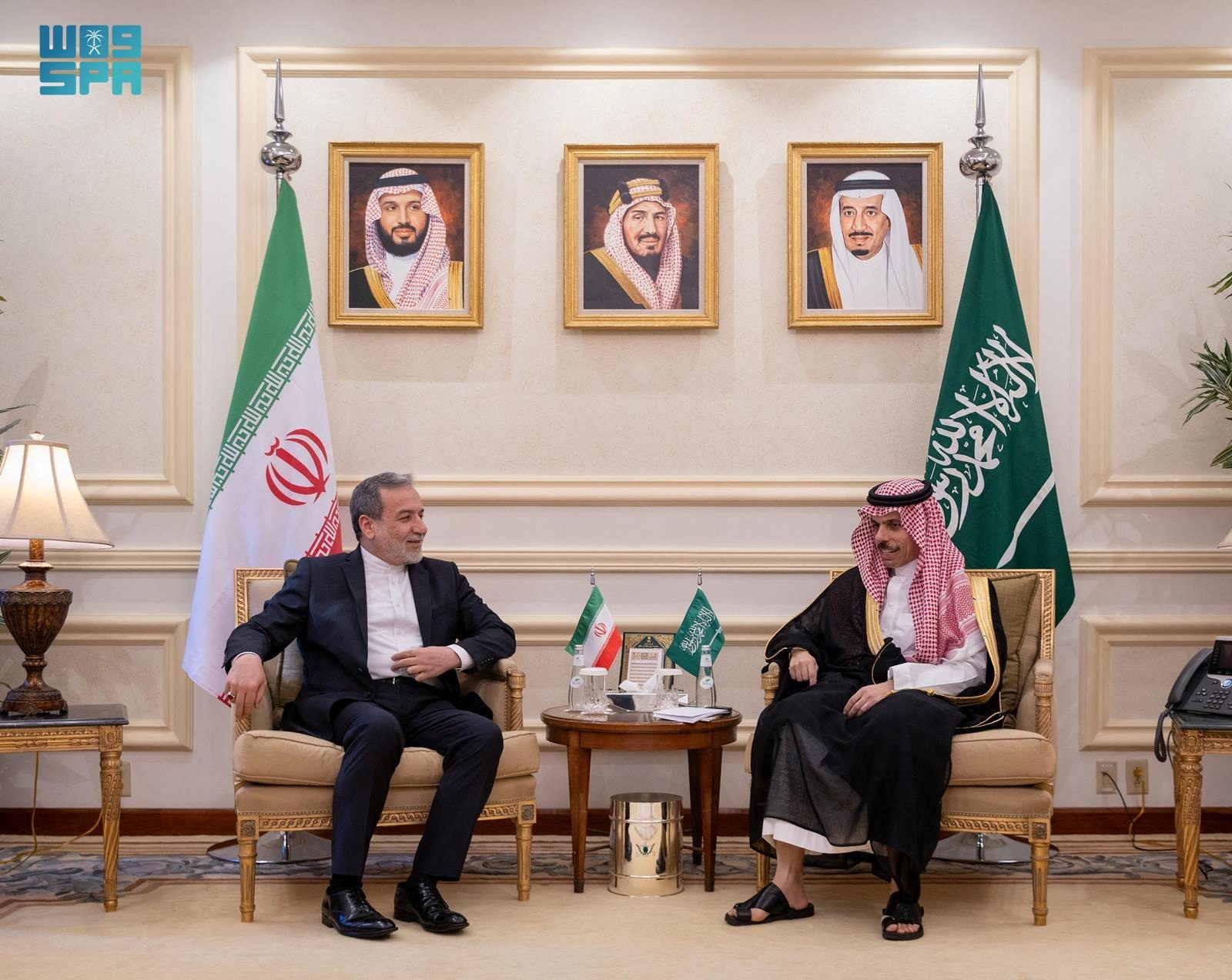
Riyadh isn't preparing for a military response to Iran. That’s a dated script for a play that’s already been cancelled. The Western press keeps trying to frame the Middle East through the lens of a 2015-era regional cold war because it’s easy to write and even easier to sell. It fits the narrative of a "preparing for the worst while hoping for the best."
It’s wrong.
The truth is far more cynical and significantly more complex. Saudi Arabia has stopped trying to "win" against Iran, and Iran has stopped trying to "overthrow" the House of Saud. What we are witnessing isn't a diplomatic breakthrough or a military pivot. It is a cynical, cold-blooded admission of limited capacity. Riyadh isn't arming for a showdown; it’s paying for a ceasefire to protect a balance sheet.
The Myth of the Military Pivot
Most analysts look at Saudi defense spending and see a preparation for war. They see the procurement of advanced missile defense systems and the flirtation with nuclear technology as a signal to Tehran.
They’re missing the point.
Riyadh’s military strategy isn't about winning a conflict with Iran; it’s about making a conflict too expensive for the Saudi Vision 2030 portfolio. You cannot build a global luxury tourism hub in the Neom desert if Houthi drones are hitting airports every Tuesday. The military posture is a high-cost insurance policy for a real estate play.
If the Saudis were actually preparing for a military response, you would see a shift in domestic mobilization and a hard-line stance on regional proxies. Instead, we see the opposite. We see the normalization of relations with Assad in Syria and a desperate attempt to exit the Yemen quagmire at any cost. That isn't the behavior of a state readying its sword. It’s the behavior of a state that realized its sword was chipped and its treasury was leaking.
Tehran’s Tactical Retreat
On the flip side, the idea that Iran is being "contained" by Saudi diplomacy is laughable. Iran is pivoting because it is suffocating under internal economic pressure and a demographic that no longer buys the revolutionary rhetoric.
Tehran didn't come to the table in Beijing because they suddenly respected Saudi sovereignty. They came because the "Axis of Resistance" is becoming too expensive to maintain at full volume. By shaking hands with Riyadh, Iran buys breathing room to manage its internal dissent without worrying about a Saudi-funded insurgency on its borders.
This isn't peace. It’s a managed standoff.
The False Promise of China as a Power Broker
The biggest "lazy consensus" in recent years is that China has replaced the United States as the regional referee. This is a fundamental misunderstanding of how Beijing operates.
China doesn't want to be the referee. They want to be the customer.
Beijing’s mediation wasn't an act of grand statesmanship; it was a supply chain optimization. They need Saudi oil and Iranian gas to flow without interruption. They have zero interest in providing security guarantees or enforcing the terms of the deal. If a missile flies tomorrow, China will issue a statement about "mutual restraint" and keep buying from whoever is still pumping.
Riyadh knows this. They aren't pivoting to China for security. They are using China as a threat to get the United States to lower the price of its own security guarantees. It’s a classic bazaar haggle, and Washington is falling for it.
The Economic Realities of the Detente
Let’s talk about the money.
Saudi Arabia needs a stable oil price to fund its transition away from oil. That sounds like a paradox, but it’s the reality of a rentier state trying to diversify. To achieve this, they need a predictable OPEC+ and a Middle East that doesn't look like a war zone to foreign direct investors.
Iran needs access to any market that isn't blocked by the U.S. Treasury.
The Cost of Conflict Table
| Factor | Saudi Risk | Iranian Risk |
|---|---|---|
| Infrastructure | High (Targeted desalination/energy plants) | Moderate (Already degraded) |
| FDI Impact | Catastrophic (Ends Vision 2030) | Negligible (Already near zero) |
| Domestic Stability | High (Dependence on social contract) | Extreme (Existential threat to regime) |
| Military Spend | Unsustainable at current tech burn rate | Low tech, high volume (Sustainable) |
The math is simple: Saudi Arabia has everything to lose. Iran has nothing left to lose.
In that equation, the party with the most to lose always pays for the peace. Riyadh is currently paying the "stability tax" through diplomatic concessions.
The Nuclear Elephant in the Room
Everyone asks: "Will Saudi Arabia get the bomb if Iran does?"
The wrong question.
The real question is: "Does Saudi Arabia even want the responsibility of a nuclear program?"
Nuclear weapons are an insurance policy for regimes that fear invasion. Riyadh doesn't fear a ground invasion from Iran. It fears a thousand small cuts—drones, cyberattacks, proxy militias, and internal subversion. You can’t nuke a Houthi drone cell in a Yemeni basement.
The Saudi nuclear ambition is a bargaining chip. It’s a way to force the U.S. into a formal defense treaty—the kind of "NATO-plus" agreement that Washington has spent decades avoiding. If Riyadh actually wanted a bomb, they wouldn't be talking about it in the Wall Street Journal. They would be buying it off the shelf from Pakistan.
Why the "Military Response" Narrative Fails
If you believe Riyadh is preparing for a military strike, you have to explain who is going to fly the planes.
The Saudi military, despite its shiny Western hardware, has proven in Yemen that it lacks the operational depth for a high-intensity conflict against a peer competitor like Iran. It relies heavily on foreign contractors for maintenance and intelligence.
A military response against Iran would require an American buy-in that doesn't exist. No matter who is in the White House, the appetite for a new Middle Eastern war is at an all-time low. Riyadh isn't stupid. They know that if they start a fire, they will be the ones left holding the garden hose while the U.S. watches from the porch.
The Intelligence Gap
We often assume that because both sides are talking, they are sharing information. They aren't.
The "detente" is a facade of high-level meetings covering a basement full of intensified espionage. Both sides are currently doubling down on cyber warfare and intelligence gathering. They’ve moved the battlefield from the deserts of Yemen to the servers of Riyadh and Tehran.
This is the "nuance" the competitor article missed. Diplomacy isn't the alternative to conflict; it’s the new theater for it. You don't shake hands to end the war; you shake hands to see how close you can get to your enemy’s throat without them flinching.
The Vision 2030 Trap
Crown Prince Mohammed bin Salman has tied his entire legitimacy to an economic transformation that is mathematically impossible in a high-tension environment.
This makes him vulnerable.
Iran knows that any small disruption—a "mysterious" explosion at a refinery, a maritime incident in the Strait of Hormuz—sends Saudi risk premiums through the roof. Riyadh’s "military preparation" is actually an attempt to build a "Fortress Saudi" that can withstand these irritants without derailing the IPO of every state-owned entity.
It’s a defensive crouch disguised as a power move.
Stop Asking if Diplomacy Will Work
It’s the wrong metric.
"Work" implies a return to a peaceful, cooperative regional order. That is never happening. The 1979 revolution changed the DNA of the region permanently.
Instead, ask if the detente is useful.
For Riyadh, it’s useful because it buys time to build cities in the sand.
For Tehran, it’s useful because it breaks the regional isolation and stunts the Abraham Accords' momentum.
For the West, it’s useful because it keeps oil flowing while they deal with Ukraine and the Pacific.
But don't mistake usefulness for sincerity.
The moment Vision 2030 either succeeds or fails, the Saudi need for this specific peace evaporates. The moment the Iranian regime feels secure at home, their need for a Saudi handshake disappears.
We aren't seeing a new era of Middle Eastern stability. We are seeing two exhausted boxers leaning on each other in the twelfth round so neither one falls over.
Anyone telling you they are "preparing for a military response" is selling you a 20th-century solution to a 21st-century problem of economic survival.
The war isn't coming. The war is already happening, and it’s being fought in the accounts of sovereign wealth funds and the code of regional power grids. If you’re looking for tanks at the border, you’re looking in the wrong direction.
Look at the bond yields. Look at the tourism targets. Look at the desperate silence of the proxy wars.
That’s where the real conflict lives.