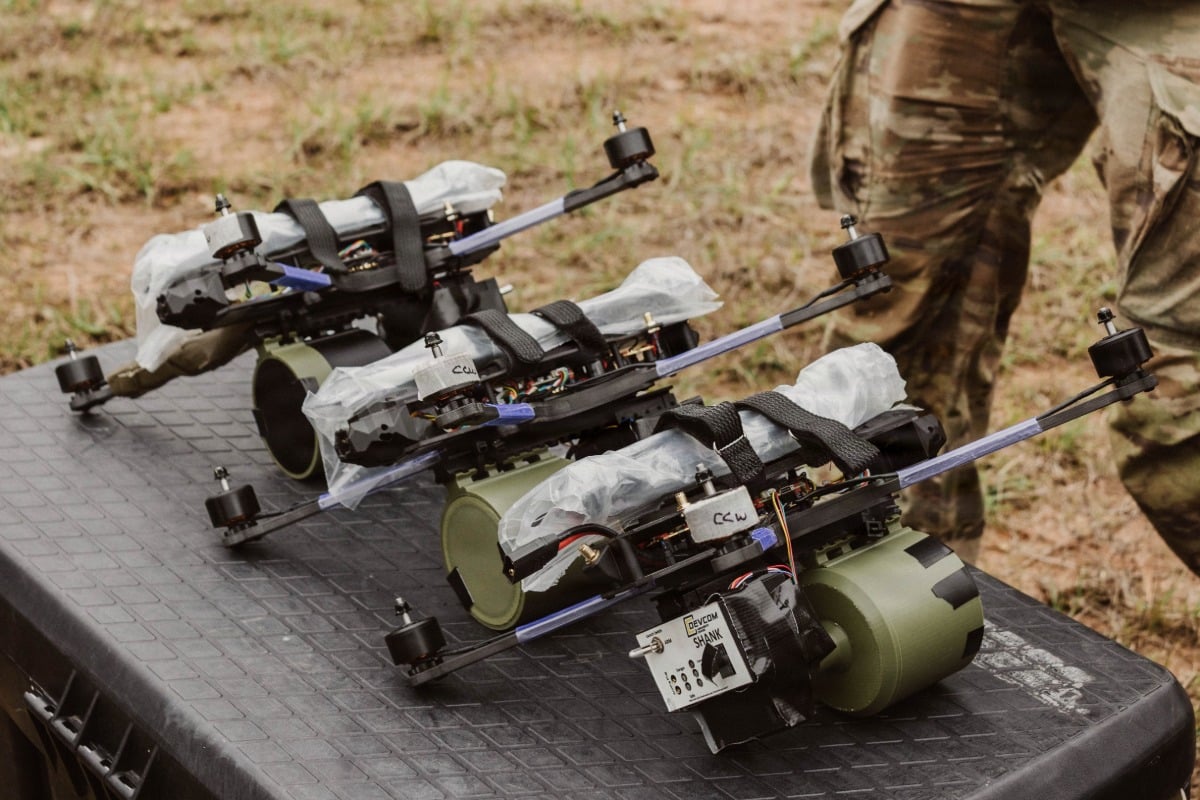
The Dual-Driver Dynamics of Defense Drone Scaling
The global demand for unmanned aerial systems (UAS) has shifted from low-volume, bespoke production toward high-throughput defense manufacturing. A Croatian drone manufacturer planning a major factory expansion illustrates a critical inflection point in the industry: scaling production requires transitioning from artisan assembly to integrated supply chain operations.
Expansion initiatives in the UAS sector are rarely constrained by design capability; they fail at the operational handoff between prototype validation and unit economics optimization. To evaluate the strategic viability of a manufacturing scale-up, three core operational vectors dictate unit throughput and cost variance. If you found value in this article, you might want to read: this related article.
                  ┌─────────────────────────────────────┐
                  │      UAS Scaling Framework          │
                  └──────────────────┬──────────────────┘
                                     │
         ┌───────────────────────────┼───────────────────────────┐
         ▼                           ▼                           ▼
┌─────────────────┐         ┌─────────────────┐         ┌─────────────────┐
│  Component      │         │ Factory         │         │ Sovereign       │
│  Localization   │         │ Throughput      │         │ Compliance      │
│  & Sourcing     │         │ Mechanics       │         │ & Regulatory    │
└─────────────────┘         └─────────────────┘         └─────────────────┘
The expansion strategy relies on three interdependent vectors:
- Component Localization: Reducing dependence on non-domestic suppliers for flight controllers, brushless DC motors, and secure telemetry links.
- Factory Throughput Mechanics: Optimizing floor layout, sub-assembly staging, and automated quality assurance to lower takt time.
- Sovereign Procurement Compliance: Meeting hardware security standards required by regional defense bodies and international procurement networks.
Supply Chain Risk in Tier-2 and Tier-3 Components
A primary failure mode in scaling UAS manufacturing is raw component exposure. While airframe fabrication (utilizing carbon fiber layup or vacuum thermoforming) can be expanded inside local facilities, critical electronics remain vulnerable to global supply bottlenecks. For another angle on this event, refer to the recent coverage from Reuters Business.
- Flight Control Hardware: Reliance on foreign microcontroller units (MCUs) exposes output schedules to international trade restrictions and foundry lead times.
- Propulsion Systems: High-power-to-weight brushless motors require neodymium magnets, binding the supply chain to specific raw material refining centers.
- Payload Sensors: Electro-optical/infrared (EO/IR) gimbals demand optical calibration systems that present significant manufacturing friction when scaling unit volumes.
A successful factory expansion hinges on securing dual-sourced Tier-3 components or establishing regional fabrication partnerships. Companies that ignore component vulnerabilities simply build larger assembly halls that sit idle waiting for microcontrollers.
Throughput Optimization and Modern Floor Mechanics
Transitioning from small batch production to industrial-scale output requires restructuring physical assembly operations. UAS manufacturing differs from standard automotive assembly due to payload variability, rigorous RF testing needs, and individual flight trim requirements.
Reducing Takt Time Across Sub-Assemblies
Factory output $Q$ over a operational period $T$ is governed by the structural throughput rate $R$ and total bottleneck delay $D$:
$$Q = \frac{T \cdot R}{1 + (D \cdot R)}$$
To increase total throughput without exponential capital expenditure, manufacturers must systematically reduce $D$ through modular sub-assembly lines running parallel to the main airframe integration track.
       [ Avionics Pre-Assembly ] ────┐
                                     │
       [ Propulsion Integration ] ───┼───> [ Final Integration ] ───> [ RF Calibration ] ───> [ Flight Trim ]
                                     │
       [ Payload Staging ] ──────────┘
- Pre-Assembly Testing: Avionics stacks, ESCs (electronic speed controllers), and wiring harnesses must undergo automated hardware-in-the-loop (HIL) burn-in testing prior to airframe integration. Defective components caught post-airframe integration increase rework time by an estimated 300% to 500%.
- Standardized Mounting Interfaces: Implementing uniform mechanical interfaces allows the same assembly line to handle multiple vehicle configurations (e.g., reconnaissance vs. payload delivery) without retooling line fixtures.
- Automated Optical Inspection (AOI): Replacing manual solder and joint inspections with computer-vision AOI stations cuts airframe QC cycle time while establishing a traceable digital history for each unit serial number.
Strategic Capital Expenditure Allocation
Capital expenditures (CapEx) in new production facilities must prioritize process capability over total floor square footage.
| CapEx Investment Area | Direct Impact on Operational Output | Risk Vector |
|---|---|---|
| Automated Composite Layup | Reduces labor cost per airframe; normalizes weight tolerances across units. | High initial capital lockup; requires consistent resin quality. |
| Anechoic RF Testing Chambers | Eliminates external interference delays during telemetry calibration. | Facility footprint requirements; high calibration overhead. |
| In-House CNC & Rapid Tooling | Shortens iteration cycles for custom payload mounts and fixtures. | Higher per-unit maintenance cost compared to contract machining. |
| Automated HIL Testing Rigs | Catches component failures early, protecting throughput metrics. | Requires custom software integration for distinct drone revisions. |
Regulatory Realignment and Defense Market Entry
Expanding physical capacity without securing regulatory clearance creates severe inventory lockup. Sovereign procurement programs enforce strict criteria regarding component provenance, cybersecurity, and electromagnetic compatibility.
Navigating Defense Procurement Metrics
Defense buyers require rigorous operational compliance and long-term maintenance infrastructure. European defense funds and regional buyers prioritize three operational criteria:
- NDAA / EU-Compliant Supply Chains: Complete exclusion of restricted microchips or telemetry radios from foreign non-aligned vendors.
- Traceable Bill of Materials (BOM): Real-time inventory software that tags every chip, motor, and carbon sheet to specific batch sources for post-incident audits.
- Low-Latency Support Infrastructure: Field-replaceable unit (FRU) architectures that permit field technicians to swap arms, payloads, or communications boards without returning the whole unit to the central factory.
A manufacturing site expansion that fails to integrate these compliance requirements risks producing inventory that is structurally ineligible for government or institutional contracts.
Operational Execution Strategy
Scale-up initiatives in UAS manufacturing must focus capital deployment where it directly expands throughput or lowers failure rates on the assembly line.
- Decouple Avionics Assembly from Airframe Construction: Establish an independent, clean-room avionics integration line that feeds pre-tested, pre-flashed core electronics modules directly to the main assembly track.
- Implement Modular Tooling Stations: Avoid single-use assembly jigs. Invest in reconfigurable workbenches that accommodate airframe variations via fast-change software profiles and adjustable fixtures.
- Build Strategic Raw Material Buffers: Maintain a minimum 90-day buffer of hard-to-source Tier-3 components (MCUs, RF transceivers, high-density batteries) to insulate the primary production line from macro-economic supply shocks.
- Automate Quality Control Tracking: Link every torque wrench, HIL test rig, and optical inspection system directly to an enterprise system to build an immutable manufacturing record for each hull produced.
Focusing factory expansion on operational mechanisms, strict supply chain audits, and modular floor architecture ensures increased physical footprint translates directly into scalable unit delivery.
.png)