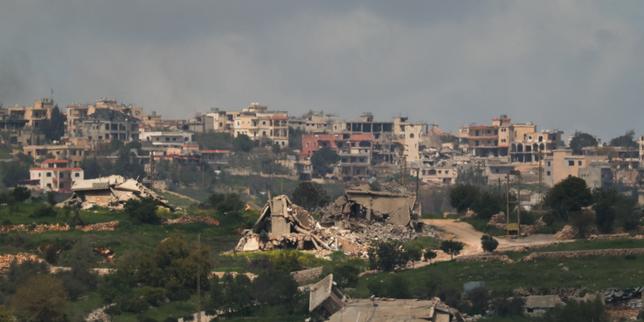
The tactical objective in Bint Jbeil is no longer a matter of military speculation. Satellite imagery and ground-level footage confirm a systematic leveling of the urban fabric that goes far beyond traditional urban warfare. Israeli forces are not merely clearing buildings to flush out Hezbollah cells; they are executing a deliberate engineering project to create a permanent, uninhabitable buffer. By reducing entire neighborhoods to rubble, the Israel Defense Forces (IDF) are ensuring that even if a diplomatic ceasefire is signed tomorrow, there will be nothing for the civilian population to return to in the immediate future. This is the "grey zone" of modern conflict—a physical erasure of the borderland designed to trade Lebanese sovereignty for Israeli security.
The Engineering of Displacement
In previous conflicts, the goal was typically "search and destroy." You find the rocket launcher, you neutralize the threat, and you move on. Today, the doctrine has shifted toward "deny and demolish." Bint Jbeil, historically a symbol of Lebanese resistance and a significant cultural hub in the south, is being treated as a strategic obstacle.
The methodology is methodical. Units move through sectors with heavy machinery and controlled demolitions, targeting not just suspected military infrastructure but the logistical spine of the town. This includes bakeries, water towers, and schools. When you remove the ability of a town to sustain life, you remove the town itself. The IDF argues this is necessary because Hezbollah has spent two decades weaving its operational capacity into the civilian architecture. While that claim carries historical weight, the scale of the current destruction suggests a broader goal: the creation of a "killing zone" where any movement can be identified and neutralized from across the border without the need for constant ground presence.
The Myth of the Temporary Buffer
History is littered with "temporary" security zones that became decades-long occupations or permanent scars on the geography. The 1978-2000 occupation of South Lebanon serves as a grim precedent. However, the 2026 iteration is different because of the technology involved. Sensors, AI-driven kinetic platforms, and constant drone surveillance mean the IDF does not need to keep thousands of troops stationed in Lebanese mud. They only need a clear line of sight.
To get that line of sight, the topography is being forcibly altered. Orchards that provided cover are being bulldozed. Traditional stone houses that stood for a century are now piles of grey dust. This creates a vacuum. A buffer zone is only effective if it remains empty, and the current level of destruction in Bint Jbeil is a message to the Lebanese state and the international community that the "Status Quo Ante" is dead. There is no going back to the pre-October 7th arrangement where Hezbollah sat within spitting distance of Israeli kibbutzim.
The Hezbollah Calculus and the Failed Deterrent
Hezbollah’s leadership has long relied on the "Equation of Deterrence"—the idea that any significant Israeli incursion would be met with such a punishing barrage of fire that the cost would be unbearable. That equation has been solved, and the answer was not what the group expected.
Despite their deep tunnel networks and localized knowledge of the terrain, the group is struggling against a high-intensity maneuver that prioritizes demolition over engagement. Hezbollah fighters are often forced to choose between staying in a building that is about to be brought down by a D9 armored bulldozer or retreating further north. Every foot they retreat allows the buffer to expand.
The irony is that by entrenching themselves so deeply in towns like Bint Jbeil, Hezbollah provided the pretext for the town's annihilation. The IDF's legal justification hinges on the "military necessity" of clearing civilian structures used for combat. It is a brutal, circular logic. Hezbollah uses the houses because they are there; Israel destroys the houses because Hezbollah is in them. The result is a ghost map.
The Economic Ghost in the Machine
We often talk about war in terms of casualties and territory, but the economic displacement is what will define the next decade for Lebanon. The south is the country's tobacco and olive heartland. Bint Jbeil was a commercial artery for the region. By turning this area into a wasteland, Israel is effectively severing a limb of the already fragile Lebanese economy.
The financial cost to rebuild what has been lost in the last few months exceeds billions of dollars—money that the Lebanese central bank does not have and that international donors are increasingly hesitant to provide without massive political concessions. This creates a secondary buffer: a "poverty buffer." If people cannot work the land or open shops, they will not stay. They move to the overcrowded suburbs of Beirut, further destabilizing the capital and shifting the country's demographic balance.
The Failure of UNIFIL and International Law
The United Nations Interim Force in Lebanon (UNIFIL) has become a spectator to its own irrelevance. Tasked with monitoring a border that no longer exists in any functional sense, peacekeepers find themselves trapped between an advancing military machine and a non-state actor that ignores their presence.
International law stipulates that destruction of property not justified by military necessity is a war crime. However, in the ruins of Bint Jbeil, "necessity" is being redefined in real-time. If a commander decides that a row of houses obscures the view of a potential ATGM (Anti-Tank Guided Missile) site, those houses are gone. The burden of proof has shifted. It is no longer about proving a house is a threat, but proving it is not. In a high-speed conflict, that proof never arrives in time.
Tactical Reality vs. Strategic Failure
While Israel is winning the tactical battle of the buffer zone, it may be losing the strategic war. A wasteland is easy to monitor, but it is impossible to govern. By creating a vacuum in the south, Israel is not necessarily creating security; it is creating a breeding ground for the next generation of radicalization.
The children who watched their family homes in Bint Jbeil disappear in a cloud of dynamite smoke are the recruits of 2035. Security based purely on scorched earth is a depreciating asset. It works today, and perhaps tomorrow, but it creates a long-term deficit of stability that no amount of concrete or barbed wire can fix.
The military reality is that the border has moved. It is no longer the Blue Line drawn by the UN. The new border is the edge of the rubble. It is a jagged, dusty frontier that marks the end of Lebanese civilian life and the beginning of a high-tech no-man's land.
The Logistics of Erasure
The scale of the equipment moving into the south is staggering. This isn't just about Merkava tanks. It's about the "heavy cats"—the D9 bulldozers that have become the most feared weapon in the Israeli arsenal. These machines work in tandem with demolition teams that map out the structural integrity of city blocks to ensure that when a charge is set, the collapse is total.
This isn't an accidental byproduct of war. It is a logistical feat. The amount of explosives required to level a town the size of Bint Jbeil is significant, and the coordination required to do so while under fire suggests a high-level command priority. The IDF is essentially "de-urbanizing" the frontier.
The Silence of Beirut
In Beirut, the political class is paralyzed. There is a profound sense of helplessness as the southern border is reshaped. The Lebanese Armed Forces (LAF) remain on the sidelines, lacking the air defense or the heavy armor to challenge the Israeli advance, and lacking the political mandate to confront Hezbollah.
This leaves the civilians of the south as the ultimate losers. They are pawns in a game between an Iranian-backed proxy and a high-tech regional superpower. For the resident of Bint Jbeil, the nuance of "limited operations" or "security corridors" is meaningless. Their reality is the loss of a multi-generational heritage, replaced by a strategic void.
The international community continues to call for a "return to 1701," the UN resolution that ended the 2006 war. But 1701 assumed a south that was still intact, a place where people lived and worked. You cannot implement a 20-year-old resolution on a landscape that has been physically deleted. The map has changed, and the diplomats are still reading the old one.
Stop looking for the "end" of the operation. The operation is the end of the town.