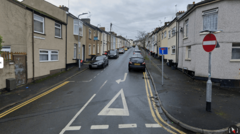
The rain in South Wales doesn't just fall. It bleeds into the stone, turning the grey terraces of Newport into a heavy, dark mirror of the sky. On a standard afternoon, the noise of the town is predictable. Routine. The rumble of a diesel engine idling near the bus station, the wet slap of footsteps on pavement, the distant, muffled chatter from a half-empty pub.
Then, the air shatters.
Two sharp, metallic cracks split the damp atmosphere. They are sounds that do not belong to the rhythm of daily life. For a fraction of a second, the brain tries to reject them. A car backfiring. A firecracker left over from a forgotten weekend. But the sudden, violent absence of all other ambient noise tells a different story.
Someone has just been shot.
To understand what happened on that ordinary pavement, you have to move past the sterile language of the evening news brief. The official reports will tell you that a man believed to be carrying a crossbow was shot by police. They will mention words like "incident," "containment," and "non-life-threatening injuries." They present the world as a series of neat chess moves. A threat appeared, an action was taken, the board was cleared.
But reality is messy. It smells of wet asphalt, cordite, and sudden, blinding panic.
The Anatomy of a Second
Imagine standing at a window overlooking the road. It is 3:00 PM. You are thinking about what to make for dinner, or whether you remembered to pay the electricity bill. Down on the street, a figure moves with an awkward, heavy posture. In his hands is an object that looks entirely out of place in a modern town centre. A crossbow is an archaic weapon, a machine of tension and wood and steel designed centuries ago for silent execution. Seeing one in the wild, stripped of a historical reenactment or a hunting context, triggers an immediate, primal alarm.
It is a visual paradox that forces a terrible choice upon the people paid to keep the peace.
When armed officers arrive, the world shrinks to a pinpoint. The training takes over, but training cannot silence the adrenaline coursing through a human heart. The police officers behind those shields are not machines. They are mothers, fathers, sons, and daughters who woke up that morning, drank their coffee, and drove to work. Now, they are staring down the barrel of a situation where a single mistake means someone dies.
Consider the pressure of that specific pocket of time. The gap between arriving on the scene and pulling a trigger is often measured in heartbeats.
The public expects perfection. We demand that our authorities act with the precision of a surgeon and the foresight of a prophet. Yet, the information they possess in that critical moment is always fractured. Is the weapon loaded? Is the man experiencing a profound mental health crisis, or is he driven by a deliberate, malicious intent? In the space of three seconds, an officer must calculate the trajectory of a bolt, the distance to the nearest bystander, and the lethal potential of the threat.
When the trigger is pulled, it isn't a victory. It is a failure of every safety net that was supposed to keep that man from standing on that corner in the first place.
The Ripple on the Pavement
The immediate aftermath of a police shooting is a strange, clinical theater. The chaos evaporates, replaced by a rigid, bureaucratic choreography. Blue plastic tape stretches across the road, fluttering in the wind like a makeshift boundary between the normal world and a crime scene. Forensic investigators in white boiler suits move like ghosts across the tarmac, photographing every scrap of debris, every footprint, every drop of blood.
The man who was shot is hurried away in the back of an ambulance, blue lights painting the brick walls of Newport in rhythmic flashes. He survives. The physical wounds will heal, stitched together by NHS surgeons in a sterile operating theatre.
But the neighborhood stays wounded for much longer.
The true cost of these events is found in the invisible weight they leave behind. Neighbors stand behind their curtains, watching the flashing lights reflect in the puddles. There is a quiet, creeping realization that the safety we take for granted is incredibly fragile. A street you walk down every single day to buy milk can turn into a tactical operations zone in the blink of an eye.
The narrative we are often fed after these events is simple: the bad guy was stopped, the public is safe. It is a comforting lie designed to let us sleep at night. The truth is far more unsettling. Every time an officer fires a weapon on a British street, a tremor goes through the community. Trust is questioned. Fear is localized. The collective anxiety of a town ticks upward, just a fraction, because the illusion of absolute security has been pierced.
The Unseen Burden
We rarely talk about the days that follow the silence. We don't talk about the officer who went home that night, sat on the edge of their bed in the dark, and tried to wash the smell of gunpowder out of their skin. We don't talk about the family of the man with the crossbow, who are left to piece together how a life derailed so spectacularly on a Tuesday afternoon.
The dry facts of a news report can never capture the heavy, lingering sadness of a town processing violence. They cannot quantify the collective intake of breath when a community realizes how close it came to a tragedy that would define it for decades.
The rain continues to fall in Newport, washing the pavement clean, erasing the physical markers of what transpired. The blue tape will eventually be taken down. Cars will drive over the same patch of road, their drivers completely unaware of the precise spot where a life was altered forever. But for those who heard the shots, the silence that followed will always be a little too loud.

.webp)