The Baltic wind does not care about geopolitics. It sweeps across the limestone cliffs of Estonia’s Saaremaa Island, smelling of damp pine needles, salt, and cold peat. For centuries, the biggest disruption to a quiet Tuesday afternoon here was a shift in the weather or a stubborn fishing boat engine.
Then came the rip.
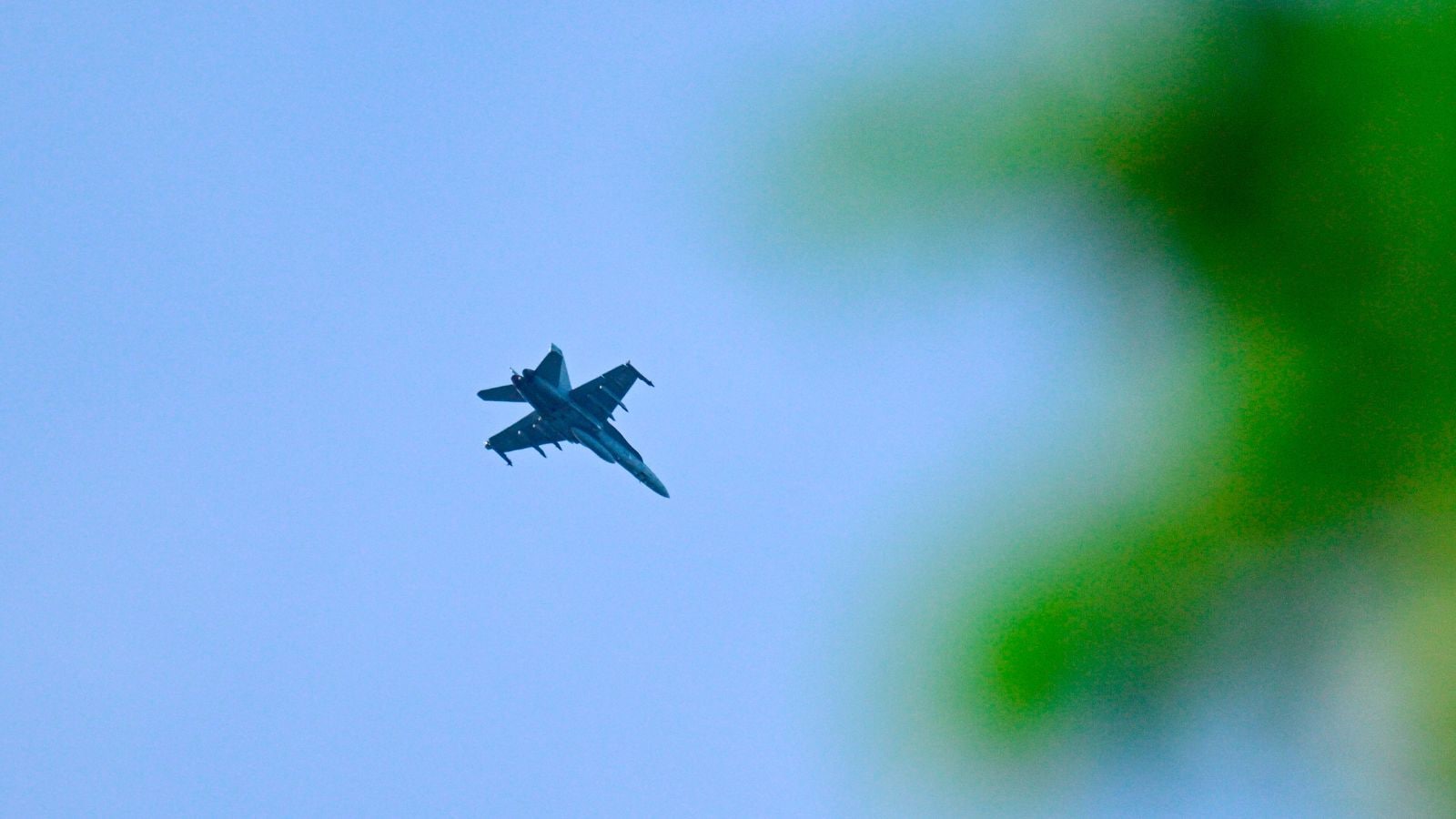
It is a sound that does not belong to nature. It is the tearing-canvas shriek of two Eurofighter Typhoon jets cutting through the clouds at Mach 1.5. For a split second, the air vibrates in your chest. The windowpanes rattle in their wooden frames. And then, a dull thump echoes from the gray horizon toward the sea.
A shadow falls out of the sky. Metal twists, electronics fry, and debris plunges into the freezing waters.
The wires will tell you a sterile story. They will report that a NATO quick-reaction aircraft, scrambled from an airbase in Spain or Germany on a routine policing mission, intercepted and neutralized an unmanned aerial vehicle (UAV). They will note the coordinates. They will state that the drone was of Ukrainian origin, likely gone rogue due to a catastrophic guidance failure. They will call it an "incident."
But an incident is what happens when you spill coffee on a rug. This is something else entirely. This is the friction of a continent-wide firestorm bleeding across its borders, whispered in the terrifyingly quiet language of automated warfare.
The Invisible Threads of the Borderland
To understand what happened in the sky over Estonia, you have to understand what it feels like to live in the shadow of a giant.
Let us construct a lens to look through. Imagine a woman named Maria. She is a hypothetical schoolteacher in Kuressaare, the main town on Saaremaa Island, but she represents thousands of real people who look at the horizon every day. Maria’s grandfather remembers when the Soviet tanks rolled in. Her father remembers when they left. She grew up believing that the sky belonged to the birds and the occasional low-flying propeller plane delivering mail.
Lately, the sky has grown crowded with ghosts.
When a drone takes off from a launchpad deep inside Ukraine, its mission is usually simple: strike a target, disrupt a supply line, or map an enemy position. The machine obeys code. It calculates GPS coordinates, accounts for wind resistance, and burns through its fuel cell with mathematical precision.
But code is fragile.
A single Russian electronic warfare jammer operating hundreds of miles away emits a powerful radio frequency pulse. The drone's internal compass spins wildly. It loses its connection to the satellite constellation hovering in low Earth orbit. Stripped of its digital tether, the machine does not stop. It goes blind. It enters a default "fail-safe" mode, which is often anything but safe. It flies straight, driven by a stubborn, dead-reckoning algorithm, crossing borders it cannot see, entering airspace it was never meant to touch.
By the time it reaches Estonia, the drone is no longer a weapon of war. It is a flying ghost ship.
The Scramble
Inside the radar rooms at Ämari Air Base on the Estonian mainland, the world exists as a series of glowing green vectors. Air traffic controllers watch the commercial airliners—the flights from Helsinki to Riga, the cargo carriers heading west—moving like clockwork.
Then, a blit appears. It has no transponder signal. It is not responding to radio hails. It is small, fast, and moving on a trajectory that cuts directly through civil aviation corridors.
This is where the clock starts ticking.
NATO’s Baltic Air Policing mission is not a theoretical exercise. It is a continuous, high-stakes game of tag played at 30,000 feet. When the alarm sounds, the pilots do not have time to debate international law or the nuances of the conflict to the south. They sprint across the tarmac, their heavy flight suits rustling, their boots pounding against the concrete.
Within five minutes, the Eurofighters are airborne.
The pilots are thrust into a bizarre, high-tech detective story. They must visually identify an object that might be no larger than a dining room table, moving at hundreds of miles per hour through the soup-thick Baltic clouds. If they misidentify it, the consequences are catastrophic. Shoot down a civilian hobbyist, and you create a domestic tragedy. Shoot down a stray Russian reconnaissance asset, and you risk triggering a direct military confrontation between nuclear powers.
Through the targeting pod of the lead Eurofighter, the pilot finally sees it. The silhouette is unmistakable. It is a medium-range Ukrainian reconnaissance drone. It is tumbling slightly, its engine sputtering, burning through its final liters of fuel.
It is a runaway train in a crowded sky.
The decision is made not with anger, but with a cold, professional detachment. A short burst from the aircraft’s automatic cannon, or the lock-on click of an infrared missile. A flash of fire, a cloud of smoke, and the threat is erased.
The Cost of the Stray Spark
Why does a single downed drone over a quiet Baltic island matter so much? Because it exposes the myth of isolation.
We like to think of modern conflicts as contained. We watch the maps on our screens, neatly color-coded with red and blue lines, believing that the violence stops where the marker ends. But technology does not respect cartography. The systems we build to fight wars are increasingly autonomous, increasingly reliant on the invisible spectrum of radio waves and software logic. When those systems break, they break outward.
Consider the sheer density of the airspace over Northern Europe. Every day, thousands of civilians trust their lives to the predictability of flight paths. A stray drone, oblivious to air traffic control, is a flying piece of shrapnel in a room full of glass.
More profoundly, the incident highlights the incredible strain placed on the frontline states of the NATO alliance. Estonia, Latvia, and Lithuania do not have the luxury of distance. Their strategic depth is measured in minutes, not miles. Every time a rogue piece of military hardware drifts across their borders, a whole apparatus of defense must spin up, spending millions of dollars, burning through fuel, and stretching the nerves of human operators to the tearing point.
The real danger is not the drone itself. It is the exhaustion. It is the normalization of the absurd.
The New Normal
Walk through the streets of Kuressaare a few days after the shootdown, and you will find that life has seemingly returned to its rhythm. The cafes serve smoked fish, the tourists take photos of the medieval castle, and the sea laps gently against the shore.
But if you look closely, you notice the subtle shifts. People look up a little longer when they hear a rumble in the distance. They check the news tickers on their phones with a slight, involuntary tension in their shoulders.
The world has grown smaller, and the war has grown louder, even when it is fought by machines that cannot feel the cold Baltic wind.
The pieces of the Ukrainian drone now sit at the bottom of the sea, rusting in the dark, silent water. They are a monument to a new kind of friction—the unpredictable, messy, and deeply human fallout of an automated age. We are no longer just onlookers watching a distant tragedy; we are characters living on the edge of the script, waiting to see where the next ghost will fall.