The coffee in the green room always tastes slightly of burnt ambition. It sits in heavy ceramic mugs, thick and dark, while monitors on the walls hum with a low, constant vibration. Outside those doors, the machinery of modern politics grinds on, loud and unyielding. Inside, for a few fleeting minutes before the red light clicks on, there is only the quiet rustle of paper and the heavy weight of numbers that refuse to bend.
Numbers do not care about rallies. They do not care about the roar of ten thousand people packed into an airplane hangar, the blinding flash of camera phones, or the rhythmic chanting that shakes the rafters. Numbers live in cold basements, spread across spreadsheets, harvested from random digit dialing and weighted models. And sometimes, the person who has to read those numbers out loud is someone you never expected.
Data has a way of finding everyone in the end.
Consider what happens when a figure known for an easy rapport with the most powerful man in American politics looks down at a clipboard and realizes the script has changed. It is a specific kind of silence. The kind that settles over a television studio when the control room counts backward from five. Four. Three. Two. One.
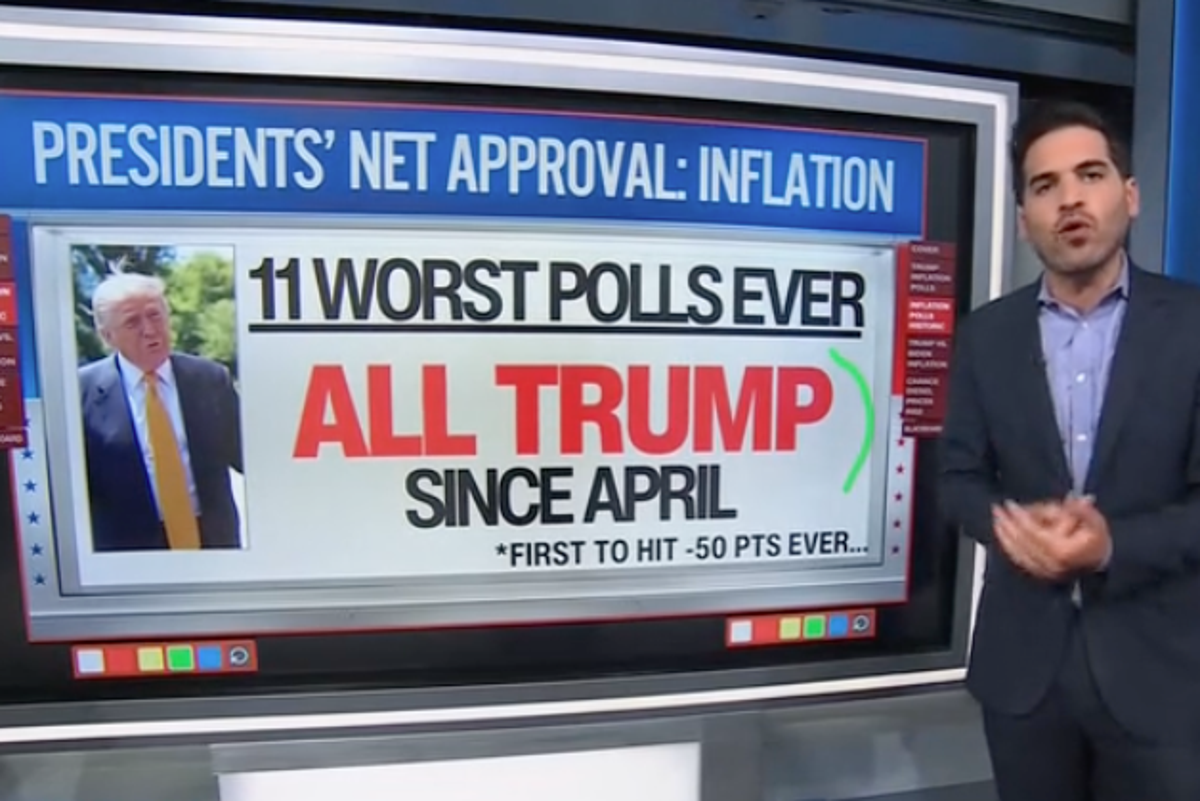
Harry Enten stood there. He is the kind of analyst who treats statistics like fragile birds, holding them up with a curious tilt of his head, gently pointing out their wingspan before showing you where they are bleeding. He is not a brawler. He does not yell. He carries the anxious energy of a junior high mathlete who just realized he solved the hardest problem on the board, but the answer spells disaster.
The television screen behind him glowed with a stark blue graphic. The words were simple, stripped of partisan spin or rhetorical flourish. They were the kind of cold, hard metrics that keep campaign managers awake at three in the morning, staring at the ceiling fan.
Donald Trump watches cable news. This is not a secret; it is one of the most thoroughly documented routines in modern history. The television is an ambient soundtrack to his days, a running commentary on his worldview, a mirror that has long reflected his grievances and his triumphs. For years, certain voices on that network have served as familiar touchstones—faces that understood the rhythm of his movement, analysts who charted his ascents with a mix of fascination and professional detachment.
So when the favorite son of the ratings block puts on his glasses, looks directly into the lens, and lays out a statistical reality that reads like an alarm bell, the echo reaches Mar-a-Lago before the commercial break even starts.
The polling average did not drop by a margin of error. It pointed to a structural vulnerability that cuts straight to the heart of the campaign’s strategy. Enten broke down the numbers with his characteristic rapid-fire delivery, hands moving in small, precise circles, trying to make sense of a shift among key voting blocks that usually form the bedrock of a conservative victory.
"Worst-ever" is a heavy phrase. In the hyperventilating ecosystem of twenty-four-hour news, hyperbole is the native tongue. Every interview is historic, every vote is existential, every poll is a landslide. But when a data analyst who has spent years mapping out the quirks of the electorate uses words like historic lows in a specific demographic, the noise drops away.
Think about the single mother working two jobs in the suburbs of a swing state. She does not care about the daily Twitter wars. She cares about the price of eggs, the insurance premium that went up again last month, and whether her oldest child is going to get squeezed out of the state university system. She sits on her couch after the kids are finally asleep, scrolling through her phone, half-listening to the cable segment playing in the background.
She is the ghost in the machine. Pollsters call her a moving target. Campaigns call her a must-win. She just calls it Tuesday.
When the numbers shift among those voters, the entire architectural map of the election has to be redrawn. For months, the narrative had been comfortable. It relied on historical precedents, on incumbent fatigue, on the deep-seated frustrations of an electorate that felt left behind by the broader economic recovery. The assumption was simple: people remember how things felt four years ago, and they want that feeling back.
Memory, however, is a selective editor. It glosses over the chaos and highlights the stability. But data measures the present tense, and the present tense is messy.
The studio lights hummed. The teleprompter scrolled. Enten pointed to a bar chart that showed a widening gap among voters who typically split the difference. These are the people who do not wear hats, who do not put bumper stickers on their cars, and who view politics with a weary cynicism that borders on exhaustion. They are the ones who decide elections in the quietest, most unglamorous counties in America.
And right now, those counties are sending up smoke signals.
The immediate reaction in the political bubble is predictable. Spin rooms spin. Spokespeople issue statements about skewed samples and hidden momentum. The base rallies, circling the wagons tighter, convincing themselves that the media is once again missing the real story on the ground.
Maybe they are. Polling has had a rough decade. It missed the populist wave of twenty-sixteen, it misjudged the midterms, and it constantly struggles to capture the hidden energy of anti-establishment movements. Every campaign manager worth their salt keeps a mental Rolodex of past polling failures to comfort themselves when the numbers turn south.
Yet there is a difference between a methodological quirk and a seismic tremor.
When the trend lines move consistently across multiple independent pollsters, across different methodologies, pointing in the exact same direction, ignoring them stops being a strategy and starts to look like superstition. It is the equivalent of hearing a strange rattling sound in your car's engine, turning up the radio, and hoping the noise will get bored and go away.
The human element here is often lost in the percentage points. Behind every drop in a demographic subgroup are thousands of private conversations around kitchen tables. It is a grandfather wondering if his grandchildren will ever afford a home. It is a small business owner calculating whether to risk expanding or just hold on until retirement. It is a young voter looking at the choices on the ballot and feeling entirely unrepresented by either side.
These are not ideological crusaders. They are weather vanes, shifting with every gust of economic reality and cultural anxiety.
When a commentator whom the former president regularly praises delivers that kind of news, it punctures the echo chamber in a way that hostile criticism never can. You can easily dismiss an attack from a network you despise. You chalk it up to bias, to the establishment protecting its own, to the inevitable friction of the arena.
It is much harder when the bad news comes from inside the house.
The segment ended with the usual quick sign-off, the anchor tossing to a commercial break for insurance or luxury cars, wiping the seriousness from their face in a fraction of a second to transition smoothly into a smiling pitch for local car dealerships. The machinery moves on. The studio resets for the next hour of shouting and analysis.
But the data remains. It sits out there in the digital ether, downloaded onto thousands of laptops, analyzed in windowless war rooms in Washington and Palm Beach.
Campaigns are won and lost in the margins where reality finally catches up to the narrative. The numbers shown on that screen did not predict the future; they simply illuminated the present. And the present is a mirror that demands to be looked into, no matter how harsh the reflection might be.
The coffee in the green room has gone cold. The monitors flash silently, waiting for the next cycle, the next poll, the next moment when the invisible weight of numbers breaks through the noise of the world.