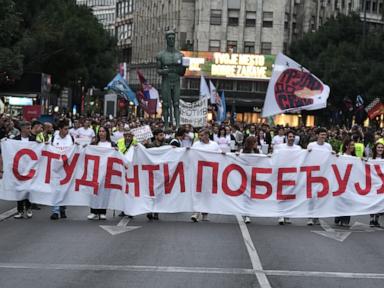
Western journalists love a clean story. Young idealists march in the streets of Belgrade, get tired of shouting at barricades, form a formal political slate, and prepare to topple a entrenched strongman at the ballot box. It reads like a screenplay. It feels like progress.
It is also a complete misreading of how hybrid regimes operate in the Balkans.
If you look at the standard coverage of Serbia's protesting youth formally entering the electoral race ahead of next month's vote, you will find the exact same lazy consensus repeated across every major wire service. The narrative assumes that converting street energy into formal party politics is the natural, mature next step for an opposition movement. Pundits treat the ballot box as an equalizer—a neutral arena where moral outrage finally translates into parliamentary seats.
Anyone who has actually watched Aleksandar Vucic and the Serbian Progressive Party (SNS) dismantle challengers over the past decade knows better. Stepping off the streets and onto the ballot under current conditions isn't an escalation of the protest movement. It is a surrender of their only real source of power.
The Structural Trap of "Playing by the Rules"
When a decentralized protest movement formalizes into an electoral ticket, it trades asymmetric advantage for symmetric weakness.
In the streets, a youth-led mobilization is unpredictable. It has no single headquarters to raid, no central bank account to freeze, and no formal leadership slate for state-aligned tabloids to smear with fabricated scandals. The state apparatus struggles to fight a hydra.
The moment those same organizers register a formal electoral list, gather signatures, and appoint spokespeople, they hand the regime a stationary target.
In political science, scholars like Steven Levitsky and Lucan Way defined this exact dynamic in their foundational work on competitive authoritarianism. In a competitive authoritarian system, democratic institutions exist—elections are held regularly, opposition parties are legal, and ballots are counted—but the playing field is so heavily tilted in favor of the incumbent that the contest is fundamentally unfair. The regime wants the opposition to enter the electoral arena because the arena is rigged from the foundation up.
I have watched opposition coalitions across Southeastern Europe fall into this exact trap cycle after cycle. They mistake international applause for domestic leverage. Diplomats in Brussels and Washington always urge protesters to "channel their grievances through democratic institutions." Why? Because street protests create instability on Europe's periphery, whereas an election—even a flawed one—gives foreign chancelleries a neat, procedural box to check.
By entering the race a month before the vote, Serbia’s student and youth leaders are validating an electoral framework they spent months calling illegitimate.
The Math the Pundits Ignore
Let's strip away the romanticism and look at the cold mechanics of Serbian elections. To beat an incumbent machine like the SNS, an opposition bloc must overcome four distinct structural barriers simultaneously:
- Media Asymmetry: National frequency television channels—the primary information source for voters outside major urban centers—operate as an extension of the ruling party. A youth list formed weeks before an election will get almost zero airtime, except when pro-government outlets run hit pieces framing them as naive pawns of foreign intelligence services or radical anarchists.
- Clientelist Networks: The SNS does not rely merely on ideological voters. It relies on a vast, disciplined patronage network where public sector jobs, municipal contracts, and social assistance are explicitly tied to electoral turnout and verified votes. Youth movements have passion; the incumbent has payrolls.
- Voter Roll Inflation and Migration: The persistent allegations of phantom voters and organized voter transport from neighboring regions—issues documented extensively by international observers like the OSCE's Office for Democratic Institutions and Human Rights (ODIHR)—mean the baseline threshold for an opposition victory is artificially inflated.
- Vote Fragmentation: Serbia’s electoral system uses proportional representation with a 3% threshold. When a new youth slate enters the race at the eleventh hour, where do their votes come from? They do not pull disillusioned pensioners away from Vucic. They cannibalize the existing, already-splintered opposition vote in Belgrade, Novi Sad, and Nis.
Imagine a scenario where the youth ticket performs remarkably well for a brand-new movement, capturing 4% or 5% of the national vote. The headlines will celebrate a breakthrough. Meanwhile, those exact percentage points will have been siphoned directly from established opposition coalitions, leaving the anti-Vucic bloc with roughly the same total seat count, only now divided among even more fractious, inexperienced lawmakers who will spend the next two years arguing over parliamentary procedure.
Dismantling the "Fresh Faces" Fallacy
Whenever an established opposition struggles against an entrenched leader, commentators inevitably ask: Don't voters just want fresh faces untainted by past failures?
This is the wrong question entirely. It treats an authoritarian consolidation problem as a branding problem.
Voters in Serbia are not staying home or voting for the status quo because they haven't seen the right logo or the sharpest 24-year-old orator. They behave the way they do because of rational risk assessment. In a system where challenging the local party boss can cost your spouse their teaching job or stall your small business's permits indefinitely, casting a vote for an unproven youth list with zero institutional protection isn't an act of hope—it's a massive personal liability.
Furthermore, the "fresh faces" obsession ignores the brutal reality of legislative survival. Running a campaign is performance art; surviving inside a hostile parliament is trench warfare. Experienced opposition politicians—flawed as many of them are—know how to navigate parliamentary rules, manage state campaign financing audits, and withstand relentless legal harassment. Throwing twenty-something activists into the National Assembly without an institutional shield doesn't reform the system. It burns out a generation of promising leaders before they reach thirty.
What Actually Forces Concessions from a Strongman
If jumping into a snap or short-runway election is a strategic blunder, what is the alternative?
History shows that competitive authoritarians rarely lose because an opposition group beats them at their own rigged game. They lose—or are forced to genuinely reform—when the cost of maintaining the status quo exceeds the cost of making concessions.
Look at successful democratic breakthroughs in the region, including Serbia’s own history in 2000. Slobodan Milosevic did not fall simply because a group of students formed a party a month before an election. Otpor!—the youth movement that helped bring him down—explicitly refused to become a traditional political party during the decisive phase of the struggle. Instead, they acted as a decentralized pressure mechanism, a brand of resistance that forced the fractured, ego-driven opposition politicians to unite behind a single presidential candidate, Vojislav Kostunica, while simultaneously building a massive, nationwide parallel vote-tabulation network to catch fraud in real time.
A youth movement's true power lies in remaining outside the formal party structure while dictating terms to it.
If Serbia’s protesting youth wanted to actually disrupt Vucic’s grip on power rather than just secure a handful of consolation seats in parliament, their playbook would look completely different:
- Refuse to run a separate list. Splitting the anti-regime vote under a 3% threshold system is an unforced error.
- Weaponize conditional endorsement. Use their moral authority and street mobilization capacity to force existing opposition parties into a single, non-negotiable technical coalition—threatening to publicly boycott any party leader who puts personal ego ahead of a unified front.
- Own the election monitoring apparatus. Instead of putting twenty-year-olds on the ballot, put ten thousand of them at polling stations as trained, hyper-vigilant observers equipped to document every irregularity from Subotica to Vranje.
- Keep the street threat credible. Make it clear that electoral fraud will not be met with polite press conferences in Brussels, but with sustained, targeted civil disobedience that disrupts economic activity.
The Uncomfortable Truth About This Approach
Of course, staying outside the formal race carries real downsides. Refusing to run leaves the youth movement vulnerable to accusations of cowardice or political immaturity—the exact talking points regime media and impatient Western diplomats love to push. Without formal parliamentary seats, activists lack legal immunity, steady state funding, and the official platform that comes with holding public office. Maintaining street momentum over months or years is exhausting, and movements that refuse to institutionalize risk fizzling out into irrelevance once public anger cools.
Those are legitimate risks. Every serious organizer has to weigh them.
But trading long-term leverage for short-term legitimacy in an election where the referee wears the incumbent’s jersey isn't bravery. It is a miscalculation.
Next month, when the ballots are counted, the international press will likely applaud the youth candidates for "bringing new energy to Serbian democracy," even as the ruling party comfortably forms another government. Vucic will smile for the cameras, point to the presence of young protesters in parliament as proof that Serbia is a vibrant, open democracy, and continue consolidating power without missing a beat.
The protesters didn't enter the race to change the game. They just agreed to play on the house's table.



