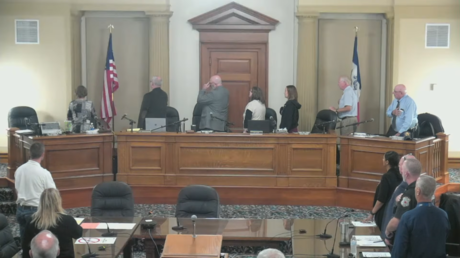
The coffee in the back of the chamber was lukewarm, tasting faintly of tin and old ambition. Outside, the streetlights of the city were beginning to hum, casting long, bruised shadows against the brick facade of the municipal building. Inside, the air was thick with the weight of routine. People shifted in molded plastic chairs. Papers rustled. Throats cleared. It was the ordinary machinery of local democracy, grinding forward on the grease of zoning permits, sewage upgrades, and minor municipal grievances.
Then came the invocation.
We have all heard them. For generations, the opening prayer at a city council meeting has functioned as a polite social lubricant. It is a moment of quiet consensus, usually invoking a generic, broadly accepted deity to bless the proceedings, steady the minds of the elected officials, and wrap the messy business of governance in a comforting cloak of shared tradition. It is a cultural pillow.
This evening, the pillow was pulled away.
When the designated guest speaker stepped up to the microphone, the room did not explode. It held its breath. The words spoken were not the familiar cadence of blessing. They were stark, deliberate, and designed to detonate the assumptions holding the room together: "Hail Satan."
Silence followed. Not the comfortable silence of reflection, but the heavy, ringing quiet of a room realizing the rules of the game had just been rewritten.
To understand why those seven words caused a tremor that echoed far beyond local news feeds, we have to look past the shock value and examine the fragile architecture of public ritual. For decades, the practice of opening government meetings with prayer has operated on an unwritten assumption of cultural homogeneity. It assumed that everyone in the room—or at least everyone whose opinion mattered—shared a common theological vocabulary.
When that assumption broke, the friction was instantaneous.
Imagine sitting in that third row. You are a lifelong resident. You came to speak against a proposed variance for a commercial warehouse down your street. You expected the usual choreography: the Pledge of Allegiance, a quiet nod to the Almighty, and the business of the evening. Instead, you are confronted with a deliberate invocation of the adversarial figure of Western theology, uttered inside a taxpayer-funded government chamber under the protective umbrella of constitutional law.
Your stomach drops. Is this free speech, or is it a provocation? Is it a defense of pluralism, or is it an assault on tradition?
The legal reality behind the gavel is clear, even if the emotional reality is jagged. The United States Supreme Court has repeatedly affirmed that legislative prayer is permissible, provided it does not coerce participation or proselytize a specific sectarian viewpoint to the exclusion of others. But freedom of speech and the Establishment Clause of the First Amendment are notoriously prickly things. They protect the speech we cherish, and they protect the speech that makes our teeth ache.
When a Satanic group requests equal access to the podium, they are not usually seeking converts. They are performing a stress test on the machinery of pluralism. They are holding up a mirror to the town square to ask a simple, uncomfortable question: Does your commitment to religious freedom apply only to the faiths you like, or does it apply to everyone?
The reaction in the room that night revealed the depth of that tension. Heads snapped up. Eyes widened. Some council members stared fixedly at their polished wooden desks, refusing to look up, as if ignoring the moment would cause it to dissolve back into the ether. Others gripped their agendas with white knuckles.
This is what happens when abstract constitutional principles collide with living, breathing human beings in a small room. We love our constitutional rights in the abstract, mounted like museum pieces behind glass. We tend to get uncomfortable when someone takes them off the wall and starts swinging them around.
Consider the dilemma of the council president. He is up for reelection in November. His constituency includes devout churchgoers who view municipal meetings as sacred civic spaces, as well as a growing demographic of secular residents who want absolute neutrality from their government. He cannot satisfy both. Every syllable he utters, every twitch of his facial muscles as the invocation is read, is being measured, judged, and weaponized for the local newspaper and social media feeds.
He stands up, clears his throat, and moves straight into the roll call. No acknowledgment of the theological lightning bolt that just struck the floor. He acts as if the weather hasn't just changed from a gentle breeze to a Category 5 hurricane.
It is a coping mechanism. Bureaucracy survives by pretending the extraordinary is entirely ordinary.
Yet, the shockwaves of that invocation linger long after the gavel falls. They force a reckoning with what public spaces are actually for. Are they sanctuaries of shared heritage, or are they neutral marketplaces where competing ideologies must tolerate one another's existence?
When the Satanic invocation was finished, the meeting pivoted abruptly to the mundane. A debate over storm drains ensued. Potholes were discussed. The zoning variance was tabled for two weeks. The contrast was almost comical, a sharp reminder that life’s administrative necessities care little for culture wars.
Yet nothing in that room was quite the same. The air had changed. The people sitting in those plastic chairs were no longer just neighbors discussing civic maintenance; they were participants in a quiet, ongoing renegotiation of what it means to live together in a pluralistic society.
We like our stories clean. We like villains we can boo and heroes we can cheer. But the reality of civic life is messier, stranger, and far more demanding. It requires us to sit in rooms with people whose deepest symbols repel us, and to keep the lights on anyway.
The prayer ended. The meeting proceeded. And somewhere out in the dark, the city kept breathing, carrying the weight of its own contradictions into the night.