The waiting room smells of old carpeting, floor wax, and a quiet, heavy kind of despair. If you have ever sat there with a child who does not fit neatly into the boxes the world provides, you know the sound of the clock on the wall. It ticks with a slow, indifferent cruelty. Every sweep of the hand measures months lost.
Months turned into years for families waiting for a piece of paper. A diagnosis. An explanation.
Let me be entirely honest with you. When we talk about neurodivergence, about autism and attention deficit hyperactivity disorder, we are talking about a system built by people who never had to look through a different lens. The traditional pathways to understanding a child's mind are choked with bureaucracy, long waiting lists, and specialists whose calendars are booked out until the next presidential election. By the time a kid gets evaluated, the crucial window of early intervention has often slammed shut, leaving parents to navigate a maze blindfolded.
It is a broken machine.
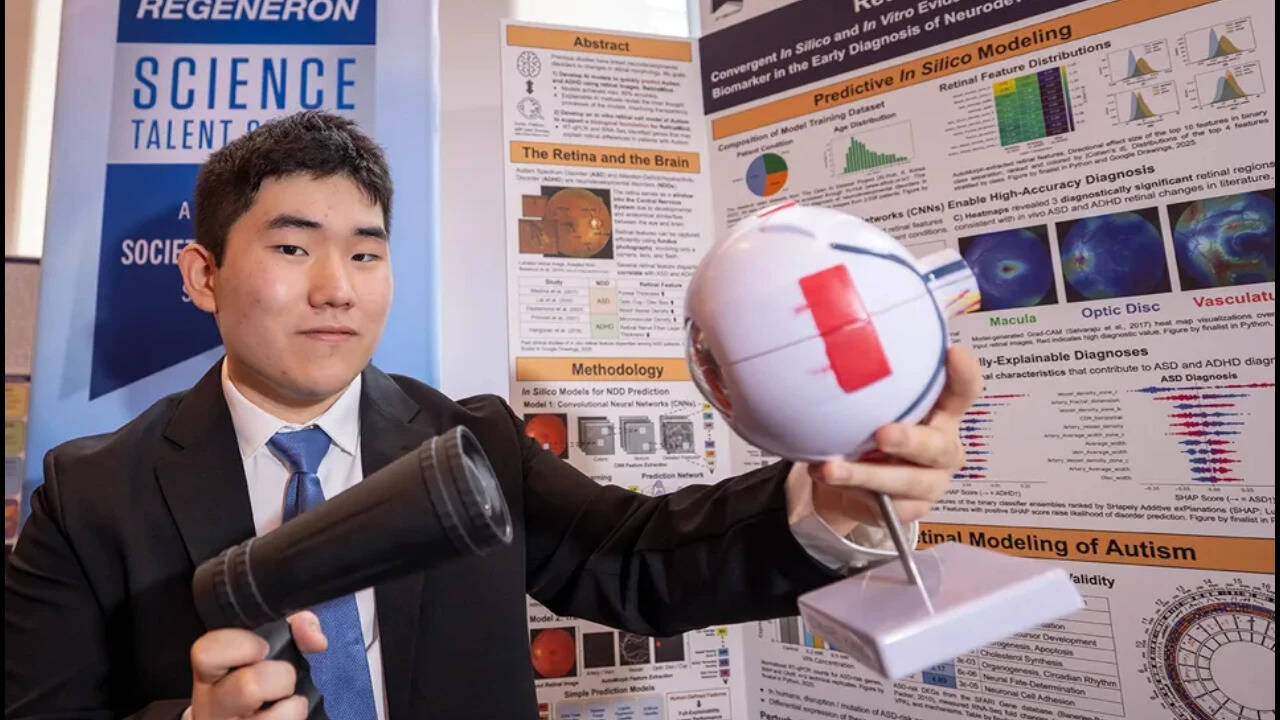
Enter Edward Kang. Seventeen years old. Age seventeen, an epoch when most of us were trying to figure out calculus formulas or how to talk to someone we liked without sweating through our shirts.
Edward looked at the broken machine of neurological screening and decided to build something better.
To understand what Edward did, we have to strip away the techno-babble. Machine learning sounds intimidating, like something out of a sci-fi thriller where the computers take over. But at its core, Edward's project was about pattern recognition. It was about listening to the quiet static of human behavior and finding the signal hidden beneath the noise.
Think of it like tuning an old radio in the middle of the night. You turn the dial, hearing only hiss and crackle. Then, for a split second, a jazz station cuts through clear and bright before fading back into the void. Edward trained an artificial intelligence model to hold that dial steady.
He didn't do it with a multi-million-dollar lab funded by venture capitalists. He did it with curiosity, determination, and a computer screen glowing in a bedroom late at night.
The Weight of the Invisible
What does it actually feel like to live inside a mind that processes the world at a different frequency?
Imagine walking into a grocery store. To most people, it is just a place to buy milk and bread. To a child with sensory processing differences tied to autism, that same grocery store is a war zone. The fluorescent lights hum at a frequency that feels like a drill press against the eardrums. The smell of the seafood counter mixes with industrial bleach, turning into a physical weight on the chest. The chatter of twenty different conversations collides in mid-air.
When that child melts down, the world looks at them with judgment. They see a behavioral problem. They see bad parenting. They do not see a nervous system screaming for mercy.
Now, consider the other side of the coin. The child with ADHD who sits at a wooden school desk while a teacher talks about fractions. Their brain is a race car engine idling with no transmission. Every movement in the hallway, every tick of the clock, every speck of dust dancing in a shaft of sunlight demands equal attention. They are told to sit still. They are told to focus.
They are trying. God, they are trying harder than anyone realizes.
And yet, the system misses them. Girls, especially, slip through the cracks for years because their symptoms look quieter, internalized as perfectionism or anxiety, until they hit a wall in high school and the burnout is absolute.
This is where Edward’s work changes the equation.
Building the Bridge
Edward Kang approached this chaotic landscape not as a clinical psychologist weighed down by decades of dogma, but as a digital native who understood how algorithms process vast amounts of behavioral data.
He developed an artificial intelligence screening tool designed to spot early behavioral markers of autism and ADHD with unprecedented speed and accessibility.
Let us be precise about what this tool is and what it is not. As a hypothetical scenario to ground the math: imagine an app on a parent's phone or a browser-based diagnostic assistant used in a pediatrician's office. The tool analyzes specific behavioral patterns, micro-expressions, or response times to visual and auditory stimuli. It cross-references these data points against thousands of verified diagnostic profiles.
It does not replace a doctor. Let me repeat that. It does not replace a trained clinician.
Instead, it acts as a high-powered scout. It looks at the vast, confusing wilderness of early childhood development and says to the pediatrician, "Look here. Pay attention to this specific cluster of traits."
By streamlining the initial screening process, Edward's model cuts through the red tape. It transforms a process that usually takes eighteen months of waiting into something that can happen in minutes.
We need to look at why this matters on a human scale. Every month a child goes without understanding why their brain works differently is a month they spend internalizing shame. They learn to tell themselves stories about being broken, being stupid, being too much, or not enough. A fast, accessible screen stops that narrative before it hardens into cement.
The Shift in Perspective
For generations, we treated neurological differences as flaws to be corrected. We tried to force square pegs into round holes until the edges splintered and bled.
The younger generation, kids like Edward, view the world through a radically different paradigm. They see cognitive diversity not as a defect, but as an alternate operating system. You would not look at a Mac and call it broken just because it does not run Windows software. You would recognize that it simply works on a different architecture.
When a teenager builds an AI screen for neurodivergence, it sends a message to the adults in the room. It says that the tools to fix our broken systems are no longer locked behind ivory towers. They are being built by the very people who inherited the mess.
We often romanticize youth, expecting them to be the future while ignoring what they are doing in the present. Edward didn't wait for permission. He didn't wait for a grant committee to approve his budget. He saw a gap where human suffering was being prolonged by administrative inefficiency, and he wrote code to bridge it.
The waiting room with the old carpeting and the floor wax does not have to be the default setting for the future.
Every time a child gets an early answer, a weight lifts off a family's shoulders. The air clears. The static stops. And beneath the noise, for the first time, you can hear the music clearly.