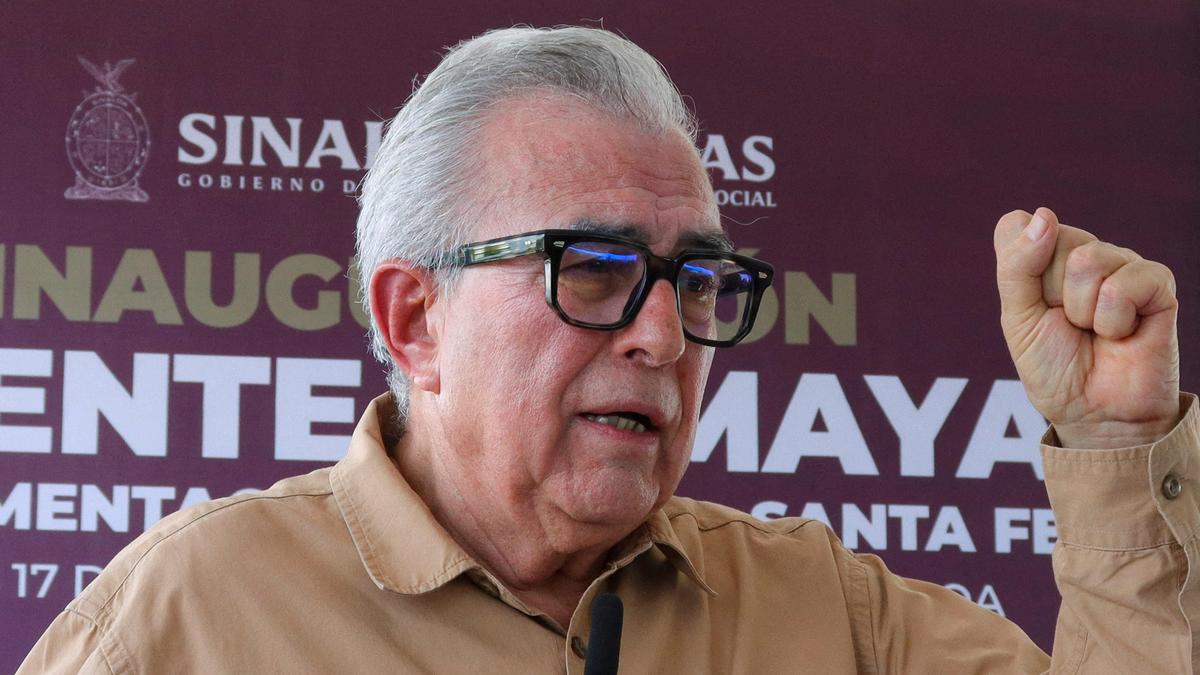
The dust in Sinaloa doesn’t just settle on the windowsills; it gets under the skin. It carries the scent of dry earth and diesel, but for decades, it has also carried the weight of an open secret. Everyone knew. They knew who held the power and who merely wore the sash of office. But when the United States Department of Justice unsealed an indictment against Rubén Rocha Moya, the governor of Sinaloa, the secret didn’t just break. It shattered.
Corruption is rarely a sudden explosion. It is a slow leak, a steady drip of compromise that eventually floods the basement of a democracy until the whole structure starts to tilt. The charges against Rocha Moya—trafficking massive quantities of fentanyl, cocaine, and meth into American cities—represent more than a legal filing. They represent the moment the mask finally slipped entirely off the face of regional governance in Mexico.
The Meeting That Never Was
Think of a hot afternoon in July. The kind of heat that makes the air shimmer over the pavement. On July 25, 2024, a narrative was constructed that would have made a novelist blush. The official story claimed that Ismael "El Mayo" Zambada, the legendary, elusive patriarch of the Sinaloa Cartel, had been ambushed and flown to U.S. soil against his will. The governor, meanwhile, was supposedly in Los Angeles on a family vacation.
The timeline was neat. It was convenient. It was also, according to federal prosecutors, a fiction.
The indictment suggests a reality far grimmer than a missed flight or a poorly timed holiday. It places the governor not in a lounge at LAX, but in the center of a web where the lines between the state’s executive power and the cartel’s board of directors became invisible. This wasn't a case of a politician being intimidated into silence. This was a partnership.
When a governor is accused of being a high-ranking member of a criminal enterprise, the "invisible stakes" become painfully visible. It means the police officers you see on the street might report to the same boss as the men selling poison to children three states away. It means the judicial system isn't a shield; it's a gatekeeper for the highest bidder.
The Fentanyl Ledger
We talk about fentanyl in numbers. We talk about milligrams and seizure weights. We talk about the 70,000 Americans who die every year from synthetic opioids. But behind every indictment is a ledger written in blood.
The U.S. charges allege that Rocha Moya didn't just look the other way while the Sinaloa Cartel refined its chemistry; he facilitated the logistics. Imagine a logistics manager for a multinational corporation. Now, replace the electronics or the clothing with a substance so potent that a dusting the size of a few grains of salt can stop a human heart.
The "business" of the cartel requires more than just chemists and gunmen. It requires infrastructure. It requires the ability to move trucks past checkpoints without inspection. It requires the legal authority to keep the "cooks" safe from federal interference. When the governor is on the payroll, the entire state becomes a private shipping lane.
The indictment highlights a chilling level of integration. We aren't looking at a bribe-taker. We are looking at a system where the Sinaloa Cartel had effectively achieved "vertical integration" with the government. They owned the production, they owned the distribution, and most importantly, they owned the law.
A Breach of More Than Law
There is a specific kind of betrayal that happens when a leader sells out their people. For the citizens of Culiacán, the capital of Sinaloa, the news wasn't a shock, but it was a gut punch. It confirmed their deepest fear: that the violence they endure—the blockades, the "Culiacanazos," the sudden disappearances—is sanctioned by the very people sworn to protect them.
The human cost is measured in the silence of the streets. When the government and the cartel are one and the same, to whom do you report a crime? Who do you call when your son doesn't come home?
Trust is a fragile currency. Once it is debased, it is nearly impossible to restore. By allegedly taking a seat at the table with El Mayo and the sons of "El Chapo" Guzmán, Rocha Moya didn't just break the law. He liquidated the trust of millions of people who were trying to live honest lives in a land where honesty is increasingly a dangerous luxury.
The Long Arm and the Short Fuse
The American legal system moves with a ponderous, grinding weight. It is slow until it is suddenly, terrifyingly fast. The decision to charge a sitting governor is a diplomatic earthquake. It signals that the U.S. government has decided that the "security cooperation" with Mexico is currently a one-way street paved with empty promises.
The evidence presented isn't just hearsay from disgruntled underlings. It involves intercepted communications, financial trails that move through shell companies like ghosts, and the testimony of those who were in the room when the deals were struck. The U.S. isn't just accusing Rocha Moya of being a criminal; they are accusing him of being an architect of the modern drug trade.
Consider the complexity of moving tons of meth across a militarized border. It involves a dance of timing, intelligence, and corruption. The indictment describes a governor who was an active participant in that dance. He wasn't a wall; he was a bridge.
The Ghost in the Executive Office
What happens to a state when its head is severed by a legal sword? Sinaloa is currently a pressure cooker. The arrest of Zambada and the charges against Rocha Moya have created a power vacuum that is being filled with gunfire. The factions of the cartel—the Mayos versus the Chapitos—are fighting for what’s left, and the government, now decapitated of its credibility, stands by, paralyzed.
The invisible stakes are no longer invisible. They are the bullet holes in the side of a bus. They are the families shuttered inside their homes while the city burns outside. They are the thousands of miles of "product" flowing north, fueled by the greed of a man who thought he was untouchable because he held a staff of office.
The tragedy isn't just that a politician was corrupt. Politicians have been corrupt since the first city-state was carved out of the mud. The tragedy is the scale. The tragedy is that the "Sinaloa Model" of governance has become a blueprint: a hybrid of democracy and narco-syndicalism where the voters choose the face, but the capos choose the policy.
The Finality of the Evidence
In the quiet rooms of the Eastern District of New York, the files sit in heavy stacks. They contain the details of meetings in remote mountain hideouts, of suitcases filled with U.S. currency, and of orders given to eliminate rivals who stood in the way of the "enterprise."
Rocha Moya may maintain his innocence from behind a podium or a lawyer's statement, but the narrative has moved beyond him. The story of Sinaloa is no longer a local tragedy or a footnote in a State Department report. It is a cautionary tale about what happens when the darkness isn't just outside the door, but sitting in the chair, signing the bills, and smiling for the cameras.
The dust in Culiacán continues to settle. It covers the statues, the plazas, and the government buildings. But it can no longer hide the tracks of the men who walked between both worlds, leaving a trail of ghosts in their wake.