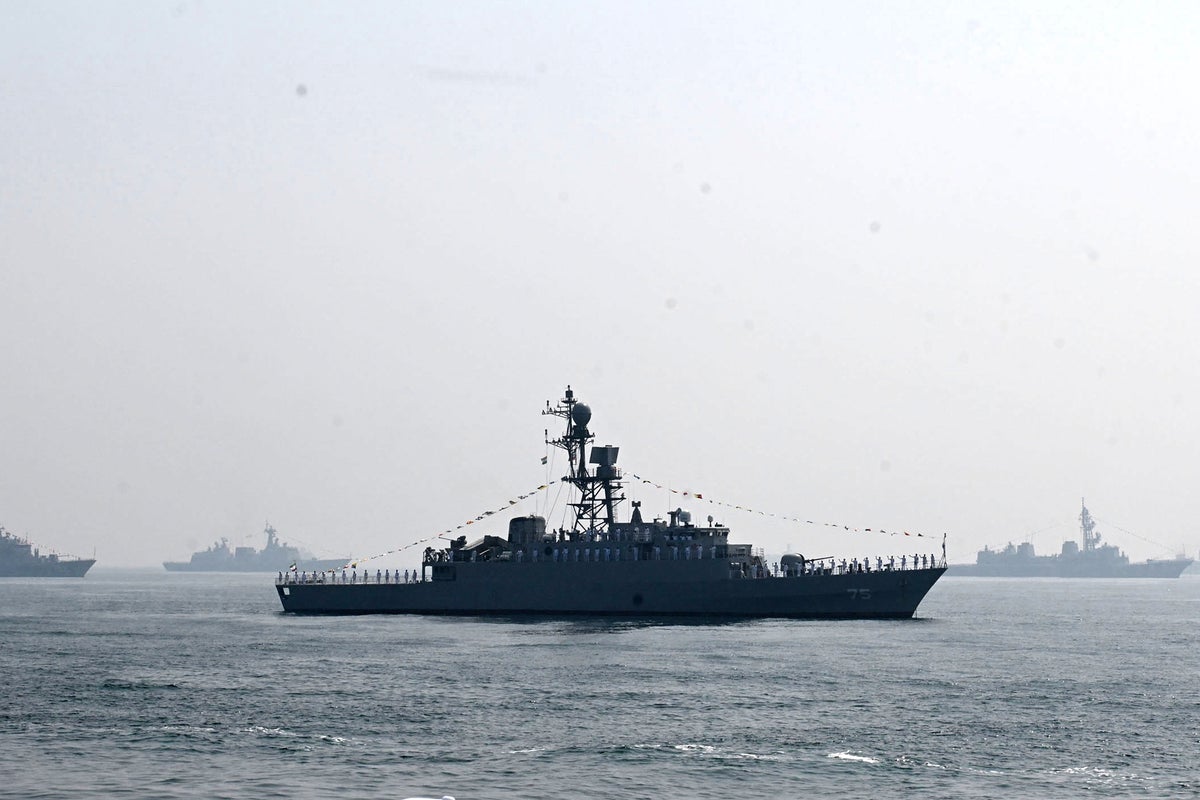
The horizon off the coast of Sri Lanka does not look like a geopolitical chessboard. To a fisherman in a motorized outrigger, it looks like a flat, unrelenting blue that occasionally yields a catch of skipjack tuna. But beneath that surface, and gliding across it, a silent tension is manifesting in the form of steel hulls and encrypted frequencies.
When news broke that a second Iranian vessel had crossed into Sri Lankan waters, it wasn't just a maritime update. It was a signal. The arrival follows a chaotic sequence of events involving a United States submarine—a ghost of the deep that reportedly engaged in an "attack" that remains shrouded in the kind of ambiguity only modern naval warfare can produce.
Steel. Salt. Silence.
The ocean has a way of swallowing secrets, but it cannot hide the sudden, heavy presence of foreign warships in a region that usually worries more about monsoon cycles than missile trajectories.
The Ghost and the Machine
Consider the crew of a merchant tanker. They are moving millions of dollars of cargo through the Indian Ocean, their world defined by the hum of massive engines and the steady glow of radar screens. Suddenly, the radar blips change. They are no longer alone.
The reported US submarine attack wasn't a cinematic explosion with debris flying into the clouds. Modern sub-surface warfare is often a game of electronic blinding and acoustic signatures. If a submarine strikes, it is a sudden, violent intrusion into the physics of the sea. For the Iranian vessels now appearing in these waters, the mission is no longer just about transit. It is about presence. It is about saying, We are still here.
The first Iranian ship was a statement. The second is a reinforcement. When a nation sends a second hull into a high-tension zone, they are signaling that the first was not an anomaly. It is a pattern. It is a defensive perimeter being drawn in salt water.
Why Sri Lanka Matters
Sri Lanka sits like a teardrop at the bottom of the Indian subcontinent, but strategically, it is a fortress at the crossroads of the world. Every major shipping lane connecting the energy riches of the Middle East to the hungry markets of East Asia passes through these waters.
If you control the porch, you control who enters the house.
For the Sri Lankan officials who confirmed the entry of the second Iranian ship, the situation is a delicate balancing act. They are caught between the staggering influence of Western naval power and the defiant maritime expansion of Middle Eastern players. It is a heavy burden for a nation still navigating its own internal recovery. They have to play host to guests who might, at any moment, turn the living room into a battlefield.
The Invisible Stakes of the Deep
Imagine a wire stretched across a dark room. You can’t see it, but you know if you trip it, the lights will go out. That is what the Laccadive Sea feels like right now.
The technology involved in these encounters is almost alien to the civilian mind. We aren't talking about simple cannons anymore. We are talking about $sonar$ $arrays$ capable of detecting a heartbeat miles away and $electronic$ $countermeasure$ (ECM) suites that can make a massive destroyer vanish from a digital map.
$$f_d = \frac{2v \cdot f_s}{c}$$
The Doppler shift in a sonar ping—represented by the formula above—is the difference between knowing a threat is there and being hit by it. When these ships move, they are constantly calculating. The crew isn't just looking at the waves; they are staring at waterfalls of green data, hunting for the acoustic signature of a Virginia-class submarine that might be lurking five hundred feet below their keel.
The fear isn't just about a torpedo. It's about the unknown. It’s about the fact that in the middle of the ocean, there is no one to call for help if your navigation systems suddenly scramble or your engines lose power because of a directed energy pulse.
The Human Cost of High-Stakes Posturing
We often talk about "vessels" and "assets" as if they are inanimate objects moving on a map. They aren't. They are floating metal cities filled with people.
There is a twenty-four-year-old sailor on that second Iranian ship. He hasn't slept well in three days because the "general quarters" alarm keeps sounding in his dreams. He is thousands of miles from home, staring at a coastline he will never set foot on, wondering if the American sub his captain warned him about is currently tracking his ship's propeller noise.
On the other side, inside the cramped, recycled air of a US submarine, a technician sits with headphones pressed to his ears. He is listening. He isn't just listening for engines; he is listening for the sound of intent.
One mistake—one nervous finger on a launch console, one misunderstood radio transmission in a heavy storm—and the narrative shifts from "maritime entry" to "international conflict."
A Sea of Uncertainty
The entry of this second ship suggests that the Iranian navy is not intimidated by the reported American aggression. In the world of high-seas diplomacy, retreat is a scent that sharks can smell. By doubling down, Iran is attempting to project a "robust" (to use the dry term of analysts) posture that refuses to yield the lane.
But the sea doesn't care about posture.
The Indian Ocean is vast, but it is becoming crowded. When the US, Iran, and local authorities all occupy the same narrow corridor of water, the margin for error shrinks to nothing. We are watching a slow-motion collision of interests where the prize is not land, but the right to move through the water unmolested.
The signals coming out of Colombo are measured. Officials use careful language. They speak of "sovereignty" and "monitoring." But between the lines of the press releases, there is a palpable sense of dread. No one wants to be the site of a proxy war played out in the deep blue.
The second ship is now a permanent fixture on the radar. It moves with a deliberate, slow pace, a heavy weight dragging across the maritime map. It is a reminder that the world is small, the oceans are interconnected, and the shadows beneath the waves are getting longer.
As night falls over the coast of Galle, the lights of these massive ships twinkle on the horizon like fallen stars. They look peaceful from the shore. They look like progress. But for those who understand the language of hulls and sonar, those lights are a warning. The ocean is no longer just a highway; it has become a stage for a drama that no one knows how to end.
The water remains cold. The steel remains hard. The silence remains loud.