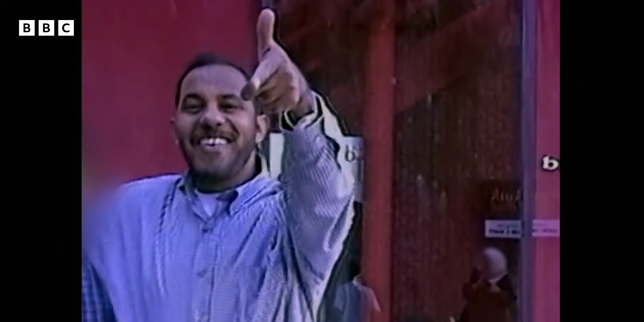
The sunlight hitting the Pacific coastline on a crisp February morning in the year 2000 was deceptively ordinary. Waves crashed against the cliffs of La Jolla, surfers carved paths through the foam, and the air smelled of salt and eucalyptus. In this sun-bleached corner of Southern California, life moved to a lazy, comforting rhythm. Nobody looked twice at the strangers arriving at the airport. Nobody suspected that the casual kindness shown to two unassuming travelers would ripple outward, eventually altering the course of modern history.
At the center of this quiet prologue stands Omar Al-Bayoumi. To the people who knew him then, he was not a villain straight out of a thriller
The Shadow Beneath the Welcome Mat
news
The air in Southern California during the late summer of 2000 tasted of salt, warm asphalt, and the heavy, electric promise of anonymity. San Diego was a city where people went to reinvent themselves. It offered endless ribbons of freeway, stucco apartment complexes draped in bougainvillea, and a coastline that stretched out like an unwritten promise. In this sprawling theater of reinvention, ordinary kindness was currency. People helped strangers with directions. They held doors. They translated confusing utility bills at kitchen tables.
Sometimes, though, the hand extended in welcome is the one that opens a trapdoor to history.
Omar Al-Bayoumi was a man who understood the loneliness of the expatriate. Working for a Saudi aviation contractor, he navigated the subtle friction of living between two worlds—the conservative rhythms of his homeland and the dizzying, permissive sprawl of America. He was a familiar face at the King Fahd Mosque in Culver City, a gregarious presence who knew how to bridge gaps. By all outward accounts, he was an administrative worker trying to carve out a stable life.
Then came a Tuesday in February 2000.
At a modest Mediterranean restaurant near the University of California, San Diego, Al-Bayoumi sat down to eat. Across the room, two men sat struggling with the language, the menu, and the quiet, heavy dread of outsiders who did not belong. They spoke Arabic with a Gulf dialect. They looked exhausted, out of place, and entirely unequipped for the American machine.
Their names were Nawaf al-Hazmi and Khalid al-Mihdhar.
They were not lost travelers seeking a new life under the California sun. They were vanguard operatives. Months earlier, they had crossed into the United States bearing operational orders, operational funds, and a quiet, murderous mandate that would eventually reshape global geopolitics. But ideology alone cannot find an apartment. Fanatism cannot sign a residential lease or navigate a credit check. Terrorism, for all its grand and terrifying mythology, is deeply bureaucratic. It requires parking spots, grocery runs, bank accounts, and addresses.
It requires a local guide.
Consider what happens next, because the transition from stranger to benefactor happened with chilling speed. Al-Bayoumi did not just exchange pleasantries with Hazmi and Mihdhar; he adopted them. He noticed their isolation and moved swiftly to cure it. Within days, he brought them to San Diego, found them an apartment right next door to his own, co-signed paperwork, and helped them secure a bank account. He threw them a welcoming party. He introduced them to the local social fabric, smoothing over their rough edges and integrating them into the community.
To the federal investigators who would later reconstruct these moments piece by agonizing piece, this choreography looked less like random charity and more like professional asset management.
Years later, the shadow of Omar Al-Bayoumi would loom large over the sprawling corridors of the congressional inquiries and FBI case files known as Operation Encore. Journalists, victims' families, and intelligence analysts asked the same agonizing question: Was he an unwitting patsy who happened to cross paths with monsters, or was he an intelligence asset who performed a vital logistical function for a conspiracy he understood?
The official record offers a complex, frustrating mosaic. Declassified documents reveal that Al-Bayoumi had extensive contacts with Saudi government officials in the United States. He received a stipend. He visited Saudi diplomatic compounds with suspicious frequency. When federal agents interrogated his past, they found a man whose financial ledger did not entirely match his modest salary. Yet, when the twin towers fell on a crystal-clear September morning, Al-Bayoumi was already gone. He had packed up his life and left the United States months prior, moving to the United Kingdom just weeks before the attacks, leaving behind an apartment, a car, and a trail of questions that would take decades to untangle.
The official investigations stopped short of proving that Al-Bayoumi knew the specific details of the airline hijackings. Many investigators concluded he may have acted as a supportive community member executing instructions from diplomatic circles to assist arriving compatriots, oblivious to the destination of their madness. But innocence in the shadow of mass murder is a fragile concept.
To look at Al-Bayoumi’s actions is to confront the terrifying banality of evil's logistics.
Conspiracies do not hatch in vacuums. They require infrastructure. They require a grocery store clerk to bag their food, a landlord to hand over keys, and a friendly neighbor to make them feel comfortable enough to stay. Hazmi and Mihdhar were terrible at blending in. They spoke broken English, drew suspicion with their erratic behavior, and struggled with the basic mechanics of American life. Left to themselves, they might have drawn the attention of local law enforcement or federal authorities long before the fuel tanks were full.
Al-Bayoumi gave them camouflage. He provided the social armor that allowed them to walk freely through the sun-drenched streets of Southern California, unnoticed and unbothered, while they plotted the murder of three thousand people.
This is the chilling reality of modern terror. It does not wear a uniform that frightens you. It wears the smile of a helpful neighbor. It sits across from you at a restaurant, notices your confusion, and offers to help you find an apartment. It speaks in a gentle tone, pours tea, and signs your lease.
Decades after the dust settled over Lower Manhattan, the name Omar Al-Bayoumi remains a ghost story whispered in the halls of counterterrorism agencies. Was he a master spy executing a quiet, state-sponsored mission of infiltration, or was he simply a man who made a fatal error in choosing whom to help?
The truth likely lies in the gray, uncomfortable space between malice and negligence. But the legacy of his actions remains etched in stone and memory. Hospitality is one of humanity’s oldest and most sacred virtues. It is the glue that binds communities together across divides of language and culture. Yet, when perverted by ideology or exploited by the ruthless, that same hospitality becomes the vessel through which catastrophe arrives.
The sun still shines on the coastline of San Diego. The ocean breeze still carries the scent of salt and eucalyptus. But beneath the polished surface of every welcoming smile and every quiet act of neighborly grace, history leaves a warning. We never truly know the hands we are holding, nor the doors we are opening, until the light goes out and the smoke clears.