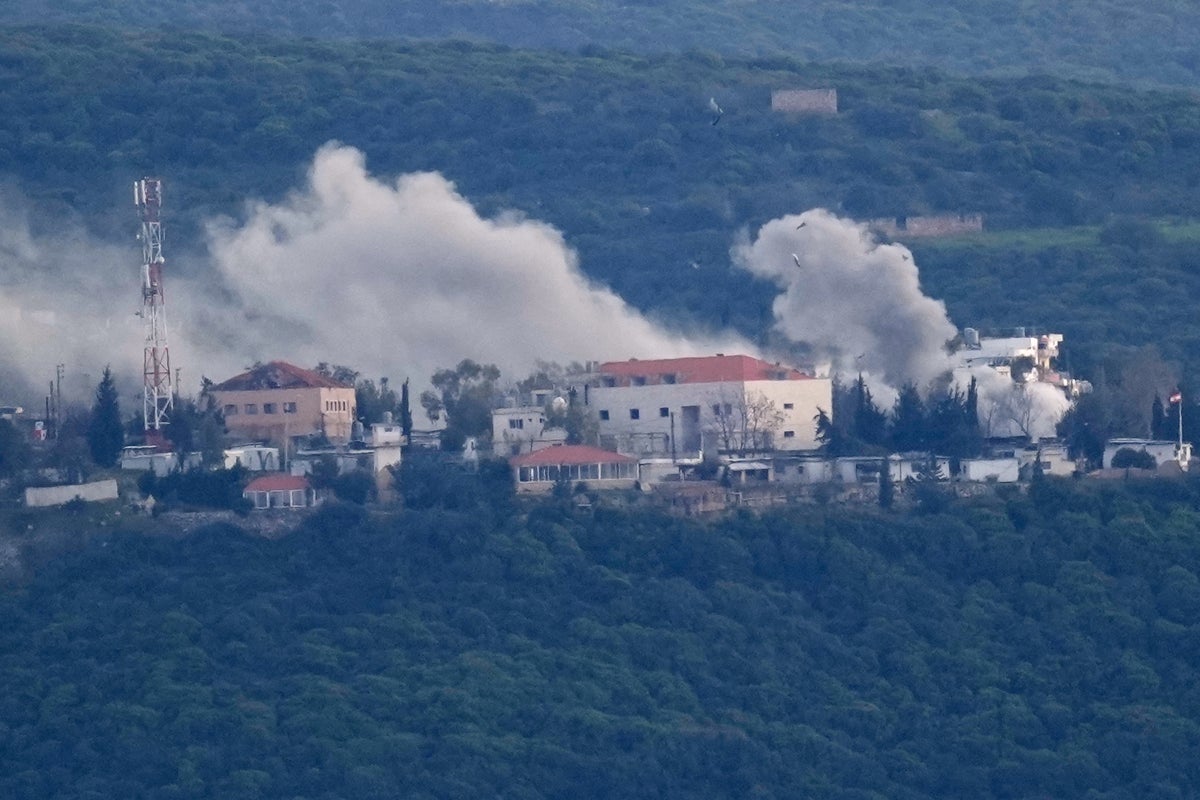
The coffee was still warm on the table in Nabatieh when the walls began to breathe outward. It is a specific kind of silence that precedes the roar—a momentary vacuum where the birds stop mid-chirp and the air turns heavy with the scent of ionized dust. For those living in southern Lebanon, this silence has become a daily companion, a predatory pause before the world deconstructs itself into gray powder and jagged rebar.
Malak, a fictional composite of the thousands who have fled their ancestral olive groves in the last few months, didn't grab her passport first. She grabbed a handful of soil from a potted mint plant on her balcony. It sounds like a cliché until you realize that when your geography is being erased, the physical earth is the only receipt you have of your existence. She is one of the nearly one million people displaced in a conflict that is no longer just a border skirmish. It is a systematic dismantling of a region.
We often talk about war in the language of logistics. We count the dead. We measure the craters. But the real story isn't in the diameter of the hole left by a bunker-buster; it is in the terrifying familiarity of the pattern. Aid workers on the ground are whispering a name they hoped never to apply to this lush, mountainous terrain. Gaza.
The comparison isn't hyperbole used for shock value. It is a mathematical observation of displacement and destruction. Since October 2023, and with terrifying acceleration in recent weeks, the scale of the "scorched earth" policy has moved north. More than 2,000 lives have been extinguished, and the infrastructure that makes life possible—hospitals, water pumping stations, schools—is being turned into a memory.
The Architecture of Erasure
Think of a neighborhood as a nervous system. The roads are the nerves, the markets are the synapses, and the homes are the cells. When a strike hits a residential block in Tyre or Bint Jbeil, the damage isn't localized to the blast radius. The strike severs the connection between the past and the future.
In Gaza, the world watched as high-rises pancaked into layers of concrete. In southern Lebanon, the landscape is different—rolling hills and ancient stone villages—but the result is hauntingly similar. Entire villages are being "razed to the ground," a phrase that feels sterile until you consider that a village is a collection of multi-generational debts, wedding photos, and the specific way the sun hits a certain street corner at 4:00 PM.
The logic of the conflict has shifted from targeted strikes to a broader, more existential pressure. The goal appears to be the creation of a "no-man's land." But "no-man" is a lie. These lands belong to the farmers who can no longer reach their tobacco crops and the children who are now learning the difference between the whistle of a drone and the scream of a jet.
The Invisible Stakes of the South
The numbers tell one story: 10,000 strikes, billions in damages, thousands of families huddled in classrooms in Beirut. But the invisible stakes are higher. This is about the death of the "Buffer Zone" as a concept and its rebirth as a graveyard.
International law suggests that civilians must be protected, yet the "safe zones" are shrinking. When the orders come to evacuate, they often come via social media or leaflets dropped from the sky, giving families minutes to decide what thirty years of living is worth. Do you take the photo album or the extra gallon of water? Do you wake the grandfather who can't walk, or do you pray the strike hits the house next door instead?
This is the psychological toll of "Gaza-fication." It is the realization that nowhere is sacred. Not the hospitals where the wounded seek breath. Not the shelters where the terrified seek sleep.
Consider the plight of the healthcare system. In the south, medical centers are closing because the staff are either dead or have been forced to flee. This creates a secondary wave of mortality. The woman who needs dialysis, the child with a high fever, the man with a chronic heart condition—they become casualties of war without a single drop of blood being shed by a bullet.
The strategy is a slow strangulation. By destroying the means of life, you ensure that even if the bombs stop tomorrow, there is nothing to return to. No school for the children. No shop to buy bread. No clinic to treat a cough. This is how you move a population without ever officially "deporting" them. You simply make their reality uninhabitable.
A Mirror Held Up to the World
The fear among aid agencies isn't just about the immediate violence. It is about the precedent of impunity. If the world accepted the level of destruction seen in Gaza, why would the rules change for Lebanon? The border is a line on a map, but the human capacity for suffering is a universal constant.
The Lebanese economy was already a ghost of its former self, haunted by hyperinflation and political gridlock. This conflict is the final weight on a collapsing floor. When a farmer in the south loses his olive trees—trees that took fifty years to reach their prime—he isn't just losing a crop. He is losing his pension, his children’s inheritance, and his connection to the soil.
The international community speaks in the passive voice. "Tensions are rising." "Concerns are being felt." But for the family sleeping on a thin mattress in a public park in Beirut, the voice is active and loud. The sky is falling.
The danger of comparing Lebanon to Gaza is that it might suggest a sense of inevitability. It shouldn't. It should be a flashing red light. Gaza was a warning of what happens when the "rules of engagement" become a suggestion rather than a mandate. Southern Lebanon is the proof that the lesson wasn't learned.
The Geography of Fear
Movement in the south is now a game of Russian Roulette. The main arteries—the roads that connect the coastal cities to the mountain villages—are being targeted to cut off supply lines. But these are the same roads used by ambulances and fleeing civilians.
The displacement is not a temporary relocation. It is a seismic shift in the demographics of the country. When people move from the south to the north, they carry their trauma, their needs, and their desperation with them. Lebanon is a small house, and it is currently being forced to fit everyone into the hallway while the bedrooms burn.
The "New Gaza" isn't a metaphor for the amount of rubble. It’s a metaphor for the abandonment of a people. It represents the moment a civilian population is rebranded as a "collateral consequence."
Malak sits in a schoolroom in the mountains now. She still has that handful of mint-scented soil in a plastic bag. She looks at it every morning to remind herself that she isn't a refugee by choice, but a person in exile from a home that might no longer have a roof.
The sun sets over the Mediterranean, casting a long, orange glow over the smoke rising from the border. It looks beautiful from a distance, like a painting of a sunset. But if you get close enough, you can hear the sound of a society being unmade, brick by brick, life by life, until there is nothing left but the dust.
The tragedy is not that we don't know what is happening. The tragedy is that we are watching it happen twice.
There are no more words for the "unprecedented." There is only the cold, hard reality of the present: a land of cedars being turned into a land of ash.



