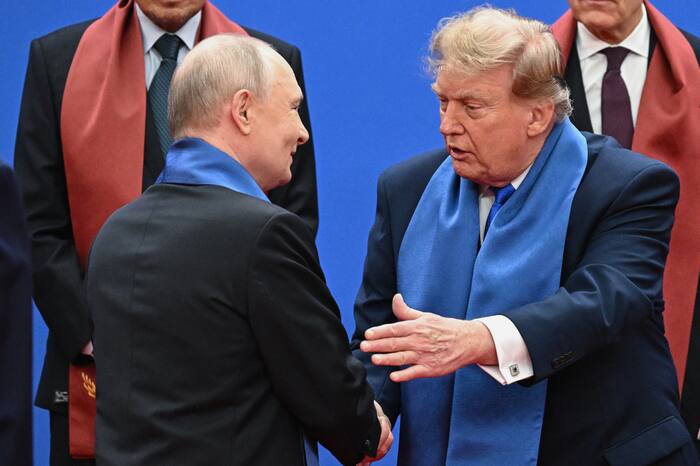
The November 19, 2026 trilateral summit in Shenzhen between Donald Trump, Xi Jinping, and Vladimir Putin—preceded by a bilateral session in which Trump referred to Putin as "my friend"—is not an ideological alignment, nor is it a replay of the 1945 Yalta Conference. Standard diplomatic reporting treats the personal warmth between Washington and Moscow as the central variable, obscuring the underlying structural mechanics. In reality, the Shenzhen gathering and its resulting Heads of State Declaration toward Peace represent a calculated exercise in triangular diplomacy designed to decouple strategic stability from regional territorial disputes while insulating the three powers from multilateral legal and economic constraints.
To understand the operational significance of the Shenzhen summit, analysts must separate theatrical bilateral signaling from the binding—and non-binding—commitments codified in the four-point communiqué. You might also find this similar story insightful: Why Federal Agencies Are Cracking Down on Telework Ahead of Grand Theft Auto VI.
The Mechanics of Triangular Signaling and Asymmetric Leverage
In classical international relations theory, specifically Lowell Dittmer’s Strategic Triangle framework, three actors operate in one of four configurations: a ménage à trois (symmetrical amity), a romantic triangle (one pivot maintaining positive relations with two wings that remain hostile to each other), a marriage (two partners aligned against a pariah), or a unit veto (universal hostility). Prior to November 2026, the international system operated as a rigid marriage between Beijing and Moscow opposed by Washington.
Trump’s bilateral meeting with Putin at Kylin Villa and his public deployment of personalist rhetoric ("my friend") execute a deliberate shift toward a pivot strategy. By lowering the rhetorical barrier to entry for Moscow, Washington alters the bargaining payoffs for Beijing. As reported in latest articles by TIME, the effects are notable.
- The Cost Function for Moscow: Russia entered Shenzhen as the junior economic partner to China, constrained by Western sanctions, International Criminal Court (ICC) arrest warrants, and kinetic attrition in Ukraine and the broader Middle East theater. Securing a seat at a three-power table at Kylin Villa grants Putin immediate diplomatic parity with the world's two largest economies without requiring prior territorial concessions.
- The Payoff Matrix for Washington: By signaling openness to bilateral normalization with Russia—including floating Putin’s attendance at the upcoming G20 summit in Florida—the White House introduces friction into the Sino-Russian alignment. Even if Moscow does not abandon Beijing, the mere plausibility of a U.S.-Russia thaw forces China to pay a higher diplomatic and economic price to retain Russian loyalty.
- The Hosting Advantage for Beijing: Convening the summit on the sidelines of the Asia-Pacific Economic Cooperation (APEC) forum in Shenzhen allows Xi Jinping to frame China as the indispensable convener of global order. By invoking the three nations' shared history as World War II victors, Beijing attempts to establish an exclusive great-power directorate that sidelines U.S. treaty allies, visibly demonstrated by the diplomatic cold shoulder given to Japanese Prime Minister Sanae Takaichi during the same APEC window.
Deconstructing the Four Pillars of the Shenzhen Declaration
The tangible output of the November 19 summit is the U.S.-Russia-China Heads of State Declaration toward Peace (published simultaneously by the White House, the Kremlin, and China's Ministry of Foreign Affairs with each capital placing its own name first in the title). A rigorous legal and operational audit reveals that the document avoids enforceable treaties in favor of sovereignty-reinforcing political commitments.
1. Security Council Primacy and UN Reform
The first clause commits the three permanent members of the United Nations Security Council (UNSC) to "reform the UN so that the UN can respond more effectively to global challenges". While UN reform has been debated for decades—most recently under Action 39 of the UN’s September 2024 Pact for the Future regarding African representation and veto mechanics—its inclusion here serves a narrower purpose. By asserting UNSC reform as a trilateral prerogative, Washington, Moscow, and Beijing re-centralize global governance authority within the P3/P5 veto structure, implicitly rejecting middle-power attempts to bypass Security Council gridlock through General Assembly mechanisms.
2. Refined Petroleum Supply and Energy Market Stabilization
The second provision states that the three nations "plan to increase the production and supply of refined petroleum products for the benefit of all nations" while reaffirming "stable energy flows". This language directly addresses acute physical bottlenecks in global energy markets. According to International Energy Agency (IEA) data from November 2026, global refinery runs dropped to roughly 81.3 million barrels per day in October amid persistent disruptions to energy infrastructure and trade routes, with a projected recovery to 84.7 million barrels per day in December.
- Operational Reality: The declaration contains zero binding barrel-per-day quotas, nor does it repeal statutory U.S. restrictions such as the Ending Importation of Russian Oil Act (Public Law 117-109). Instead, it establishes a mutual non-interference understanding regarding refining capacity and maritime transit—a critical concession for Moscow, whose downstream refining infrastructure has suffered sustained kinetic degradation during the Ukraine conflict.
3. Sovereign Immunity and Jurisdictional Containment
The third clause represents the sharpest ideological departure from post-Cold War liberal institutionalism. The three leaders declared that "state consent and respect for immunities of State officials" are foundational, warning that the International Criminal Court and similar bodies "must not abuse their jurisdiction".
- Legal Mechanism: None of the three states are parties to the Rome Statute. However, under customary international law—as tested in the International Court of Justice’s 2002 Arrest Warrant case and the ICC Appeals Chamber’s 2019 Jordan Referral re Al-Bashir ruling—heads of state face severe travel and diplomatic constraints when non-party warrants intersect with third-party treaty obligations. By issuing a joint executive rebuke of supranational jurisdiction, Washington effectively neutralizes the diplomatic isolation weaponized against Putin via his ICC warrant, while shielding U.S. and Chinese officials from future extraterritorial legal exposure.
4. Strategic Nuclear Risk Reduction Without Force Caps
The final pillar revives the Reagan-Gorbachev formula—previously reaffirmed by the P5 in January 2022—stating that "a nuclear war cannot be won and must never be fought," paired with a commitment to "dialogue on reducing nuclear risks and preventing the proliferation of nuclear weapons".
- The Structural Gap: Unlike bilateral Cold War treaties (START, New START), the Shenzhen declaration imposes zero ceilings on deployed warheads, delivery vehicles, or fissile material production. With China rapidly expanding its nuclear triad to achieve parity with the U.S. and Russia, Beijing has consistently rejected quantitative arms control caps. The Shenzhen text accommodates China's force-building trajectory by substituting crisis-communication protocols (risk reduction and non-proliferation) for verifiable numerical limits.
The Omission Matrix: What the Communiqué Deliberately Excludes
In diplomatic drafting, excluded variables carry more diagnostic weight than included platitudes. Comparing the pre-summit agenda—which explicitly flagged nuclear arms and active wars in Ukraine and Iran—against the final text exposes the exact boundaries of trilateral consensus.
- The Ukraine Conflict: Despite Trump’s post-summit assertions that Putin wants to end the war and that "it takes two to tango," the declaration makes no mention of Ukraine, ceasefires, or territorial lines. With Russian forces holding an advantage in the air war against Ukrainian energy infrastructure entering winter, Moscow avoided locking itself into a multilateral settlement framework while retaining momentum on the ground.
- Middle East Escalation and Iran: Although ending the war in Iran topped pre-summit briefings, no joint mechanism or containment pledge emerged. China’s reliance on discounted Middle Eastern crude and Russia’s defense-industrial ties with Tehran prevent either power from underwriting U.S. coercive diplomacy in the Persian Gulf.
- The Taiwan Strait: While Xi Jinping used private sessions to press Washington to be "sensible" regarding Taiwan, the U.S. delegation kept cross-strait language out of the trilateral text, preserving strategic ambiguity and preventing Moscow from gaining formal diplomatic standing in Indo-Pacific security architecture.
Legal Bindingness vs. Political Signaling
A recurring analytical error in media coverage is treating the Shenzhen declaration as an enforceable treaty. Under international jurisprudence—specifically the International Court of Justice’s 1974 Nuclear Tests judgment and 1994 Qatar v. Bahrain decision—joint minutes or public declarations only create binding legal obligations when the text demonstrates a clear intent to be bound, supported by specific, actionable terms.
The Shenzhen document fails every threshold of legal bindingness:
- It uses hortatory verbs ("plan to increase," "reaffirmed," "will conduct a dialogue") rather than mandatory legal covenants.
- It lacks verification mechanisms, enforcement timelines, or dispute-resolution clauses.
- It bypasses domestic legislative ratification in all three capitals.
Its true function is expectation management. It signals to global markets, multilateral institutions, and mid-tier allies that the three major nuclear powers will not allow regional proxy wars or international legal bodies to trigger direct great-power confrontation.
Limitations and Structural Vulnerabilities of the Shenzhen Model
Treaty-free personalist diplomacy carries severe operational vulnerabilities that limit its durability:
- Alliance Erosion: Treating Tokyo as an afterthought while embracing Moscow and Beijing degrades the credibility of U.S. extended deterrence in the Indo-Pacific and Europe. When treaty allies perceive that Washington prioritizes trilateral concert politics over alliance consultation, those allies accelerate independent hedging strategies—including indigenous defense industrial buildup and latent nuclear latency.
- Asymmetric Compliance: In non-binding frameworks, transparent democracies face domestic political costs for reversing course, whereas authoritarian systems can pocket the immediate legitimacy gains (such as the weakening of ICC norms) while ignoring energy or non-proliferation assurances whenever tactical conditions shift.
- The Zero-Sum Security Dilemma: Dialogue on nuclear risk reduction cannot indefinitely offset the destabilizing physics of a three-body nuclear arms race. As China approaches numerical parity with the United States, Washington faces the "two-peer problem"—needing to deter two nuclear-armed adversaries simultaneously—which inevitably drives U.S. force posture expansion regardless of summit communiqués.
Strategic Forecast and Operational Directives
The Shenzhen summit marks the formal transition from a rules-based multilateral order to a transactional concert of great powers. Expect the following operational shifts over the next two quarters:
- De-escalation of Extraterritorial Legal Warfare: Multilateral bodies such as the ICC and UN special rapporteurs will experience sharp reductions in diplomatic backing and enforcement cooperation from Washington, accelerating the fragmentation of international criminal jurisdiction.
- Bilateralization of Conflict Resolution: Washington will bypass European and multilateral formats to pursue direct, transactional deals with Moscow over Ukraine's energy grid and territorial freeze lines ahead of the Florida G20 summit, forcing Kyiv and Brussels into reactive postures.
- Institutionalized Trilateral Crisis Channels: While quantitative nuclear arms control treaties remain dead, defense ministries in Washington, Beijing, and Moscow will establish technical military-to-military hotlines and notification protocols for missile launches and space operations under the mandate of the Shenzhen declaration's fourth clause.
For institutional decision-makers, corporate risk officers, and policy analysts, the directive is clear: stop pricing geopolitical risk based on multilateral treaty frameworks or ideological bloc alignments. Model all sovereign, energy, and sanctions exposure through the lens of bilateral transactional leverage, assuming that legal and institutional constraints will be subordinated whenever two or more of the Shenzhen principals identify a shared interest in market stability or sovereign immunity.