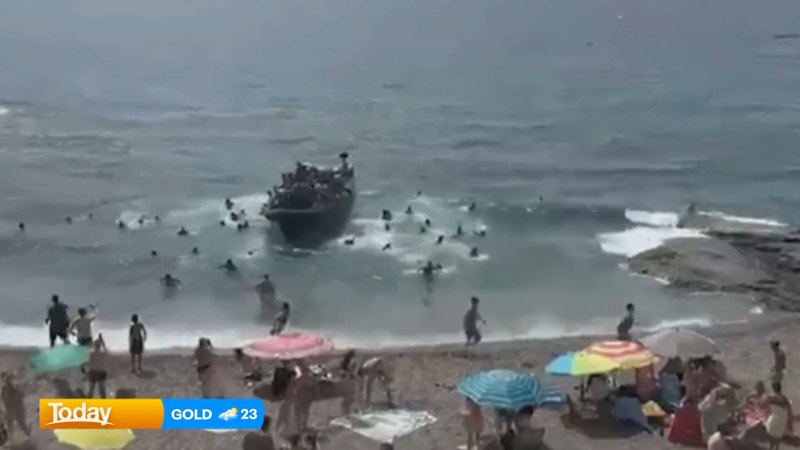
Dawn breaks gray and indifferent over the English Channel. For years, this stretch of water has served as a watery graveyard for hope and a political battleground for two nations separated by twenty-one miles of unforgiving sea. On the northern French coast, the sand is tracked with footprints that vanish as the tide rolls in. For a long time, those footprints belonged to desperate travelers pushing inflatable dinghies into the surf, watched by a system that seemed entirely incapable of stemming the tide.
Now, the numbers are changing. Official figures show small boat arrivals declining significantly, dropping by roughly forty percent compared to previous highs, while thousands of attempted crossings are intercepted before they ever leave the French shore. Politicians in London proclaim that the strategy is working, pointing to increased enforcement and bilateral agreements as proof that the line is holding. But statistics written in a parliamentary report rarely capture the messy, dangerous reality playing out on the water.
Consider what happens when enforcement tightens on a beach. Smugglers do not simply fold their operations and walk away. Instead, they adapt.
Imagine a warehouse near Calais, hidden away from the paved roads, where criminal networks pivot their logistics. Where they once used small, flimsy rafts meant for fifteen or twenty people, they now inflate massive, industrial rubber vessels designed to hold over a hundred souls. These are the so-called mega-dinghies. They are heavy, unwieldy, and terrifyingly easy to overload. When French police increase patrols on the sand, the response from the syndicates is not surrender; it is a grim escalation of risk.
This is the invisible friction of border policy. For every barrier erected on land, the pressure shifts to the sea. The reduction in total boat numbers tells only half the story. The vessels that do make it past the blockade are larger, carrying upwards of seventy or eighty people on average, sometimes pushing past a hundred and seventy. When an engine sputters or catches fire on one of these giant inflatables in the middle of the shipping lanes, the catastrophe is magnified tenfold.
Governments measure success in percentages. They look at the year-on-year drop in arrivals, pointing to thousands of prevented departures and pilot schemes that allow for returns. But down on the water, the human element remains as fragile as ever. People fleeing war zones in Sudan, Eritrea, or Afghanistan arrive in northern France having survived thousands of miles of overland danger, only to find themselves bargaining with criminals for a single seat on a rubber tube that defies basic physics.
The policy shift is real, and the increased French policing backed by UK funding has undeniably disrupted old patterns. Patrols are heavier, boots are firmly on the ground, and some unauthorized routes are choking off. Yet, human desperation operates on a different logic than state bureaucracy. As long as the push factors of conflict and poverty remain stronger than the pull of deterrence, the migration routes simply mutate. They shift ports, they alter vessel sizes, and they find new crevices in the armor of European border security.
The water remains cold. The crossings continue, fewer in number, but laden with an even greater hazard. The official narrative celebrates a turning tide, but the horizon tells a more complicated story of adaptation, endurance, and a sea that refuses to be neatly managed.