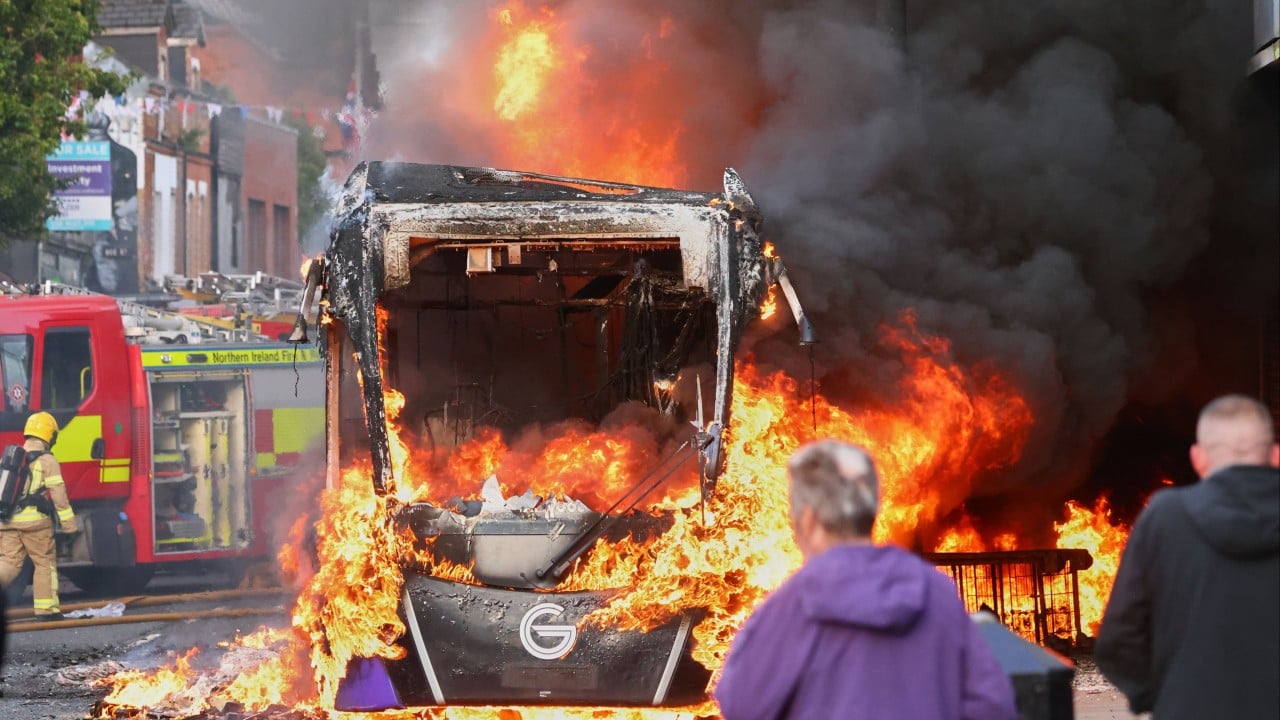
The metal scrape of a rolling shutter at dawn used to mean business. In the Lower Ormeau, or along the Sandy Row artery, it was the definitive sound of a neighborhood waking up, of milk crates rattling, of tea being steeped in heavy ceramic pots.
Now, the sound is different. It is a defensive armor. It is the sound of a city locking its breath inside.
Walk down these streets on a Tuesday morning and the silence feels heavy, almost deliberate. Belfast is a place where history does not sleep; it merely takes long, fitful naps. Over the past weeks, those naps have been shattered. A horrific knife attack—the kind of sudden, senseless violence that leaves an entire society reeling—became the spark. But the fire that followed did not target the tragedy itself. It turned inward, morphing into a jagged wave of anti-immigration fury that has left the city's newest residents wondering if the walls they thought had come down were simply rebuilt out of sight.
Fear does not arrive with a banner. It settles in the small omissions of daily life.
Consider a hypothetical shopkeeper named Ahmed. He came to Northern Ireland a decade ago, drawn by the promise of a peace process that the world celebrated. He chose Belfast because the rent was manageable and the people, when they smiled, possessed a warmth forged by their own survival of hard times. For years, Ahmed’s morning routine was a clockwork ritual of stocking shelves and swapping weather complaints with regulars.
Today, Ahmed watches the street through a two-inch gap in his reinforced blinds. His children did not go to school yesterday. They stayed in the back room, playing muted video games while the distant thud of fireworks and police Land Rovers echoed from the main road.
This is the hidden tax of civil unrest. It is not just the broken glass or the scorched brickwork of a burnt-out cafe. It is the sudden, paralyzing contraction of a human life.
The statistics tell a stark, numerical story of a region grappling with rapid demographic shifts. For generations, Northern Ireland was defined by a binary friction—green and orange, Catholic and Protestant. It was a closed loop. But the turn of the century brought a quiet transformation. The foreign-born population in Belfast has shifted significantly over the last twenty years. People arrived from Poland, Romania, Sudan, and Syria, filling vital gaps in the health service, opening restaurants, and transforming neighborhoods that had been hollowed out by decades of industrial decline and emigration.
To the outside observer, this looked like progress. It looked like a modern, cosmopolitan European city shedding its old ghosts.
But beneath the surface, the old mechanics of territorial anxiety remained entirely intact.
When a society has spent half a century conditioned to view every square inch of a neighborhood as a statement of political dominance, a new flag, a new language, or a new face can be easily weaponized by those looking for a target. The recent knife attack became a lightning rod. Within hours, online algorithms did what they do best: they took a localized tragedy, stripped it of nuance, infused it with false rumors about identity, and served it to an audience already simmering with economic frustration.
What followed was not a political debate. It was a hunting expedition.
The violence that erupted across Belfast’s fault lines was targeted with clinical precision. It was not indiscriminate rioting. Businesses owned by ethnic minorities were picked out, systematically smashed, and set alight. The messages sprayed on the brickwork were crude and ancient: Our Streets. Get Out.
The irony is thick enough to choke on. The very communities where these anti-immigration riots took hold are the ones that have suffered the most from decades of underinvestment, poor housing, and political stagnation. The anger is real, but its direction is an illusion. It is far easier to blame the man who arrived last year with nothing than to confront the systemic failures of a political system that has spent thirty years failing to deliver a peace dividend to its poorest youth.
Belfast’s geography has always been its destiny. The city is crisscrossed by "peace walls"—massive barriers of concrete, iron, and steel designed to keep warring factions apart during the Troubles. Decades after the Good Friday Agreement, most of those walls still stand. Some have even been heightened.
They are a physical manifestation of a psychological reality. When you grow up in the shadow of a wall, you learn to see the world in terms of binaries. Us and them. Inside and outside. Safe and hostile.
When the anti-immigration mobs marched through the streets, they used these exact internal maps. They marched along the traditional borders, using the old language of siege mentality to justify the terrorization of families who have no connection to the political chess board of Ulster.
The psychological toll on the victims is a silent weight. Physical wounds heal; a smashed window can be boarded up within hours by a swift council crew. But how do you repair the sense of belonging?
A nurse from the Philippines, who spent the last five years working double shifts in a Belfast hospital, describes the feeling of walking to the bus stop now. Every lingering glance from a stranger is no longer neutral. It is parsed for danger. Is that man looking at me because I’m in scrubs, or because of the color of my skin? Should I speak English loudly on my phone so they know I belong here, or should I stay completely silent?
This is how a city loses its soul. Not in one grand cataclysm, but in a thousand tiny, defensive retreats.
The response from the broader Belfast community has not been entirely silent. Thousands have gathered in the city center to protest the violence, holding banners that read Refugees Welcome and Belfast Against Racism. The turnout was a massive, colorful defiance of the thugs with the petrol bombs. It proved that the vocal, violent minority does not speak for the entire city.
Yet, when the sun goes down and the rally crowds disperse to their suburban homes, the residents of the targeted neighborhoods are left alone with the dark. The solidarity of a Saturday afternoon march feels very distant at 2:00 AM when a brick comes through a living room window.
We often talk about social cohesion as if it is a permanent state, a monument we built once and can now forget. It isn't. It is a fragile agreement, renewed every single day through small acts of mutual recognition. It is the acknowledgment that the person running the corner shop has the same right to safety, dignity, and a future as the person whose ancestors are buried in the cemetery down the road.
The current tension in Belfast is a warning flare for any society that fancies itself immune to the poison of scapegoating. It shows how quickly a community's unresolved trauma can be hijacked by digital opportunists and turned against the vulnerable.
Rain is falling now over the Lagan, a cold, gray drizzle that washes the soot from the pavements of Sandy Row. A lone street sweeper works the curb, collecting the plastic remnants of police tape and broken glass.
A few doors down, a metal shutter slowly creaks upward, stopping halfway. A pair of eyes looks out, scanning the gray morning light, waiting to see if today will be the day the city finally decides to welcome them back.