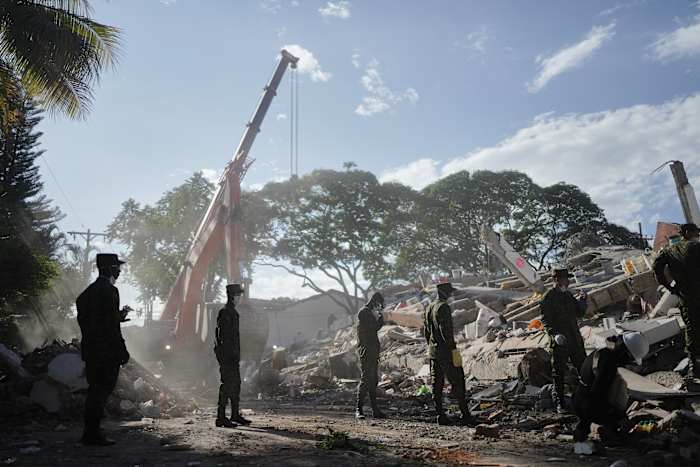
When the earth splits open and concrete floors pancake on top of one another, human instinct screams for noise. Survivors shout for loved ones, families panic in the dust, and emergency responders arrive blaring sirens and revving heavy machinery. But beneath the chaos of a collapsed building in Colombia, the most valuable commodity is not heavy equipment or specialized medical gear.
It is absolute silence. Read more on a connected subject: this related article.
As the critical window for survival rapidly narrows following a major seismic event in the Andean region, rescue coordinators are once again forced to wage a secondary battle against well-meaning crowds, erratic onlookers, and the sheer sensory overload of disaster zones. The directive is brutal in its simplicity. Stop talking. Turn off the engines. Shut down the generators.
Without quiet, the acoustic locators cannot pierce the rubble. Without silence, the faint tapping of a trapped hand against a steel rebar goes entirely unheard. Further analysis by The New York Times highlights similar views on this issue.
Operating in Colombian disaster zones requires navigating a complex labyrinth of geographic hazards, structural engineering failures, and spontaneous community responses. Having spent decades covering humanitarian crises, search and rescue operations, and structural collapses across Latin America, I have seen firsthand how the first seventy-two hours dictate survival statistics. The physics of structural collapse are unforgiving, but the human factor often determines whether a victim walks away or remains beneath the debris.
The Physics of Acoustic Extraction in Seismic Zones
To understand why rescue teams enforce strict periods of silence, one must understand how sound travels through dense, fractured material. When an earthquake triggers a structural failure, floors do not always crumble into dust. Frequently, they drop vertically, creating void spaces where pockets of air remain trapped alongside living human beings.
These voids act as resonance chambers. A sharp sound made by a survivor inside a concrete pocket can travel along steel beams and solid slabs for surprising distances. However, ambient noise acts as an acoustic blanket.
Diesel engines vibrating at low frequencies, helicopters hovering overhead to film broadcast footage, and the voices of anxious relatives standing twenty feet away create a wall of white noise. This environmental noise completely masks the micro-frequencies of human distress. Seismic rescue units utilize ultra-sensitive acoustic listening devices equipped with geophones and directional microphones. These sensors can detect the slightest sound waves bouncing through concrete and soil.
If the background noise level exceeds specific decibel thresholds, the equipment becomes useless. The operator hears nothing except the rumble of the surrounding city.
Creating a window of silence means freezing an entire perimeter. For twenty or thirty minutes at a time, heavy machinery stops moving. Rescuers drop to their knees, placing their ears against fractured pillars or staring at digital readouts connected to structural probes. It is an exercise in agonizing patience. Every second spent in silence is a second lost from excavation, yet it is the only method proven to pinpoint a live body beneath tons of deadweight.
Structural Vulnerabilities and the Colombian Reality
Colombia sits atop one of the most seismically active regions on the planet, cradled by the convergence of the Nazca, Caribbean, and South American tectonic plates. Cities built into Andean valleys face unique geological amplifiers. Seismic energy bounces off mountain walls, compounding tremors and stressing buildings from multiple angles simultaneously.
Despite stringent updates to modern building codes, a vast percentage of residential and commercial structures in urban centers predate these regulations. Informal construction, common in the sprawling barrios of major Colombian cities, often relies on unreinforced masonry, substandard concrete mixes, and structural modifications made without engineering oversight.
When an earthquake strikes these areas, the failure mode is catastrophic. Buildings do not merely settle; they implode into a dense aggregate of brick, gravel, and unyielding wire mesh.
This specific type of debris creates a nightmarish environment for rescue workers. Unlike large steel-frame skyscrapers that leave predictable voids, informal multi-story brick constructions crush down into a tightly packed matrix. Air pockets are smaller, more fragmented, and harder to access.
When rescue teams yell for silence in these environments, they are listening for a very narrow window of human capability. Dehydration, dust inhalation, and crushing injuries rapidly diminish a survivor's physical strength within the first forty-eight hours. By day three, a trapped individual barely has the energy to draw a deep breath, let alone shout or pound rhythmically against a wall. The margin for acoustic detection shrinks with every ticking clock.
The Psychology of Chaos at the Disaster Perimeter
The hardest part of a rescue operation is rarely the concrete. It is the crowd.
Disaster sociology demonstrates that spontaneous volunteers and anxious family members rush to the scene of a collapse long before professional civil defense units can establish secure perimeters. This reaction is entirely human. When a mother knows her child is inside a collapsed school or apartment block, telling her to stand back and stay quiet feels like an impossible cruelty.
Yet, the emotional friction between security forces and the public creates critical delays. In many Colombian municipalities, local police and civil defense volunteers lack the numbers to maintain large security cordons. Crowds press tightly against the outer edges of the rubble pile. Cell phones ring loudly. People shout updates to reporters or argue with rescue coordinators about where to dig first.
This dynamic forces rescue commanders to divert valuable personnel away from actual extraction work simply to police the perimeter and enforce quiet zones.
Field commanders have learned that direct confrontation rarely works. Explaining the science of acoustic resonance to a grieving relative is an exercise in frustration. Instead, successful operations rely on community leaders and local priests to act as intermediaries. When local authorities build trust by providing transparent updates during the mandatory listening windows, the crowd is far more likely to self-police the noise level.
Public compliance hinges entirely on communication. If people understand that the silence is actively saving lives rather than delaying work, cooperation spikes dramatically.
Technological Limitations and the Human Element
There is a persistent myth that modern technology has rendered traditional search methods obsolete. We hear endless discussions about thermal imaging drones, ground-penetrating radar, and artificial intelligence scanning satellite imagery.
While these tools play an important supporting role, none of them replace the combination of a trained rescue dog and an acoustic listening post.
Thermal cameras struggle to detect body heat through multiple layers of reinforced concrete and thick dust blankets. Ground-penetrating radar is easily confused by the chaotic internal geometry of a collapsed building, where rebar, electrical wiring, and broken furniture create a maze of false echoes. K-9 units remain extraordinarily effective, but scent cones are easily disrupted by shifting winds, chemical spills, and the overwhelming smell of dust and fuel present at every disaster site.
This leaves acoustic detection—and the absolute silence required to make it work—at the center of the operation.
When the call for silence echoes across the site, it strips away the illusion of human control. For a few brief minutes, hundreds of people stand frozen in the dust, listening to the void. It is a humbling reminder of our vulnerability in a landscape shaped by tectonic forces beyond our design. The silence is not a passive pause in the workflow. It is an active, demanding search tool, weaponized against the chaos of the collapse to pull the living back into the light.