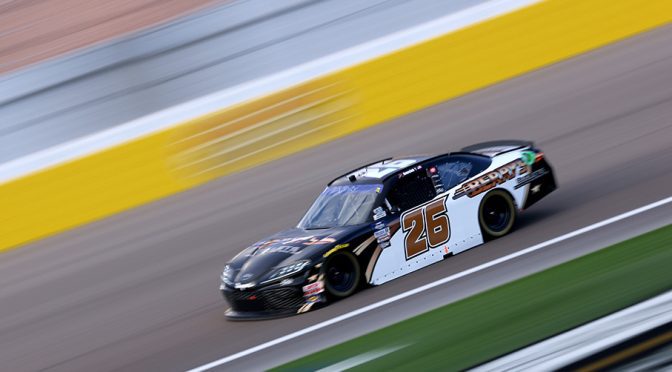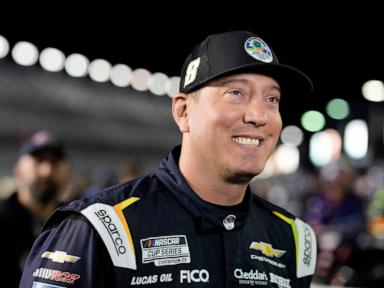
The air in Las Vegas always carries a hint of grit, a dry heat that sticks to the back of your throat and reminds you that the desert is never far away. But on this particular morning, the stillness felt different. It wasn't the heavy, expectant heat of a race day at the Motor Speedway. It was the kind of silence that happens when a clock suddenly stops ticking in a quiet room.
Kyle Busch was 41.
In the world of professional racing, 41 is a strange age. You are no longer the "young gun" terrifying the veterans with reckless slide jobs, yet you aren't quite the elder statesman ready to spend your Sundays in a rocking chair on a porch in North Carolina. You are in the sweet spot of iron-clad experience and lingering physical prime. You are supposed to have a decade of noise left in you.
Then, the noise stopped.
The news of his passing didn't just ripple through the garages of Mooresville; it leveled them. We are talking about a man who didn't just drive cars—he provoked them into submission. To understand what was lost when Kyle Busch’s heart stopped, you have to understand the specific, polarizing electricity he brought to the asphalt. He was the villain you couldn't help but respect, the "Rowdy" soul who turned every checkered flag into a personal statement of defiance.
The Man Who Refused to Be Liked
To see Kyle Busch in the rearview mirror was to feel a physical pressure. He drove with a sort of controlled desperation, as if every lap was a debt he had to pay back with interest. Most drivers want to be loved. They cultivate a sponsor-friendly smile and speak in the polished, sanded-down sentences of a corporate press release.
Kyle didn't do that.
He was the guy who would bow to a booing crowd. He leaned into the friction. If the fans wanted a black hat, he’d wear it, but he was going to win while doing it. There is a specific kind of integrity in being exactly who you are, regardless of how many beer cans are thrown your way after a win.
Consider the sheer mechanics of his career. Two Cup Series championships. Over 200 wins across NASCAR’s top three national series. These aren't just numbers on a spreadsheet; they are thousands of hours spent at 200 miles per hour, where a single degree of steering input is the difference between a trophy and a trip to the local trauma center.
The physical toll of that life is invisible until it isn't. We see the fire suits and the shiny Toyotas, but we don't see the micro-concussions, the adrenaline-ravaged nervous systems, or the way a human body reacts to being strapped into a vibrating, 3,400-pound oven for four hours every Sunday. We treat these men like gladiators made of carbon fiber, forgetting they are made of the same fragile porcelain as the rest of us.
The Brevity of the Fast Lane
Death at 41 is an affront to the natural order of the sport. We expect our legends to gray gracefully. We expect to see them in the Hall of Fame, wearing oversized rings and telling tall tales about the "good old days" when the cars were harder to drive and the safety gear was a suggestion.
When a champion dies young, it forces a Mirror Moment. You look at your own life and wonder: If I only had 41 years, would I have spent them this loudly?
Kyle Busch lived at a higher frequency than most. He wasn't just a driver; he was a team owner, a father, and a husband. He built Kyle Busch Motorsports into a powerhouse, proving that his mind for the sport was just as sharp as his right foot. He was invested in the future of racing, grooming the next generation of kids who would eventually try to knock him off his throne.
The tragedy of a "sudden and tragic" end isn't just the loss of the man, but the loss of the potential. Think of the races he hadn't run yet. Think of the son, Brexton, who was already following in his father's tire tracks. The narrative arc of the Busch family was supposed to be a long, multi-generational saga of dominance. Now, that story has a jagged, unfinished edge.
The Invisible Stakes of the Paddock
The garage area on a race weekend is usually a hive of metallic screams and pneumatic drills. But when the news broke, the mechanics stopped. The engineers stared at their monitors, seeing data points that no longer mattered.
The "invisible stakes" of racing are the bonds formed in the shadows of the haulers. These people spend more time with each other than they do with their own families. They are a traveling circus of speed, bonded by the shared knowledge that what they do is inherently dangerous.
When one of the titans falls—especially one as polarizing and talented as Busch—it creates a vacuum. It’s like a mountain suddenly vanishing from a familiar skyline. You don't realize how much you used the mountain for navigation until you’re looking at an empty horizon.
The fans who spent years booing him found themselves staring at their televisions in disbelief. It turns out that when you lose your favorite villain, you realize he was actually the hero of the show all along. He was the benchmark. He was the one who forced everyone else to be better, faster, and braver.
A Legacy Written in Rubber and Smoke
We often try to find a "lesson" in tragedies like this. We want to believe that there is some grand takeaway that makes the pain feel useful. But sometimes, there isn't a lesson. Sometimes, there is just a profound absence.
Kyle Busch’s life was a masterclass in intensity. He showed us that it is okay to be the person who pushes back. He showed us that greatness doesn't have to be polite. It just has to be undeniable.
The stats will tell you he was one of the greatest to ever sit in a cockpit. The record books will show the wins at Bristol, the dominance at Richmond, and the grit it took to come back from a broken leg in 2015 to win a championship. But the record books won't tell you how it felt to hear that engine roar one last time before the silence took over.
As the sun sets over the desert tonight, the lights of the Las Vegas strip will flicker on, oblivious to the hole left in the world of sports. But for those who spent their Sunday afternoons watching the number 18 or the number 8 slice through traffic, the world is a little quieter, and the air a little heavier.
The race didn't end because the laps ran out. The race ended because the lights went dark. And in that darkness, we are left to remember a man who never knew how to slow down, suddenly forced into a stillness he never asked for.