The air at twelve thousand feet does not just chill the skin; it strips the breath from your lungs before you even realize you are starving.
Standing on the edge of the Qinghai-Tibetan plateau, the world looks entirely indifferent to human presence. The mountains are jagged teeth biting into a pale, bruised sky. The wind howls across the barren flats, carrying no scent of pine or earth, only the metallic taste of high-altitude dust and frozen grit.
This is where the sky meets the soldier.
For decades, the mechanics of modern military might have been written in the abstract. We read about defense budgets, tonnage, troop deployments, and logistical arcs as if they were lines on a dry-erase board. We forget that behind every statistic, every tactical projection, and every geopolitical chess move, there is a human being strapped into a harness, staring out the open door of a transport aircraft, listening to the roar of twin turbines, and calculating whether today is the day gravity wins.
Then, the official bulletin drops.
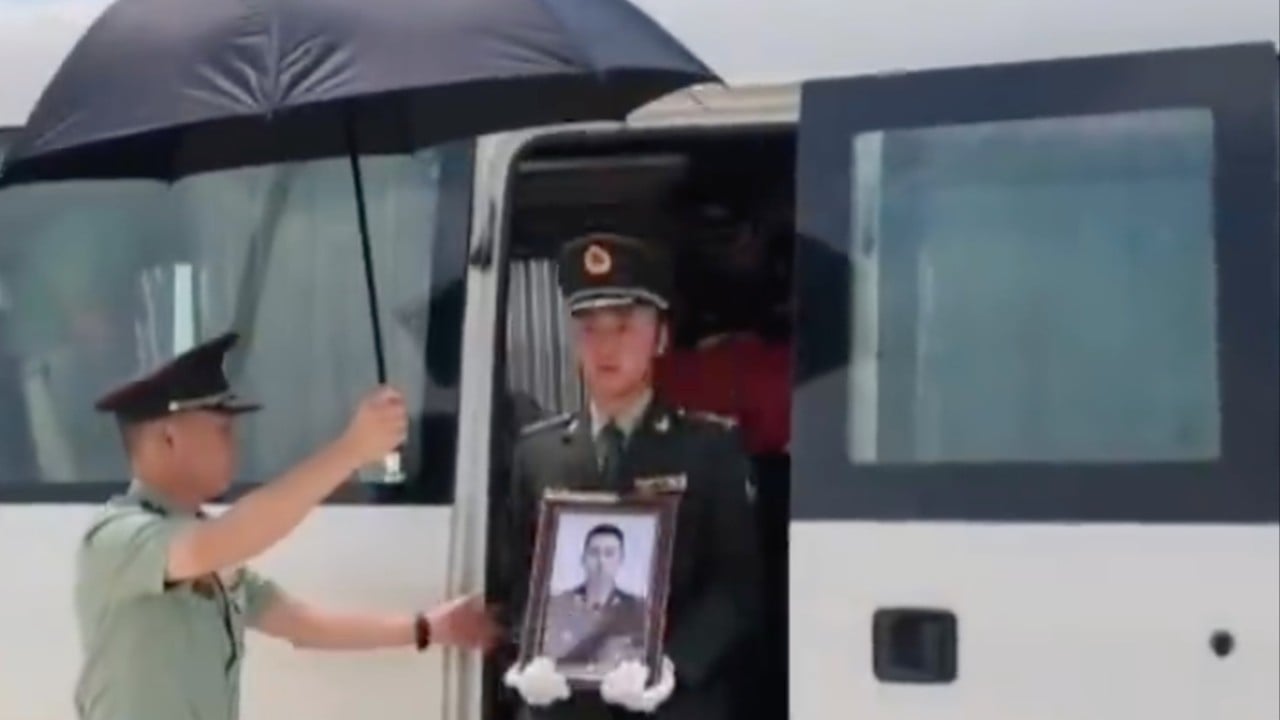
Beijing acknowledges a casualty. A Chinese paratrooper, young, rigorously trained, wrapped in layers of high-tech synthetic gear designed to withstand the brutal atmospheric pressure of a high-altitude jump, is dead. Not in the theatrical fire of an international conflict, but in the grinding, unromantic crucible of a military exercise.
Silence follows.
To understand what happened in Qinghai, you have to understand the peculiar psychology of modern military expansion. When a nation pushes its armed forces into extreme environments, it is not merely testing equipment. It is testing the absolute limits of human biology against the relentless laws of physics.
Consider what happens inside a transport cabin during a high-altitude, low-opening drop. The temperature plummets far below zero. Oxygen is scarce enough to make vision blur at the edges. The jumpmaster does not need to shout; a tap on the shoulder is enough. You step out into a void that feels less like the sky and more like an open ocean of nothingness.
For a brief, terrifying second, you are weightless. Then the wind catches you. It does not just push against your suit; it tries to tear your limbs from their sockets.
When things go wrong in these moments, they do not go wrong slowly. They unravel in fractions of a second. A deployment line tangles. A reserve chute fails to clear the slipstream. The altimeter spins past the danger zone while the mind struggles to process the math of survival through a fog of hypoxia.
The official statements are always models of bureaucratic restraint. They speak of unfortunate accidents during routine training. They offer sanitized condolences. They file the incident away in the ledger of operational costs.
But a human life is not a line item.
Behind the uniform was a person who likely spent weeks in a damp barracks facility, eating mess-hall rice, writing quiet letters home that glossed over the danger, and obsessively checking the buckles of their parachute rig. They were someone who knew the statistics. They knew that training casualties are the dark, unspoken tax paid by any military striving to project power across unforgiving terrain.
The Qinghai exercises are not happening in a vacuum. They are part of a massive, sweeping modernization effort. For years, observers have watched the People's Liberation Army transform from a massive, infantry-heavy defensive force into a lean, highly mobile expeditionary machine. They want airborne brigades that can deploy anywhere along contested borders within hours. They want troops capable of operating in the thin, unforgiving air of the world's highest plateaus.
Ambition demands victims. That is the grim, unspoken truth of geopolitical competition.
When you build a force designed to master the roof of the world, the roof of the world fights back. The altitude does not care about your five-year plan. The sudden downdrafts sweeping off the Himalayan foothills do not respect national sovereignty or military doctrine. They are pure, unfeeling physics.
When Beijing publicly acknowledges a training death, it signals a shift in how information is managed, yet it also exposes the raw vulnerability inherent in rapid escalation. In the past, such losses might have been buried beneath layers of institutional secrecy, dismissed as minor operational friction. To acknowledge it now is to stare the cost directly in the face. It is an admission that the machine has teeth, and sometimes, it feeds on its own.
We must look past the geopolitical theater to grasp the human weight of these moments.
Down in the valleys, far from the howling winds of Qinghai, families wake up to a world that has fundamentally broken. A knock on a door. A pair of officers standing in the quiet morning light. The sudden, suffocating realization that the phone call will never come.
The geopolitical analysts will spend weeks parsing what this exercise means for regional stability. They will measure the readiness rates of airborne units and debate the strategic implications of high-altitude projection. They will treat the soldier's death as a data point in a much larger puzzle.
They are missing the story.
The story is the sound of the wind over the plateau. The story is the quiet dignity of a mother folding a pristine uniform. The story is the terrifying reality of what nations ask of their young men and women in the name of power and prestige.
Gravity does not take sides. It does not negotiate. It simply waits for the moment our preparation falls short of our ambition.
And high above the plains of Qinghai, the wind keeps blowing, indifferent to the lives it touches, and the ones it takes.


