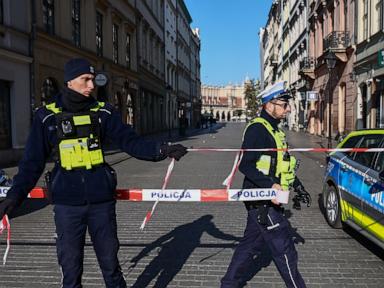
Silence.
In a Polish provincial town on a Tuesday morning, silence has a specific, heavy texture—the smell of damp cobblestones after a night rain, the rhythmic clatter of a tram three blocks over, the hiss of an espresso machine waking up behind a frosted windowpane. For decades, that quiet was not merely the absence of noise. It was a social contract, an unspoken guarantee forged out of hard history and strict civic order that violence of a certain, chaotic, imported kind simply did not happen here.
Then comes the sound that does not belong.
Not a backfiring engine. Not fireworks left over from a saint’s day festival. A sharp, percussive crack that splits the morning air into a before and an after, followed by another, and another, until the mind stops trying to translate the noise into something benign and accepts the unthinkable.
When Polish prosecutors announced that a deadly mass shooting was being investigated not merely as a tragic criminal outburst, but as an act of terror, the words landed like lead in the national bloodstream. To an outside observer scanning headlines from thousands of miles away, the distinction might seem semantic—a matter of legal filing codes and jurisdictional turf. Murder is murder. Grief is grief.
Yet inside the courtroom, inside the intelligence briefings, and around the kitchen tables of a nation suddenly staring at police tape across a familiar street, that single legal classification changes everything.
The Architecture of a Broken Assumption
To understand why a terror investigation in Poland carries such existential weight, you have to understand the baseline of daily life across Central Europe. Unlike nations where active-shooter drills have become a grim rite of passage for schoolchildren, Poland has long maintained some of the strictest firearm regulations in the European Union. Civilian gun ownership rates hover near the bottom of continental charts—roughly two and a half firearms per hundred residents, heavily skewed toward licensed hunters and sport shooters subjected to rigorous psychological evaluations and background checks.
Statistically, a Polish citizen is exponentially more likely to be struck by lightning or injured on an icy winter footpath than to face an armed assailant in a public square. That statistical cushion bred a particular kind of civic ease. People walked home alone at midnight without glancing over their shoulders. Crowds gathered in town squares for summer concerts without concrete bollards blocking every alley.
Consider a hypothetical commuter—let us call her Anna, a thirty-four-year-old archivist waiting at a bus shelter just fifty meters from the perimeter tape. In our imagined reconstruction of that morning, Anna is not thinking about geopolitical threat matrices or lone-actor radicalization pipelines. She is thinking about whether she remembered to turn off the kettle and whether her son’s winter boots still fit. When the first shots ring out, her brain refuses the data. She steps off the curb to look, not out of recklessness, but because her entire lived experience has trained her to expect a dropped pallet of bricks or a blown tire.
That fraction of a second—the lag between reality and comprehension—is the exact vulnerability that terrorism exploits.
Crime Versus Terror
Why do prosecutors reach for the terror statute when standard homicide charges already carry life imprisonment?
Think of ordinary violent crime as a house fire caused by faulty wiring. It is devastating, lethal, and demands an immediate emergency response, yet its destruction is contained to the structure where it began. Terrorism, by legal definition and psychological design, is arson committed in a dry forest during a gale. The primary target is never solely the people caught in the immediate blast radius or line of fire. The target is the nervous system of everyone else watching from a safe distance.
Under Article 115 of the Polish Penal Code, an offense crosses the threshold into a terrorist act when it is committed with the intent to seriously intimidate a large number of people, compel a public authority to undertake or abstain from specific actions, or cause severe disruption to the political, constitutional, or economic system of the state.
Notice the shift in focus.
In a conventional murder trial, prosecutors reconstruct a personal grievance—a debt unpaid, a domestic rupture, a sudden intoxication-fueled rage. The motive turns inward, toward a specific victim or a narrow circle of acquaintances. When the state invokes anti-terror laws, the prosecution is arguing that the victims were chosen precisely because they were interchangeable. They were stand-ins for an idea, a demographic, a uniform, or simply the public itself.
That legal pivot triggers an immediate cascade behind the scenes. Local police detectives step back as the Internal Security Agency—Poland’s ABW—takes command of the digital forensics. Encrypted messaging apps, fringe forum histories, cross-border financial transfers, and ideological manifestos suddenly become the centerpiece of the inquiry. The investigation ceases to be about who pulled the trigger and becomes an urgent interrogation of what fed the trigger finger.
The Invisible Stakes of the Label
There is a quiet danger in how quickly the word "terror" travels from a prosecutor’s podium to a television chyron. Once spoken, it cannot be walked back without sounding dismissive of the dead.
I remember standing outside a courthouse in Warsaw years ago during another high-profile security trial, watching how the mere rumor of extremist involvement altered the posture of everyone in the plaza. Mothers pulled their children closer to their coats. Shopkeepers locked their doors twenty minutes early. Nothing in the physical environment had changed since morning, yet the air felt thinner, charged with a low-grade static that made every raised voice sound like a threat.
Fear is a tax collected in installments. You pay it every time you scan the exits of a train station. You pay it when you hesitate before attending a public rally. You pay it when suspicion begins to curdle the ordinary trust between neighbors who speak with different accents or worship in different buildings.
And prosecutors know this. They walk a razor’s edge between transparency and amplification. If they withhold the terror designation to keep the public calm, they risk accusations of a cover-up, of sanitizing an ideological threat to protect political incumbents. If they declare it too early—before forensic teams have separated genuine ideological commitment from severe, untreated psychosis—they hand a lone, fractured individual the exact grandiosity they craved.
History offers sobering precedents across Europe. In Munich in 2016, an eighteen-year-old gunman killed nine people at a shopping mall; investigators spent months untangling whether the attack constituted far-right political terrorism or an apolitical rampage modeled on school shootings, ultimately concluding the two impulses had fused into an inseparable hybrid. In Oslo, in Kongsberg, in Hanau, European justice systems repeatedly confronted a modern phenomenon that defies neat twentieth-century categories: the self-radicalized actor who absorbs extremist aesthetics online the way a sponge absorbs dirty water, without ever receiving orders from a foreign cell or swearing allegiance to a formal hierarchy.
What Happens Inside the Investigation
When a Polish prosecutor opens a terror file, the clock starts ticking differently. Standard investigative procedures are replaced by extraordinary statutory powers designed for national security emergencies.
First comes the digital autopsy. Investigators seize phones, hard drives, router logs, and cloud backups, working backward through months of search histories and encrypted chat threads. They are looking for a watershed moment—the point where passive grievance hardened into operational planning. Did the suspect purchase ammunition in small, staggered batches to evade automated red flags? Did they conduct physical reconnaissance of the site, testing sightlines and police response times?
Second comes the ideological audit. Modern extremism rarely arrives in a single, tidy ideological package. Prosecutors frequently uncover a patchwork of contradictory obsessions—anti-state conspiracy theories stitched onto xenophobic manifestos, grievance-fueled misogyny blended with apocalyptic accelerationism. The legal burden is steep: to sustain a terror conviction in a Polish court, prosecutors must prove beyond a reasonable doubt that intimidation of the public or coercion of the state was a primary objective, not merely a byproduct of madness.
Third, and perhaps most quietly, comes the reckoning with weapon acquisition. In a country where legal firearms require medical clearances, written exams, and secure gun safes subject to unannounced police inspections, every illicit weapon leaves a trail of systemic failure. Was the firearm smuggled across porous eastern borders awash in surplus ordnance from regional conflicts? Was it a deactivated collector’s piece illegally converted back into live-fire capability in an underground workshop? Or did a licensed owner slip through a bureaucratic crack?
Each answer points to a different vulnerability that parliamentarians will argue over for years.
The Myth of Immunity
For a long time, Central Europe consoled itself with a quiet geographic exceptionalism. Mass shootings were an American pathology, born of a unique constitutional culture and an ocean of civilian weaponry. Coordinated terror attacks were a Western European burden, the bitter harvest of colonial legacies and entrenched urban enclaves. Poland, homogeneous and tightly regulated, believed itself insulated from both currents.
That illusion does not survive contact with a hyper-connected world.
Radicalization no longer requires a physical safe house in a distant capital or a smuggled suitcase of pamphlets. It happens at two in the morning in a quiet bedroom in Kraków, Gdańsk, or a town too small to appear on international weather maps, illuminated by the blue glow of a monitor feeding an endless stream of grievance and instructional violence. Borders drawn on physical maps mean very little to algorithms optimized to keep angry people scrolling until anger curdles into action.
To admit this is not to surrender to panic. It is simply to grow up about the nature of modern risk. Security is never a permanent condition achieved once and locked in a vault; it is a daily maintenance project, fragile and imperfect.
The Morning After the Tape Comes Down
Eventually, the forensic vans pull away from the curb. Municipal workers scrub the dark stains from the paving stones with high-pressure hoses, and the yellow police tape is rolled up and tossed into the back of a patrol car. The tram resumes its regular schedule, clattering past the intersection every eleven minutes as it has for half a century.
Outwardly, the town looks identical to the photograph taken forty-eight hours earlier.
Yet watch the people crossing that square on the first morning after the barricades are lifted. Look at how their eyes linger a beat longer on an unattended backpack beside a bench. Notice how a sudden slam of a delivery van’s rear doors makes three pedestrians flinch in unison before they catch themselves, force a tight smile, and keep walking.
A prosecutor can file an indictment. A judge can hand down a sentence of life without parole. Legislators can tighten background checks and expand intelligence budgets. None of those institutions can refund the innocence of a Tuesday morning when a loud noise was just a dropped crate of bricks, and silence was something you never had to think about at all.