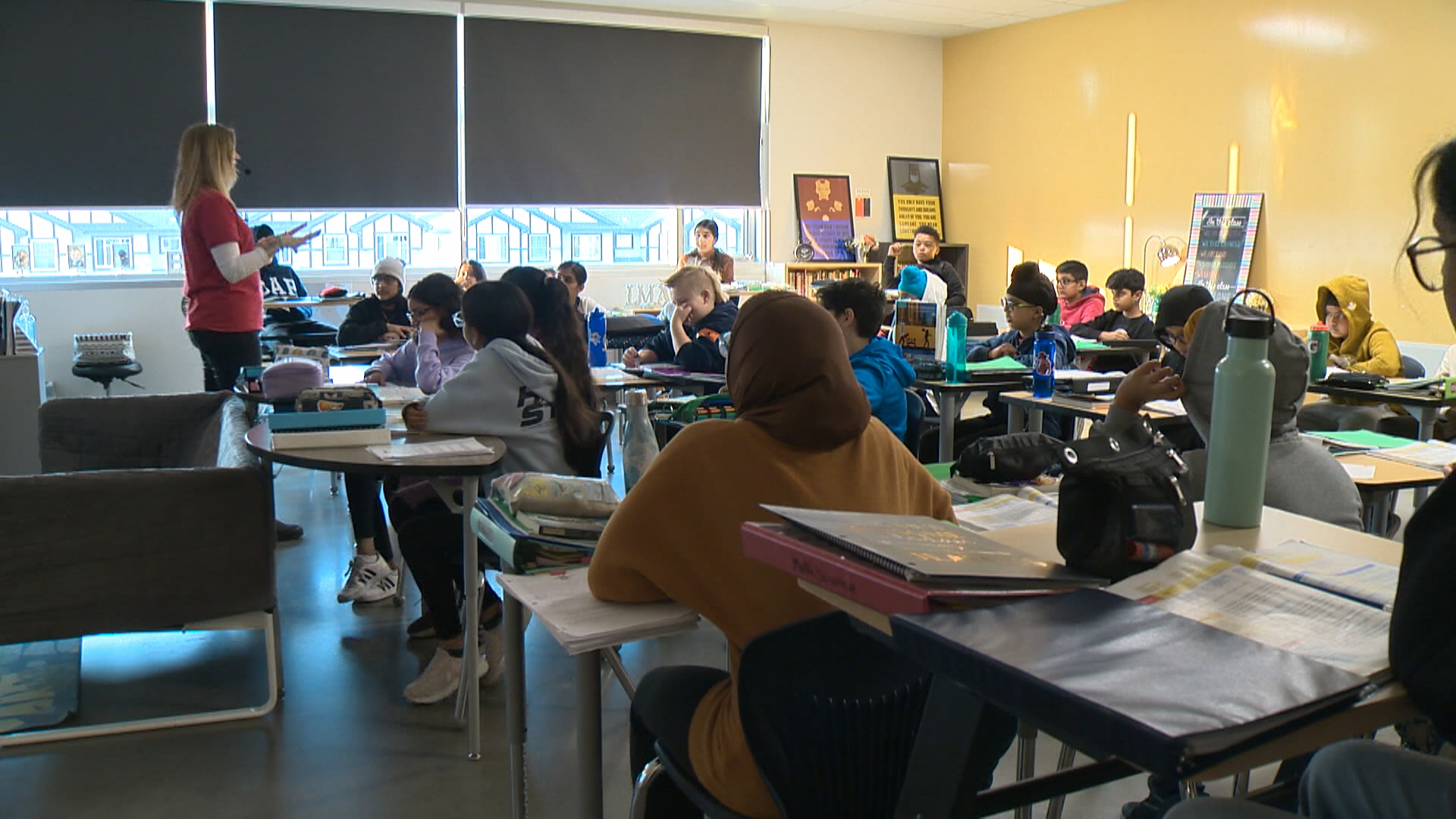
Mrs. Gable used to keep a small, ceramic owl on her desk. It watched over thirty-two Grade 11 students as they wrestled with the complexities of the 20th century. When a student asked her what she thought about a controversial government policy or a social movement flickering across their phone screens, she would tilt her head, much like the owl, and ask, "What do the facts tell you?"
She was a master of the middle ground. But today, that middle ground is no longer a personal teaching philosophy. It is becoming the law.
In Alberta, the air in the hallways has shifted. The provincial government is moving to mandate "neutrality" in the classroom. On paper, it sounds like the ultimate virtue—the gold standard of fairness. But as the chalk dust settles, teachers, parents, and students are realizing that neutrality is rarely a vacuum. It is a weight.
The Weight of the Scales
Imagine a scale. On one side, you have a historical event, a scientific discovery, or a social shift. To keep the scale perfectly level, you must find an equal and opposite weight to place on the other side. This is the essence of the new mandate. Teachers are being told that when they present "controversial" topics, they must provide a balanced perspective.
The problem is that "balance" is a subjective art form masquerading as a mathematical certainty.
Take a hypothetical student named Leo. Leo is seventeen, fueled by caffeine and a desperate need to understand why his world feels like it’s vibrating at a high frequency. He walks into Social Studies and asks about climate change. Under the new guidelines, his teacher cannot simply point to the melting glaciers or the carbon data. They must also present the counter-narrative with equal vigor.
But what happens when the "other side" of a fact is an opinion? Or when the "other side" of a human right is a debate about whether that right should exist at all?
The invisible stakes here aren't just about what is taught, but what is silenced by the fear of getting it wrong. A teacher who fears a disciplinary hearing for being "unbalanced" is a teacher who stops taking risks. They stop pushing students to think critically because the safest path is to say nothing at all.
The Cost of a Quiet Classroom
Education was never meant to be a sterile transmission of data. It is a contact sport. It requires the friction of ideas rubbing against one another to create the heat of understanding.
When we mandate neutrality, we risk creating a generation of "both-siderists." These are people who believe that because there are two sides to every story, both sides must hold equal truth. But the world doesn't work that way. Sometimes, one side is supported by a mountain of evidence, and the other is a molehill of misinformation.
In the staff rooms of Calgary and Edmonton, the coffee is growing cold as teachers whisper about the "neutrality police." They aren't worried about being fair; they’ve spent their careers trying to be fair. They are worried about the loss of nuance.
Consider the complexity of teaching the history of Residential Schools. For decades, the "other side" of that story was a curated silence. Now that the truth has been brought into the light, how does a teacher "balance" the systemic trauma of a generation? Does balance mean giving time to the "benefits" of forced assimilation? To do so would be a betrayal of the facts, yet the mandate looms like a shadow over the lesson plan.
The Myth of the Blank Slate
There is a persistent belief among some policymakers that children are blank slates, and teachers are ideological painters trying to stain them with their own colors. This view underestimates students.
Students like Leo don't want to be told what to think, but they also don't want to be left in a fog of ambiguity where every truth is negotiable. They see through the performance of neutrality. They know when a teacher is holding back, and they interpret that hesitation as a lack of courage or, worse, a lack of honesty.
The mandate aims to protect students from indoctrination. It’s a noble goal. No parent wants their child to be a mouthpiece for a teacher’s personal politics. However, the mechanism of this protection—the forced balancing of all issues—creates a different kind of indoctrination: the belief that truth is a matter of geography, depending entirely on where you stand.
The New Architecture of the Mind
If you change the way a child is allowed to discuss a problem, you change the way they think about it.
The Alberta government argues that this move will ensure schools remain "halls of learning, not political battlegrounds." It is a compelling soundbite. It resonates with parents who are exhausted by the polarization of the modern world. They want their kids to learn math, reading, and science without the "noise" of the culture wars.
But the "noise" is actually the sound of a democracy breathing.
When we strip away the ability to weight evidence—to say "this is more likely true than that"—we are teaching children to be spectators of their own lives. We are training them to wait for a consensus that may never come before they feel allowed to form a conviction.
The math is simple:
$Neutrality \neq Objectivity$
Objectivity is the pursuit of truth regardless of where it leads. Neutrality is the refusal to lead at all.
The Ghost in the Room
There is a ghost haunting this legislation. It’s the ghost of the "Uncomfortable Truth."
In a neutral classroom, discomfort is a red flag. If a topic makes a segment of the population uncomfortable, the instinct under this mandate will be to "balance" it until it is smooth, round, and utterly harmless. But learning is supposed to be uncomfortable. It is supposed to challenge the stories we tell ourselves at the dinner table.
I remember a teacher who once stood in front of my class and said, "I’m going to tell you something today that will make you angry. I want you to sit with that anger and figure out where it’s coming from."
That wasn't an act of bias. It was an act of invitation.
Under the new Alberta rules, that teacher might be looking over their shoulder. They might be wondering if a parent will file a complaint because their child came home "unbalanced."
The Ripple Effect
The impact of this policy won't be felt in a single day. It will be a slow erosion. It will be the book that isn't assigned because it’s too "one-sided." It will be the guest speaker who isn't invited because finding a "counter-speaker" is too much of a logistical headache. It will be the student who stops raising their hand because they realize the answer they’ll get is a rehearsed shrug.
Alberta is often seen as a pioneer—a province that isn't afraid to go its own way. In this case, it is leading the charge into a wilderness of equivalence.
The irony is that in the name of removing politics from the classroom, the government has performed a deeply political act. They have defined what is "controversial" and what is "settled." They have placed themselves in the chair at the front of the room, holding the red pen, deciding which weights are heavy enough to tip the scales.
Mrs. Gable’s ceramic owl is gone now, tucked away in a box as she prepares for a new year under new rules. The owl symbolized wisdom—a quality that requires the ability to see in the dark, to discern the shape of things when others see only shadows.
Wisdom is not neutral. It is discerning.
As the bells ring across the province this fall, the question won't be whether the teachers are being balanced. The question will be whether the students are still being taught how to see.
The classroom door closes. The lesson begins. But the most important part of the conversation has already been left out in the hall.