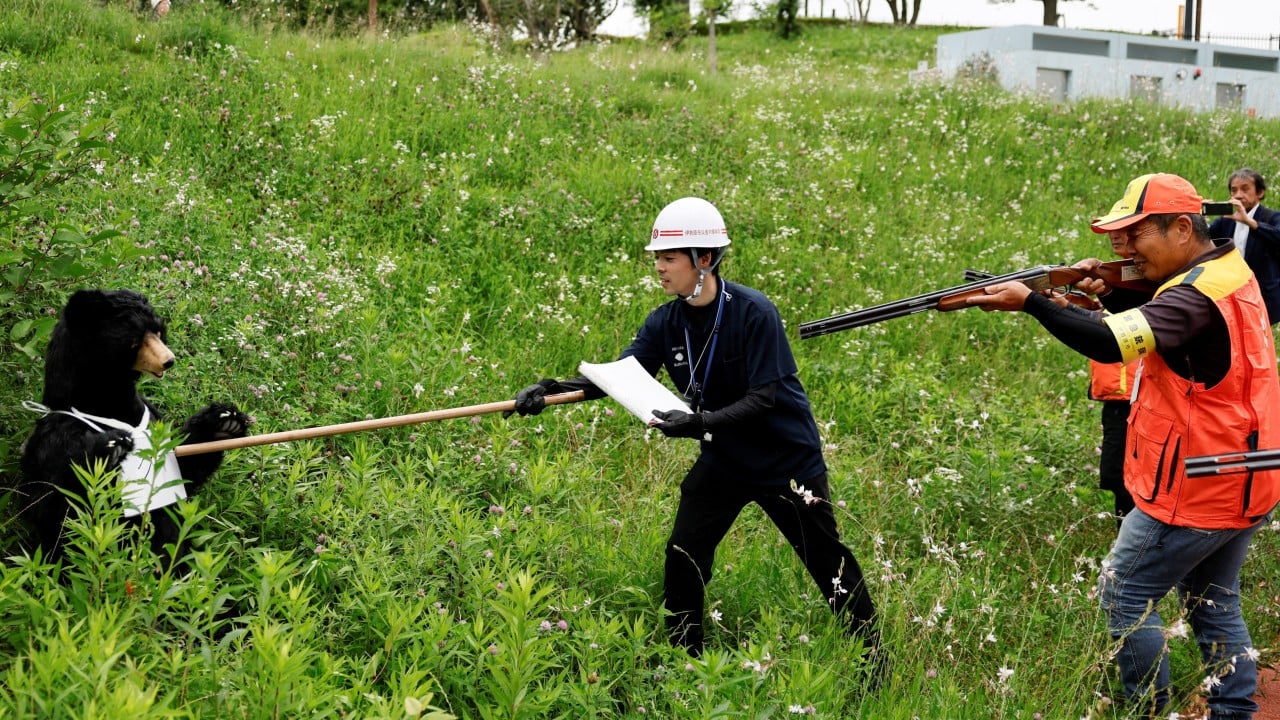
The bell attached to Kenji’s pack gave a rhythmic, metallic clink with every step he took through the damp undergrowth of the Akita Prefecture forest. In northern Japan, that sound used to be a guarantee of safety. It was a polite warning to the Asian black bears roaming the mountains: I am human, I am here, please step aside. Lately, the bells are falling silent. Or rather, the bears have stopped listening.
As rural villages empty out due to Japan's aging population, the traditional border between human civilization and the wild wilderness—known locally as the satoyama—has begun to dissolve. Abandoned rice paddies have grown into dense brush. Persimmon trees in untended yards hang heavy with sweet fruit, acting as giant, neon neon signs welcoming predators into suburban backyards. The bears are moving in, and the consequences have turned deadly.
For decades, the standard response to a bear entering a town was simple, swift, and brutal. Hunters, mostly aging men in their seventies and eighties, would track the animal down and kill it. But dead bears don't teach lessons to the rest of the population. And a dwindling pool of hunters means the old ways are no longer sustainable.
Akita needed a new language to speak to the forest. They found it in a piece of glass no larger than a grain of rice.
Imagine standing in the twilight on the edge of a sleepy mountain village. The air smells of damp cedar and woodsmoke. A shadow detaches itself from the treeline—four hundred pounds of muscle, claws, and dense black fur. In the past, this moment meant a frantic call to the local town hall, followed by a dispatch of elderly men with rifles. Today, that same bear might be carrying a tiny capsule under its skin, whispering data to satellites orbiting miles above the Earth.
The concept sounds like science fiction, but it is a grounded, bureaucratic reality unfolding right now in northern Japan. When a bear wanders too close to human habitation and is safely captured in a box trap, wildlife officials don't automatically reach for a weapon. Instead, they bring out a syringe.
They inject a microchip—a Passive Integrated Transponder (PIT) tag—into the bear's shoulder.
This isn't about tracking the animal's every heartbeat in real-time like a high-tech spy movie. These microchips serve a much more psychological purpose. When combined with GPS collars and a network of trail cameras, the chips allow researchers to build a digital biography of every troublesome bear. They log its age, its health, its sex, and most importantly, its history of human interaction.
If a bear is caught raiding an apple orchard for the first time, it gets chipped, tagged with an ear marker, and released deep back into the mountain forests, far away from the tempting scent of compost bins and fruit trees. The release is accompanied by what biologists call "aversive conditioning." Officials blast air horns, fire firecrackers, and ensure the bear’s last memory of humans is loud, terrifying, and profoundly unpleasant.
The microchip becomes a permanent permanent permanent marker of a second chance.
Consider what happens next: a year later, a bear breaks into a greenhouse in a neighboring town. The authorities trap it. They wave a handheld scanner over its thick fur. A distinct, fifteen-digit identification number flashes on the screen.
Now, the data changes the entire equation. Officials check the database. Is this a first-time offender that simply got lost, or is it a repeat offender that has lost all fear of humans? A bear that ignores aversive conditioning and repeatedly views human towns as a buffet poses a lethal threat. The microchip strips away the guesswork, allowing wildlife managers to make objective, data-driven decisions about whether an animal can be saved or if it must be culled.
The stakes extend far beyond saving individual animals. This technological intervention is a desperate attempt to preserve an ecosystem on the brink of collapse.
When a keystone predator like the Asian black bear is completely wiped out from a region, the forest changes. Acorns and beech nuts drop to the forest floor and rot; the natural pruning and seed dispersal that bears provide vanishes. Deers and wild boars multiply without check, overgrazing the understory and causing massive soil erosion. The mountain degrades. Then come the landslides during the autumn typhoons.
By using technology to manage the bear population rather than eradicate it, Akita is trying to keep the heartbeat of the forest alive.
Yet, the humans living on this shifting frontier are terrified. Talk to the grandmother who no longer walks to her mailbox after noon. Talk to the parents who wait at the bus stop with their children, holding canisters of capsicum bear spray. For them, a microchip feels like a flimsy shield against a creature that can sprint faster than a horse and tear open a corrugated iron barn door with a single swipe of its paw.
The doubt is palpable. Can you really train a wild animal with data?
The answer lies in the numbers emerging from the research stations. The data shows that a significant percentage of bears subjected to the trap-chip-and-release program never return to human settlements. They learn. They retreat into the deep ridges where the beech trees grow thick. The microchips prove that bears are not mindless killing machines; they are highly adaptable opportunists operating on a cost-benefit analysis. When humans make the cost too high, the bears choose the forest.
But the real problem lies elsewhere. The technology is only as good as the humans managing it. GPS collars run out of battery. Microchip scanners require wildlife officers to get close enough to a trapped, furious animal to read the code. And the database requires constant maintenance, funding, and cross-prefectural cooperation. If a chipped bear walks across the mountain ridge into a neighboring prefecture that doesn't use the system, the digital safety net evaporates.
The twilight deepens over Akita. Somewhere up on the ridges of Mount Moriyoshi, a bear shakes the mountain dew from its fur. Beneath that fur, a tiny piece of engineered glass rests silently against its muscle. The bear does not know it has a number. It only knows that the valley below is full of noise, terror, and the strange scent of humans.
Down in the village, a sensor flashes on a researcher's laptop screen. A dot moves away from the red line marking the town boundary, heading back up into the dark, protective canopy of the trees. For tonight, the border holds. Both worlds remain intact, separated by nothing more than a few bytes of data and the ancient, mutual understanding of fear.