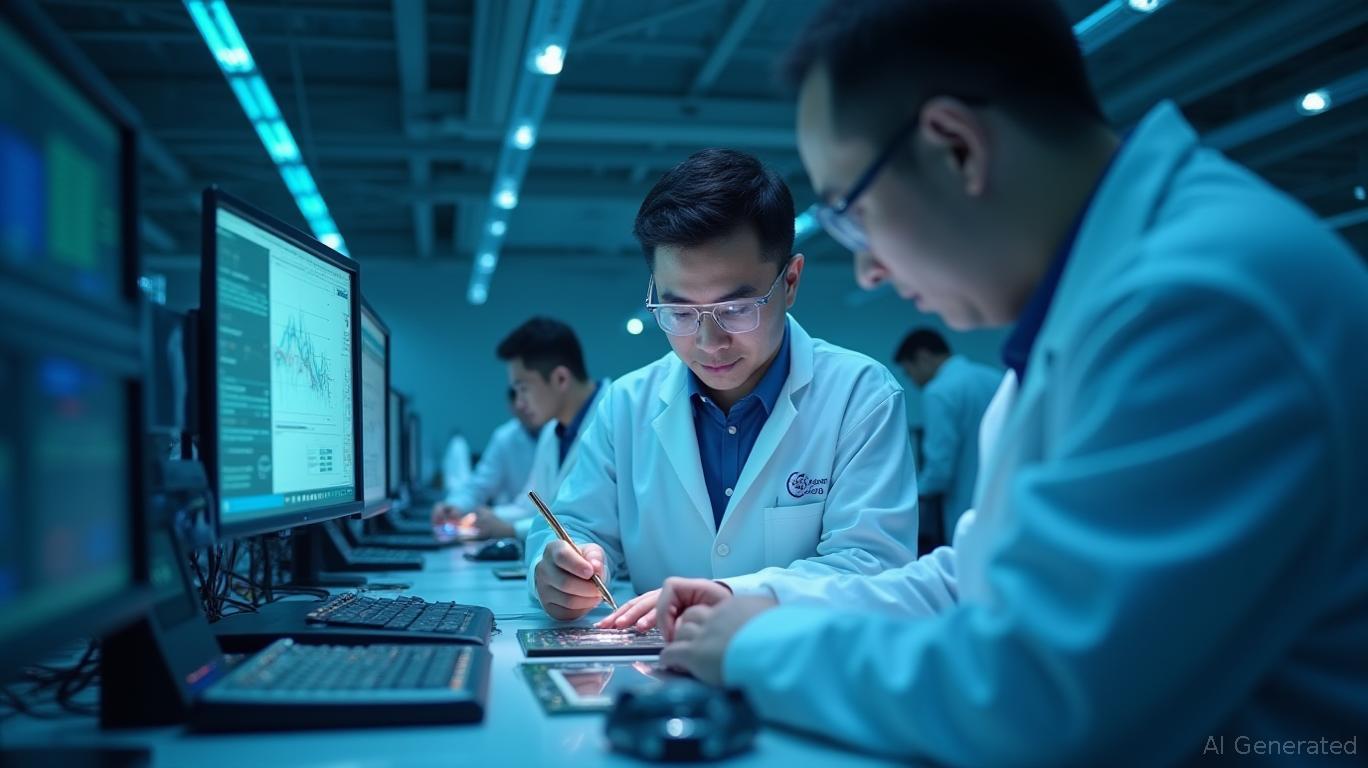
In a quiet, windowless lab in Suzhou, a young engineer named Chen watches a machine the size of a school bus hum with a low, rhythmic throb. It is three in the morning. The air smells of ozone and industrial cooling agents. On the screen in front of him, a microscopic grid of lines begins to take shape. Each line is a thousand times thinner than a human hair. For years, Chen’s team relied on software and hardware designed in California and manufactured in Taiwan. Now, those digital bridges have been pulled up. The gates are locked.
Chen is a hypothetical face for a very real, very massive shift. He represents a generation of Chinese engineers who stopped looking across the ocean for inspiration and started looking at the blueprints on their own desks. They didn't have a choice.
This is the story of how a series of global trade restrictions intended to slow a superpower down instead acted as a pressure cooker, forcing an entire industry to evolve at a speed that defies traditional market logic. In 2024 and 2025, Chinese chip companies didn't just survive; they posted record-breaking revenues. They turned a supply chain crisis into a domestic gold mine.
The Wall and the Well
To understand how we got here, you have to look at the irony of the "U.S. curbs." When Washington began restricted access to high-end semiconductors and the machines that make them, the goal was surgical: prevent China from gaining the "brains" needed for advanced AI and military hardware. But when you cut off a desert from its only spring, the inhabitants don't just sit and wait to get thirsty. They dig a well.
Before the restrictions, a Chinese tech giant might have preferred a chip from Nvidia or Intel. It was safer. It was a known quantity. There was no incentive to take a risk on a local startup that was still finding its feet. The "curbs" changed the psychology of the buyer. Suddenly, buying American wasn't just expensive—it was unreliable. What if the next round of sanctions made it impossible to get replacements? What if the software updates stopped?
Necessity became the ultimate salesman. Chinese firms began buying local, not out of patriotism, but out of survival. This shift created a massive, captive market for domestic players like SMIC and Hua Hong Semiconductor.
The AI Appetite
While the trade war built the walls, Artificial Intelligence provided the fuel. We talk about AI as if it’s a ethereal cloud of logic, but it is deeply, stubbornly physical. It lives in silicon.
Every time a user in Shanghai asks a chatbot to write a poem or a developer in Shenzhen uses an AI tool to debug code, a physical chip somewhere has to sweat. The explosion of generative AI required a gargantuan amount of computing power. While the West focused on the ultra-high-end "GPU" race, the vast majority of the world’s digital infrastructure runs on "mature node" chips. These are the workhorses. They handle the sensors in electric vehicles, the power management in smartphones, and the basic processing in smart cities.
Chinese firms realized they didn't need to win the race for the absolute smallest, most advanced chip to make a fortune. They just needed to own the middle ground. By flooding the market with reliable, locally produced chips for the AI-driven "Internet of Things," they turned a niche into a kingdom.
Consider the numbers. In the last fiscal year, major Chinese chip design and equipment firms reported revenue jumps that would make a Silicon Valley VC blush. Some saw growth exceeding 40 or 50 percent. This wasn't because they discovered a new law of physics. It was because the world’s largest manufacturing hub decided it could no longer afford to be a tenant in someone else’s digital house.
The Invisible Stakes of the "Mature" Node
There is a common misconception that if you aren't making the 3-nanometer chips found in the latest iPhones, you aren't winning. That is a dangerous misunderstanding of how the world actually works.
Think of it like transportation. The 3-nanometer chips are the supersonic jets—impressive, expensive, and rare. But the global economy actually runs on trucks, trains, and delivery vans. Those are the 14-nanometer to 28-nanometer chips. Because China was restricted from building the "jets," they poured every cent of their state-backed billions into building the best "trucks" in the world.
This created a feedback loop. As revenue poured in from these mature chips, Chinese firms gained the capital to fund their own R&D. They started hiring the best talent from around the world. They started filing patents at a rate that suggests the gap between "mature" and "advanced" is shrinking much faster than Western analysts predicted.
The emotional core of this story isn't about spreadsheets or geopolitical posturing. It’s about the loss of interdependence. For decades, the tech world operated on the "Peace through Trade" model. We were too intertwined to ever truly part ways. That era is over. We are seeing the birth of a bifurcated world where two different digital ecosystems grow in parallel, unable to talk to one another, each fueled by a deep-seated mistrust of the other’s hardware.
The Cost of Cold Facts
When we read a headline about "Record Revenue," we should see more than just a line on a graph. We should see the frantic activity in the Shenzhen markets. We should see the sleepless nights of CEOs who are wondering if their entire supply chain will be vaporized by a tweet or a policy memo tomorrow morning.
The "boom" is real, but it is a boom born of anxiety.
This domestic surge has also created a strange kind of "inward-looking" innovation. Since they cannot use certain Western software to design chips, Chinese engineers are writing their own. Since they cannot buy certain Dutch lithography machines, they are attempting to rebuild the most complex machines on earth from scratch. It is the largest engineering "Plan B" in human history.
Some might argue that this decoupling is a good thing for security. Others see it as a tragedy of efficiency—a world where we spend twice the energy to invent the same wheel twice. But the reality on the ground doesn't care about the philosophy. The reality is that the money is flowing. The factories are being built. The talent is migrating.
The Friction of the Future
If you walk through the headquarters of a firm like Naura Technology or AMEC today, the energy is different than it was five years ago. There is a sense of "The Great Task." It’s no longer about competing for a slice of the global pie; it’s about ensuring that if the rest of the world turns off the lights, China can keep the power on.
This self-reliance is expensive. It is inefficient. It is fraught with the risk of bubbles and overcapacity. But it is happening. The revenue records being broken aren't just a sign of business success; they are a ledger of a divorce.
The story of the Chinese chip industry is a reminder that humans are at their most creative when they are cornered. We think we innovate for progress, but more often, we innovate for survival. The "curbs" were meant to be a ceiling. Instead, for a thousand local firms, they became a floor.
Back in the lab, Chen finally sees the pattern he’s been waiting for. The machine finishes its cycle. He picks up the silicon wafer with a pair of tweezers, holding it up to the light. The surface shimmers with an iridescent, oily sheen—the "rainbow" of a successful circuit print. He isn't thinking about trade deficits or the halls of power in D.C. or Beijing. He is thinking about whether this batch will hold a charge.
He places the wafer in a protective case. Outside, the sun is beginning to rise over the industrial parks of Suzhou, illuminating a skyline filled with cranes and new factories, all of them racing to build a future where they no longer have to ask for permission to exist.
The silken threads of global trade are being replaced by walls of cold, hard silicon.


