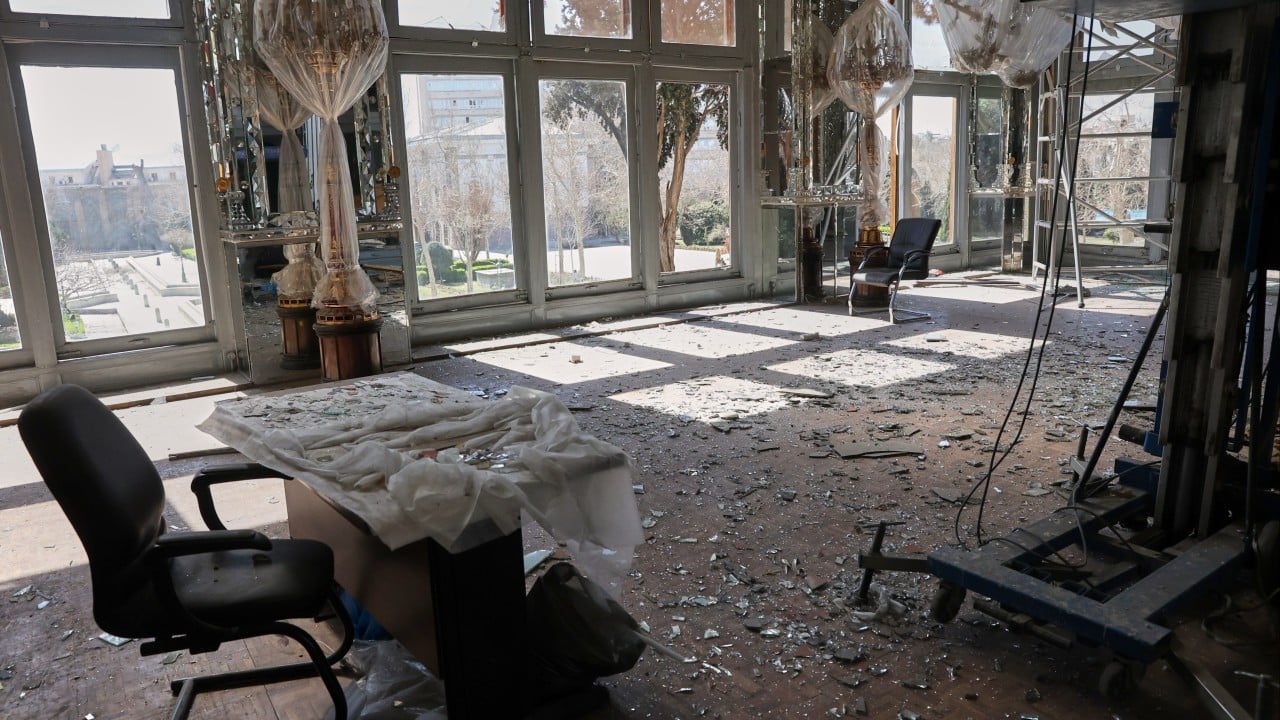
Cultural diplomacy is rarely about the art. It is about the insurance policy. While missiles crisscross Middle Eastern skies and economic sanctions tighten the throat of the Iranian economy, a quiet migration has been occurring. Thousands of years of Persian history—Achaemenid gold, Sassanid silver, and intricate Islamic ceramics—have found a temporary, high-security home within the borders of the People’s Republic of China. This is not merely a traveling exhibition for the sake of public education. It is a strategic move to insulate irreplaceable human history from the volatility of modern warfare.
The current "Glory of the Ancient Persia" exhibition, which has moved through the Forbidden City in Beijing to the Shanghai Museum, represents more than a cultural exchange. It is a physical manifestation of the Comprehensive Strategic Partnership signed between Tehran and Beijing in 2021. For Iran, sending its crown jewels abroad is a gamble on stability. For China, hosting them is a loud declaration of its role as the new steward of global civilization.
The Logistics of Cultural Preservation Under Fire
When a nation faces the threat of kinetic conflict, its first instinct is to bury its history. We saw this in Ukraine, where museum directors scrambled to hide Scythian gold in secret basements as Russian tanks crossed the border. But basements can be breached by bunker-busters. The Iranian National Museum has opted for a different strategy: the extraterritorial shield.
By moving 211 significant artifacts into China, Iran has placed its heritage behind the ultimate deterrent. No Western power or regional rival is going to risk an accidental strike on a Chinese museum. The artifacts are safe not just because of the climate-controlled glass cases in Shanghai, but because of the Chinese flag flying over the building.
The movement of these items involves a Herculean logistical effort. Each piece, some dating back to the 3rd millennium BC, must be insured against risks that traditional providers often refuse to cover in active war zones. The state-to-state agreements bypass the standard commercial hurdles, creating a "green corridor" for heritage. This isn't just about shipping crates; it's about sovereign guarantees. China provides the physical security and the political immunity that the artifacts currently lack in Tehran.
Why China is the Preferred Vault
The choice of China as a sanctuary is not accidental. For decades, the West was the traditional repository for global treasures. However, the relationship between Iran and Western institutions is fractured by legal disputes and the specter of asset seizure. The 2018 ruling by the U.S. Supreme Court regarding the "Persepolis Fortification Archive" at the University of Chicago—where plaintiffs sought to seize ancient tablets to pay for damages from Iranian-linked attacks—sent a chill through the museum world.
Tehran knows that if it sends its treasures to London, Paris, or Washington, those items become potential bargaining chips in a courtroom. China offers a different kind of contract.
The Absence of Repatriation Anxiety
Chinese museums operate under a strict state-centric model. There is no independent judiciary that might suddenly freeze an exhibit based on a human rights lawsuit or a debt collection effort. When the National Museum of Iran signs a contract with the Palace Museum in Beijing, they are dealing with an entity that is an extension of the state. This creates a level of political certainty that the West can no longer provide to "pariah" states.
Furthermore, China is currently engaged in its own massive project of "civilizational rediscovery." By framing the Persian artifacts within the context of the "Belt and Road Initiative," Beijing is connecting its own historical narrative to that of the Middle East. It isn't just showing Iranian history; it is showing shared history. This narrative alignment makes China a motivated and protective host.
The Hidden Costs of the Sanctuary Strategy
While the artifacts are safe from bombs, they are not immune to the pressures of soft power. There is an unspoken price for this protection. By housing these treasures, China gains significant leverage in the cultural and diplomatic sphere. It positions itself as the "adult in the room," the stable alternative to a West that it characterizes as chaotic and interventionist.
The Iranian curators I have spoken with in the past often hint at a quiet desperation. They are professionals who love their collections, but they are working with aging infrastructure and shrinking budgets. The high-tech facilities in Shanghai and Beijing offer a level of conservation—laser cleaning, advanced 3D scanning, and spectral analysis—that is currently out of reach in Tehran due to sanctions.
Technology as a Tool of Influence
China is using these exhibitions to showcase its cultural tech stack. The "Glory of the Ancient Persia" exhibit uses sophisticated lighting and environmental sensors that are state-of-the-art. By providing these services, China isn't just hosting an exhibit; it is becoming the primary technical consultant for Iran’s cultural sector. This creates a long-term dependency. If the sensors, the software, and the conservation chemicals are all "Made in China," the future of Persian heritage management becomes inextricably linked to Chinese industry.
Beyond the Silk Road Narrative
The public marketing of these events focuses heavily on the "Ancient Silk Road." It’s a clean, romanticized version of history that ignores the brutal realities of the present. While the captions in the museum talk about the exchange of blue-and-white porcelain and Persian cobalt, the subtext is oil, drones, and geopolitical positioning.
The exhibition features items from the Achaemenid Empire, the first global superpower. Seeing these in the heart of China serves as a subtle reminder of the rise and fall of empires. It is a historical mirror. The message to the Chinese public is clear: Great civilizations endure, but they must adapt to survive.
The safety of these artifacts also highlights the failure of international norms. The 1954 Hague Convention was supposed to protect cultural property during armed conflict. In practice, that protection has proven flimsy. The destruction of the Bamiyan Buddhas and the looting of the Baghdad Museum showed that "protected status" means nothing without a physical deterrent. Iran has recognized that a treaty is not a shield, but a superpower's museum is.
The Risk of Perpetual Loans
There is a historical precedent for "temporary" loans becoming permanent or semi-permanent fixtures. While there is no current evidence that China intends to keep these pieces, the longer the regional instability in the Middle East lasts, the harder it becomes for Iran to justify bringing them home.
Imagine a scenario where a significant escalation occurs in the Persian Gulf. The "Glory of the Ancient Persia" tour would likely be extended indefinitely. The artifacts would become a collection in exile. We have seen this before with various governments-in-exile, but seeing a nation's physical soul—its 2,500-year-old gold rhytons and glazed bricks—living permanently in a foreign capital is a profound admission of domestic vulnerability.
The Human Element
We cannot overlook the Iranian museum staff. For them, these tours are a rare opportunity to engage with the global academic community. It is a lifeline. Sanctions have made it nearly impossible for Iranian scholars to travel to the West or access international funding. The Chinese partnership provides a workaround. It is a professional sanctuary as much as a physical one for the objects.
The expertise being shared right now in the halls of the Shanghai Museum will shape the next generation of Iranian archaeologists. They are learning Chinese methods, using Chinese tools, and building a network that completely bypasses the traditional Euro-centric academic world. This is the de-dollarization of culture.
The Hard Reality of Heritage
War does not just kill people; it erases the proof that they were ever there. The decision to move these treasures to China is a cold, calculated move by the Iranian state to ensure that even if their current political structure fails or their cities are leveled, the evidence of their 5,000-year-old civilization remains intact.
It is a tragedy that the world has become so fractured that the only way to save history is to outsource it. But in a landscape where the rules-based order is crumbling, the heavy doors of a Chinese museum offer a more reliable guarantee than any UN resolution. The treasures of Iran are safe for now, tucked away in the humid vaults of the Yangtze Delta, waiting for a peace that may not come for a generation.
The cost of this safety is a subtle shift in the ownership of the narrative. When you hold another nation's history in your hands, you hold a piece of their future. China understands this better than anyone else. They aren't just guarding the past; they are underwriting it.
The artifacts will continue their tour, moving from city to city, a glittering caravan of ancient gold that serves as a reminder of what is at stake. Every time a crate is opened in a new Chinese city, it is a victory for preservation and a defeat for the idea of a stable, self-sufficient Middle East. The safety of the Silk Road is back, but this time, the protection is provided by the dragon.



