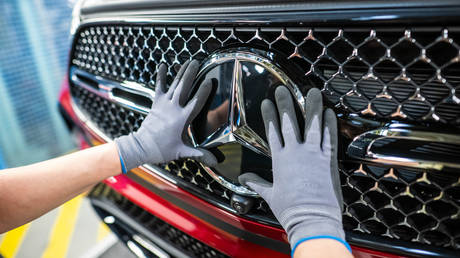
The leather in a Mercedes-Benz S-Class has a specific scent. It is the smell of quiet success, of a world where the greatest worry is the smoothness of a gear shift or the precision of a seat massage. For decades, the three-pointed star has occupied a mental space defined by elegance and the relentless pursuit of civilian perfection. But step inside the glass-walled corridors of Stuttgart today, and the conversation is shifting. The air is thinner. The stakes have changed.
Ola Källenius, the man at the helm, recently signaled a pivot that would have seemed unthinkable five years ago. He stood before the public not just as a car maker, but as a realist facing a fractured continent. Mercedes-Benz, he noted, is "willing" to move into defense production.
This isn't about slapping a logo on a tank. It is about a fundamental soul-search for one of the world’s most iconic brands. When a company built on luxury starts talking about the machinery of war, the world is no longer the place we thought it was.
The Ghost in the Assembly Line
Imagine a technician named Hans. For twenty years, Hans has calibrated sensors that keep families safe in the rain. He understands the "Pre-Safe" system—the way a Mercedes braces for impact by tightening seatbelts and closing windows a split second before a collision. It is an act of digital empathy.
Now, Hans hears the echoes of a different kind of impact.
The transition Källenius is suggesting involves a massive industrial recalibration. The expertise Mercedes possesses in heavy-duty engines, autonomous navigation, and high-strength materials is exactly what a modern military needs. The "Pre-Safe" logic that saves a driver on the Autobahn is, at its core, the same logic required for a reconnaissance drone or a troop transport navigating a minefield.
The barrier between "consumer luxury" and "national security" is dissolving. This isn't a choice made in a vacuum. It is a response to a Europe that woke up one morning to find its peace was a fragile glass ornament. Källenius is acknowledging that if the state asks for help, a pillar of German industry cannot simply look the other way.
The Weight of History
We have to talk about the shadow in the room. For a German industrial giant, the word "defense" carries a weight that American or British firms don't always feel. The history is long. The memories are etched into the very soil of the factories. Moving back toward military production requires a delicate, almost surgical level of corporate diplomacy.
Källenius is treading carefully. He isn't rushing to build artillery shells. Instead, he is opening a door. He is saying that the technological prowess that makes a Mercedes-Benz a marvel of engineering is a resource that belongs to the defense of democracy, should it be summoned.
Consider the logistics. A modern car is a rolling supercomputer. The software architecture required to manage a fleet of electric vehicles is remarkably similar to the systems needed to coordinate tactical movements in a conflict zone. Mercedes-Benz isn't just selling steel and rubber; they are selling the "brain" of the machine. If that brain can help secure a border, the ethical calculus for a CEO changes.
The Engine of Necessity
The global supply chain is a nervous system. When it twitches, everyone feels the pain. The car industry has spent the last few years reeling from chip shortages, energy spikes, and the frantic race toward electrification. In this volatile environment, diversifying into defense isn't just a moral or political statement—it’s a survival tactic.
Defense contracts provide something the volatile luxury market cannot: long-term, guaranteed stability.
While a recession might cause a billionaire to skip this year’s Maybach upgrade, a government’s need for secure logistics vehicles remains constant. It is a hedge against the winds of economic change. But there is a human cost to this logic. The workers who take pride in the "Best or Nothing" slogan for high-end sedans must now reconcile that pride with the production of machines designed for the harshest environments on earth.
The Invisible Shift
What does this look like on the ground? It looks like a laboratory in Sindelfingen where engineers who used to study wind resistance on a coupe are now looking at the thermal signature of an engine block. It looks like a board meeting where the "Customer Journey" is replaced by "Operational Readiness."
The complexity is staggering.
To move into defense, Mercedes has to navigate a labyrinth of regulations, security clearances, and ethical oversight. They are not starting from zero; the G-Wagon has been a military staple for decades. But Källenius is talking about something larger. He is talking about a systemic readiness to pivot the entire industrial might of the company toward the needs of the state.
The Mirror of the Future
We often think of progress as a straight line toward more comfort, more speed, and more light. This move suggests a detour. It suggests that the future requires a different kind of strength.
There is a certain irony in the fact that the most sophisticated safety features in the world—the things that make us feel invulnerable behind a steering wheel—are now being reconsidered for the ultimate test of safety. We are seeing the birth of a new industrial era. It is an era where the lines between our private lives and our public defense are no longer clearly drawn.
Källenius is not a warmonger. He is a man looking at a spreadsheet and a map of the world and realizing they are the same thing. The "willingness" he expresses is a somber acknowledgment of reality. It is the sound of a luxury brand putting away the champagne and rolling up its sleeves.
The silver star has always pointed toward the horizon. For a long time, that horizon was sunny, paved with smooth asphalt and lined with trees. Today, the horizon is obscured by smoke and uncertainty. Mercedes-Benz is simply making sure it has the right tires for the mud.
The silence of an electric motor is a beautiful thing. It is the sound of the future. But as the factories in Germany begin to listen for the call of the defense ministry, that silence feels less like peace and more like a breath being held.