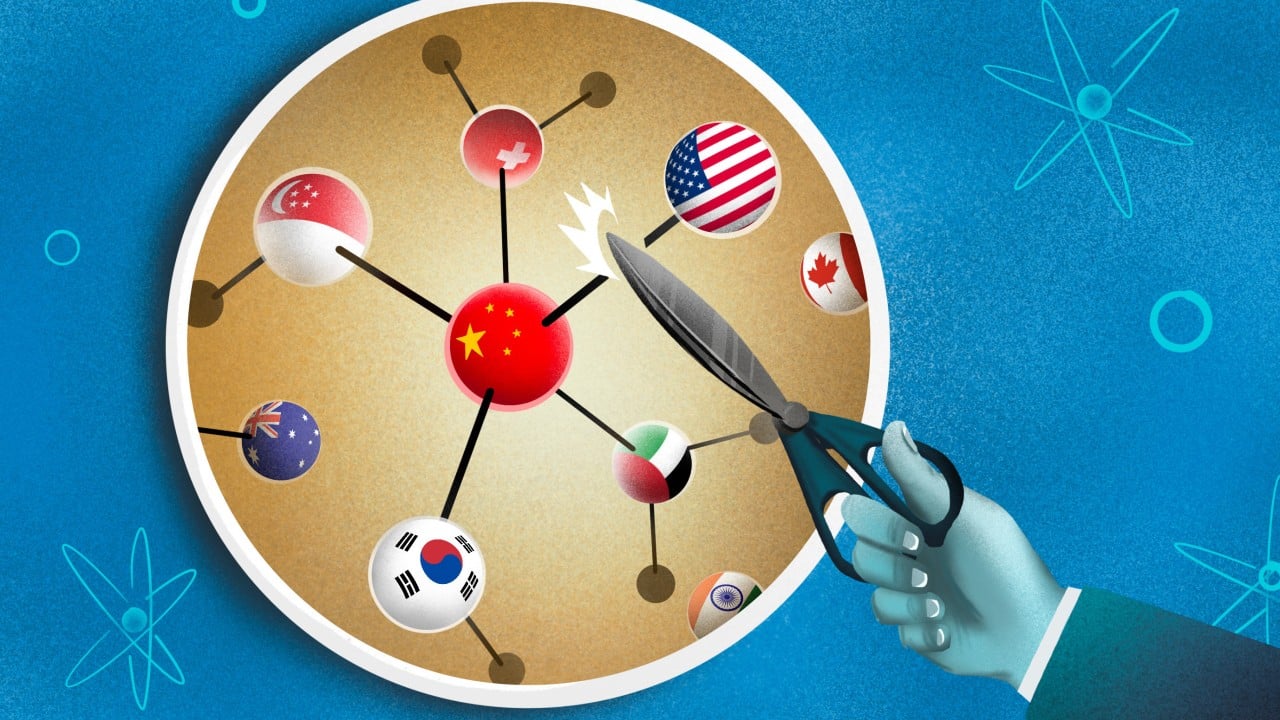
Singapore and South Korea are stepping into a massive geopolitical void as bilateral scientific cooperation between the United States and China officially shatters. For decades, the engine of modern technology ran on a simple fuel: American funding paired with Chinese talent and manufacturing scale. That engine is now seized.
As Washington and Beijing erect high walls around critical tech sectors, joint laboratories are shutting down, visas are tightening, and institutional partnerships that defined the post-Cold War era are dissolving. Into this vacuum step middle powers like Singapore and South Korea. These nations are aggressively positioning themselves as neutral arbiters and safe harbors for advanced research and development. If you enjoyed this post, you should look at: this related article.
The rupture of the ultimate bilateral scientific bridge is not just a diplomatic footnote. It represents a fundamental restructuring of how the world invents things. When laboratories split along ideological lines, redundancy replaces efficiency. The cost is borne by everyone seeking cures for diseases, better semiconductors, and cleaner energy. Yet, for nations nimble enough to play both sides, the fracturing of superpower science is an unprecedented economic windfall.
The Anatomy of a Divorce
Scientific decoupling did not happen overnight. It was a slow motion train wreck fueled by rising national security paranoia, intellectual property theft allegations, and strict legislative measures like the United States CHIPS and Science Act. For years, the flagship bilateral science and technology agreement between Washington and Beijing served as the gold standard for cross-border academic exchange. For another angle on this event, see the recent update from Wired.
That agreement has withered. Lawmakers in Washington view every joint publication in artificial intelligence, quantum computing, and biotechnology as a potential security leak. In Beijing, leadership demands domestic self-reliance, viewing foreign scientific entanglements with growing suspicion.
The consequences for researchers are immediate and brutal. University administrators across the American Midwest and the coastal tech hubs of China are ending joint programs. Funding bodies are auditing grant recipients with unprecedented hostility. A generation of researchers who trained in both countries now finds themselves treated with suspicion by both intelligence apparatuses.
Academia used to pride itself on universalism. Science was supposed to transcend borders. That idealism is dead. In its place stands a transactional reality where every molecule and line of code must answer to a national flag.
Singapore Plays the Neutral Broker
Singapore thrives on other people's chaos. As traditional pathways for US-China collaboration close, the island nation is positioning itself as the Switzerland of Asian research and development.
Singapore has invested heavily in infrastructure designed to welcome displaced talent and orphaned projects. The Agency for Science, Technology and Research has quietly ramped up recruitment drives, targeting top-tier engineers and molecular biologists who no longer feel welcome in Western institutions or who wish to avoid the political crossfire in China.
This is not accidental. Singapore's government understands that the next economic era belongs to those who control advanced manufacturing and deep-tech innovation. By maintaining open diplomatic channels with both Washington and Beijing, Singapore offers a rare workspace where researchers from opposing geopolitical camps can still share data without triggering national security alarms.
Consider the biomedical sector. Singapore hosts world-class clinical research facilities. When a joint American-Chinese oncology trial hits a wall due to compliance restrictions, Singaporean contract research organizations frequently step in to keep the data flowing. They act as the neutral clearinghouse for intellectual property that can no longer cross the Pacific directly.
South Korea and the Semiconductor Squeeze
South Korea faces a far more precarious tightrope walk. As a frontline state in the global technology supply chain, Seoul cannot afford to alienate Washington, its primary military ally and a major source of software innovation. At the same time, South Korean conglomerates like Samsung and SK Hynix rely heavily on Chinese manufacturing hubs and supply markets.
When the last major US-China research links break, South Korea experiences the shockwaves directly. The semiconductor industry is ground zero for this technological partition.
Seoul is responding by doubling down on domestic research and development while aggressively courting non-aligned partnerships. The South Korean government recently unveiled massive funding packages aimed at securing sovereign capabilities in next-generation memory chips, advanced batteries, and artificial intelligence hardware. They cannot rely on American basic research the way they used to, nor can they safely outsource manufacturing or early-stage testing to Chinese facilities.
The strategy requires a delicate balancing act. South Korean research institutes are actively forging alternative links with European labs, Japanese institutions, and Southeast Asian partners. They are diversifying their scientific portfolio away from the bilateral US-China axis before external pressures force their hand entirely.
The Cost of Fragmented Innovation
History teaches a harsh lesson about scientific nationalism. When knowledge is siloed, progress slows. The eradication of cross-border synergy introduces massive inefficiencies into the global innovation pipeline.
Duplicate laboratories will emerge. Two separate research teams in different hemispheres will spend billions of dollars solving the exact same problem because they are not allowed to share data. Critical breakthroughs in green energy transition and pandemic preparedness will stall as bureaucratic red tape and export controls choke the free flow of reagents, algorithms, and peer reviews.
The loss hits basic research hardest. Applied engineering can sometimes be brute-forced with domestic capital, but fundamental scientific discovery relies on serendipity, global conferences, and chaotic cross-pollination of ideas. When you restrict a researcher's ability to board a flight, attend a workshop, or co-author a paper based on their passport, you kill the friction that generates sparks of genius.
Navigating the New Normal
For multinational corporations and academic institutions, the playbook has changed forever. The era of frictionless global science is over. Organizations must now adopt a multi-hub strategy, isolating their research pipelines to comply with conflicting legal regimes in Washington and Beijing.
Singapore and South Korea offer a glimpse of the future. They prove that middle powers can leverage superpower paranoia to capture high-value intellectual capital. By offering stable legal frameworks, robust protection for intellectual property, and pragmatic diplomacy, these nations are transforming a global crisis into a localized economic boom.
The decoupling is irreversible. The bridge between American capital and Chinese scale has collapsed into the Pacific. What rises in its place will be smaller, heavily guarded, and fiercely contested. Innovation will survive, but it will travel a much harder, narrower road.