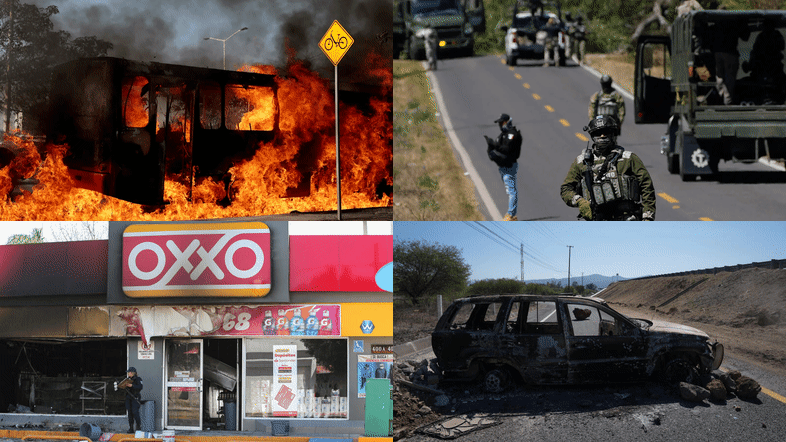
The handcuffs have a specific sound. It isn't the heavy clink of a dungeon door from a movie; it is a sharp, metallic "zip" that feels like a cold needle against the wrist. For sixty years, that sound has been the primary soundtrack of a multi-trillion-dollar experiment. We called it a war. We told ourselves it was a crusade for the soul of the neighborhood.
But if you walk through the tenderloin of any major city, or sit in a rural diner in the Rust Belt, you can see the scars of the campaign. The maps of our cities are tattooed with the results: shattered families, overcrowded cells, and a drug supply that is more lethal today than when the first "Just Say No" poster was ever stapled to a classroom wall.
The strategy was simple. We would squeeze the supply until it vanished. We would punish the demand until it withered. It was a logical, linear approach to a problem that is anything but linear. It was a war on chemistry, fought with infantry tactics.
And we lost.
The Math of a Failed Siege
Imagine a balloon.
When you squeeze one end of a balloon, the air doesn't disappear. It simply rushes to the other side, stretching the rubber until it threatens to pop. This is what economists call the "Balloon Effect." For six decades, we squeezed the supply routes in South America, only to see them bulge in Mexico. We squeezed the pharmacies, and the air rushed into the illicit labs of Southeast Asia and China.
The numbers are staggering. Since 1971, the United States has spent over $1 trillion on drug prohibition. Yet, the price of heroin has dropped by roughly 80% since 1980, while its purity has climbed. If this were a business, the board of directors would have been fired decades ago. In any other sector, a 1,000% increase in budget paired with a total failure to achieve the primary objective—reducing availability—would be seen as a catastrophe.
Instead, we doubled down. We built more prisons. We militarized local police departments. We turned addiction, a complex biological and psychological "glitch" in the human reward system, into a moral failing punishable by exile from society.
The Ghost in the Machine
Consider the story of a man we will call Elias.
Elias didn't wake up one morning and decide to dismantle his life. He was a carpenter with a bad back and a prescription that ran out too soon. When the pills stopped, the sickness started. It is a physical agony that feels like your bones are made of jagged glass and your skin is being scrubbed with steel wool.
In the eyes of the law, Elias became a criminal the moment he bought a bag on a street corner to stop the shaking. From that second, the system's only goal was to catch him. Not to fix his back. Not to stabilize his brain chemistry. Just to catch him.
When we incarcerate someone like Elias, we aren't just punishing a person. We are detonating a grenade in a household. His kids lose a father. His wife loses an income. When he eventually gets out, he has a record that makes him unhireable. He is barred from public housing. He is a ghost in the economy.
What does a ghost do when he is cold and hungry? He returns to the only thing that ever made him feel warm.
The War on Drugs created a feedback loop of trauma. By treating a public health crisis as a criminal justice problem, we ensured that the most vulnerable people would stay vulnerable. We traded treatment beds for bunk beds, and we are still paying the interest on that debt.
The Portugal Pivot
There is another way. It isn't a pipe dream or a radical utopia. It is a proven model that started with a country on the brink of collapse.
In the late 1990s, Portugal was drowning. One in every hundred people was addicted to heroin. The streets of Lisbon were littered with needles. The prisons were bursting. The traditional "tough on drugs" approach was failing so spectacularly that the government decided to do something unthinkable.
They stopped arresting people for using drugs.
In 2001, Portugal decriminalized the possession of all drugs for personal use. They didn't make drugs "legal" like milk or bread. It stayed illegal to sell them. But if you were caught with a supply, you didn't go to a cell. You went to a "Dissuasion Commission." You met with a doctor, a lawyer, and a social worker.
[Image comparing drug overdose deaths in Portugal versus the United States]
The results were a slap in the face to every prohibitionist. Within fifteen years, the number of people receiving drug treatment rose by 60%. The rate of new HIV infections dropped by 95%. Most importantly, the drug-induced death rate plummeted to one of the lowest in Europe.
Portugal stopped fighting the users and started fighting the despair that leads to use. They realized that the "War on Drugs" was actually a war on people—mostly poor people, mostly people of color, and mostly people with untreated trauma. By shifting the budget from handcuffs to healthcare, they saved their country.
The Iron Law of Prohibition
There is a dark irony to the last sixty years. The harder we pushed, the more dangerous the drugs became.
This is known as the "Iron Law of Prohibition." When you make something illegal, the market incentivizes the most potent, compact version of that product. During Alcohol Prohibition, people didn't bootleg beer; they bootlegged moonshine because it was easier to hide.
Today, we see this in the rise of fentanyl.
Fentanyl is a synthetic opioid fifty times stronger than heroin. It is so potent that a few grains can kill a grown man. It is the perfect product for a prohibited market because it is incredibly easy to smuggle. You don't need a field of poppies; you just need a lab and a shipping container.
Our attempt to eliminate drugs created a vacancy that the most lethal substances on earth were happy to fill. By destroying the relatively "stable" markets of the past, we paved the way for a chemical arms race that is currently killing over 100,000 Americans every year.
Moving Beyond the Shadow
What actually works?
It isn't a secret. The data is screaming at us from every corner of the globe.
Harm Reduction works. Providing clean needles doesn't "encourage" drug use; it prevents the spread of Hepatitis and HIV. It keeps people alive long enough to eventually choose recovery. Supervised injection sites—places where medical staff can intervene if someone overdoses—have a 100% success rate in preventing death on-site.
Medication-Assisted Treatment (MAT) works. Using substances like methadone or buprenorphine isn't "trading one addiction for another." It is stabilizing a chaotic brain so that a person can hold a job, hug their kids, and breathe again.
Social Integration works. In Switzerland, they moved away from mass incarceration and toward a "Four Pillars" policy: prevention, treatment, harm reduction, and law enforcement (targeting traffickers, not users). They didn't just give people medicine; they gave them homes and jobs.
The common thread in every success story is a shift in perspective. We have to stop seeing the "addict" as a monster to be subdued and start seeing them as a neighbor to be salvaged.
We often talk about addiction as a "choice." But choice is a luxury of a healthy brain. When the prefrontal cortex—the part of the brain responsible for decision-making—is hijacked by a chemical, choice becomes a whisper in a hurricane. You cannot punish a hurricane into stopping. You can only build a shelter and wait for the storm to pass.
The Cost of the Status Quo
The real tragedy of the last sixty years isn't just the money. It's the wasted human potential.
Think of the artists, the mechanics, the mothers, and the teachers we have locked away in cages because they were struggling with a health condition. Think of the neighborhoods we have hollowed out in the name of "public safety," only to leave them more dangerous and desperate than before.
We are standing at the end of a long, dark corridor. For decades, we have been running toward a light that turned out to be a train. It is time to turn around. It is time to admit that a policy born of fear and prejudice cannot produce a harvest of health and peace.
The handcuffs have a specific sound. But so does a door opening.
The transition won't be easy. There will be setbacks. There will be people who claim that compassion is "weakness." But we have tried "strength" for sixty years, and all it gave us was a generation of ghosts and a mountain of debt.
Real strength is the courage to look at a failing system and say, "No more." It is the willingness to fund a clinic instead of a cage. It is the radical act of treating a suffering human being like they are worth saving, even when they don't believe it themselves.
The war is over. It’s time to start the healing.
Would you like me to draft a proposal for how local municipalities can implement these harm-reduction strategies in their own communities?


