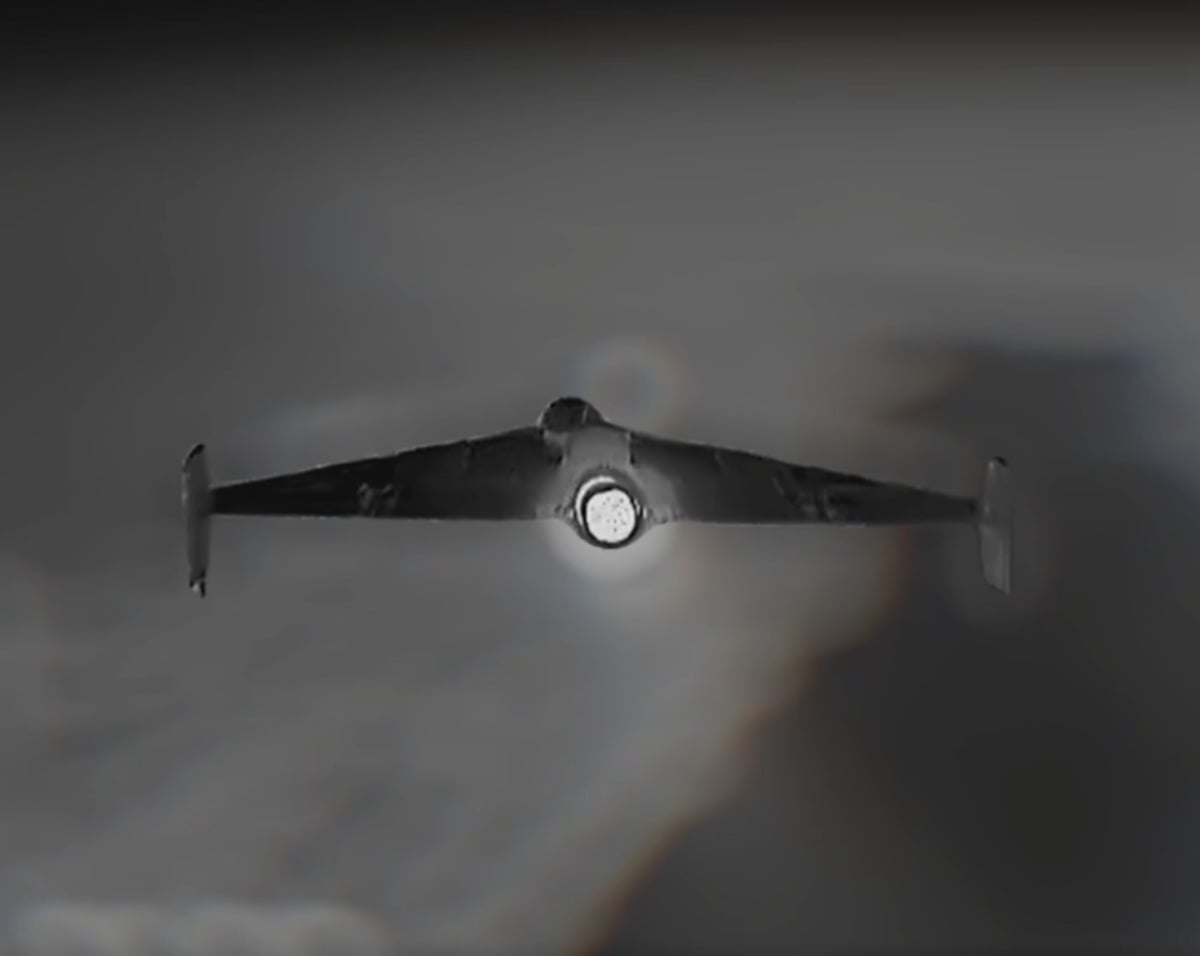
The sound is what stays with you. It is not a roar or a screech. It is the low, rhythmic buzz of a lawnmower engine, high up in the dark, moving at a steady one hundred miles per hour. In Kyiv, in Kharkiv, in Odessa, that sound means one thing. A Shahed-136 kamikaze drone is overhead, carrying eighty pounds of explosives, searching for a power grid, an apartment building, or a school. For two years, the only response was a desperate scramble. Mobile fire teams would rush into the night, shining searchlights into the black sky, praying a burst from a heavy machine gun would catch a silhouette.
Then, the machines stopped waiting for human hands.
High above an undisclosed sector of the front line, a tiny quadcopter hovers in total silence. It does not have a pilot holding a joystick in a bunker miles away. The radio frequencies are jammed anyway; static fills the airwaves like thick mud. But this little drone does not care about the static. Its camera sweeps the horizon, processing pixels at lightning speed. It spots a shape. The lawnmower buzz grows louder. The tiny quadcopter tilts its rotors and accelerates. It does not ask for permission. It does not check in with headquarters. It tracks, intercepts, and slams directly into the larger drone, neutralizing the threat before a single human being even realizes the engagement has begun.
We have crossed a line that cannot be uncrossed. The era of fully autonomous drone-on-drone combat is no longer a concept for a whiteboard in the Pentagon. It is happening right now in the skies over Ukraine.
The Death of the Joystick
To understand how we arrived at this point, you have to understand the brutal mathematics of the electronic warfare landscape. In the early days of the conflict, drones were a triumph of human ingenuity. College kids and tech-savvy volunteers rigged hobbyist quadcopters with 3D-printed release mechanisms to drop grenades into trenches. First-Person View (FPV) drones became guided missiles, steered by pilots wearing virtual reality goggles, maneuvering with surgical precision.
But war is a rapid teacher.
Russia quickly adapted, deploying massive electronic warfare truck-mounted systems like the Pole-21 and Krasukha-4. These systems do not shoot down drones with bullets. They flood the air with electronic noise. They blind GPS receivers and sever the radio link between the pilot and the aircraft. Imagine driving a car at ninety miles per hour, and suddenly your windshield turns pitch black and the steering wheel detaches in your hands. That is what jamming does to a standard drone.
When the signal dies, the drone crashes uselessly into the dirt.
This electronic wall forced Ukrainian engineers into a corner. If a human pilot cannot steer the drone through the jamming, the human must be removed from the loop entirely. The solution was not a better radio, but a brain. By installing low-power, inexpensive artificial intelligence microchips directly onto the drones, developers gave the aircraft the ability to see and think for themselves.
The Cold Logic of the Autopilot Interceptor
Consider the sheer technical hurdle of what these new interceptors are doing. A Shahed drone is a flying wing, relatively small and incredibly difficult to hit. A human pilot trying to ram one with a quadcopter faces immense latency issues. Even a split-second delay in the video feed means missing the target by several yards.
The autonomous interceptor eliminates the lag. It uses computer vision algorithms trained on thousands of hours of footage of enemy aircraft. Once the onboard camera identifies the distinct triangular shape of a Shahed, the artificial intelligence takes over the flight controls.
It calculates intercept vectors. It adjusts for crosswinds. It ignores the wall of electronic jamming because it does not need a signal to tell it what to do. The drone becomes a closed loop of cold, mathematical intent.
The economic reality of this shift is staggering. A single Shahed drone costs around twenty thousand dollars to produce, and the air defense missiles traditionally used to shoot them down, like the American Patriot or the Norwegian NASAMS, cost hundreds of thousands, sometimes millions, of dollars per shot. Spending a million dollars to destroy a twenty-thousand-dollar drone is a surefire way to lose a war of attrition. But a localized, autonomous quadcopter? It costs a fraction of the price of the target it destroys. The financial calculus of air defense has been flipped on its head.
The Ghost in the Machine
It is easy to get lost in the technical brilliance of these systems, to marvel at the code and the engineering. But the reality on the ground is far more sobering. There is a profound psychological weight that comes with relinquishing control to software.
Talk to the operators who deploy these systems. They describe a strange, unnerving sensation. They pack the drones into boxes, drive out to fields under the cover of darkness, and set them on launching pads. They press a button to initiate the system, and then they wait. They are no longer pilots. They are spectators.
There is no tension in a trigger finger because there is no trigger. The machine determines the target. The machine executes the strike.
This introduces a terrifying ambiguity into modern conflict. When a human pilot makes a mistake and strikes a civilian target, there is a chain of command, a court-martial, a psychological reckoning. When an algorithm makes a mistake, who is held accountable? The engineer who wrote the computer vision code? The factory that soldered the microchip? The soldier who pressed the start button?
The tech community has debated the ethics of autonomous weapons systems for decades in air-conditioned conference rooms. Those debates are now obsolete. The desperation of survival has a way of sweeping away philosophical hesitations. When the choice is between a theoretical ethical dilemma and an explosive drone hitting a hospital, the dilemma loses every single time.
The Horizon Beyond the Trenches
What happens when this technology spills outside the borders of Ukraine? The blueprint is out in the open. The components are cheap, commercially available, and easy to assemble. The software libraries used for computer vision are open-source, accessible to anyone with an internet connection and a basic understanding of Python.
We are looking at a future where airspaces can be locked down not by massive military installations, but by swarms of autonomous, self-governing interceptors. The implications for global security are dizzying. Dictatorships could use autonomous swarms to completely seal their borders against surveillance. Insurgent groups could deploy cheap interceptor nets to neutralize the aerial superiority of traditional military forces.
The sky, once a vast expanse where human pilots pitted their skills against one another, is transforming into an arena of competing algorithms, processing data at speeds our biological minds cannot fathom.
The sun sets over a field somewhere outside of Kyiv. The air is cold, smelling of damp earth and burnt fuel. A soldier walks back to his armored vehicle, leaving a row of small, autonomous interceptors waiting on their racks. He does not look back at them. He does not need to. They are awake, their digital eyes scanning the fading light, waiting for a sound they already know how to silence.


