The air in southern Lebanon doesn't just carry the scent of wild thyme and cedar. These days, it carries a hum. It is a persistent, mechanical thrum that vibrates in the teeth of the olive growers and the schoolteachers. Everyone looks up. They don’t look up for rain or for the sun; they look up to see if the sky is about to break.
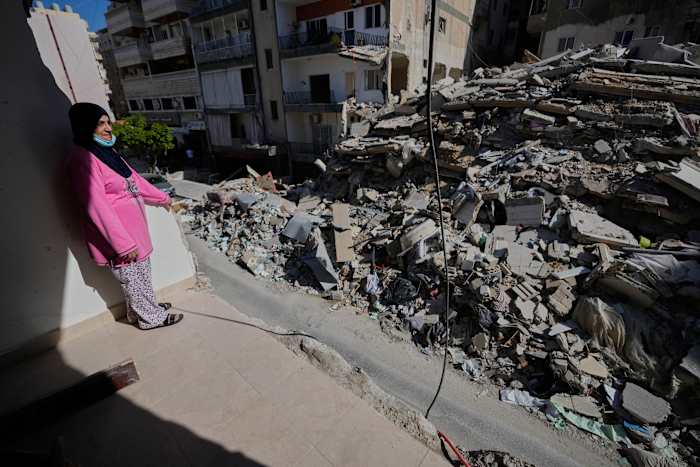
On Wednesday, the sky broke in Nabatiyeh and As-Sawana.
By the time the dust settled, ten lives had been extinguished. In the clinical language of military briefings, these are often labeled as "targets" or "collateral." But in the narrow streets where the smell of scorched concrete lingers, they are something else. They are Hussein, who won’t finish his coffee. They are the children whose backpacks were found under the rubble of a bedroom that, only minutes before, was a sanctuary of sleep.
War in this corner of the world is often described as a chess match. It is a cold, strategic calculation between Israel and Hezbollah. But a chessboard is flat and silent. This reality is vertical, loud, and smells like cordite. When an Israeli missile strikes a residential building in southern Lebanon, the shockwave doesn’t just shatter glass. It shatters the invisible social contract that allows a father to tell his daughter she is safe while he tucks her in at night.
The Mathematics of Grief
The escalation didn't happen in a vacuum. It was sparked by a drone. A small, buzzing intruder launched from the Lebanese side of the border, cutting through the crisp air toward Safed. It didn't hit a military base in the traditional sense; it hit the Northern Command headquarters. Two Israeli soldiers were wounded. One of them, a 20-year-old woman, later died from her injuries.
Blood for blood. This is the ancient, exhausting arithmetic of the Levant.
When the retaliatory strikes began, they hit with a precision that was both terrifying and indiscriminate in its secondary effects. In As-Sawana, a mother and her two sons were killed. Imagine the mundane moments preceding that strike. Perhaps she was wondering if they had enough bread for the week. Perhaps the boys were arguing over a toy. Then, a flash. The world stops.
The Israeli military maintains that it targets Hezbollah infrastructure. They point to the sophisticated tunnels and hidden launch pads nestled within the rolling hills. This is the truth of the tactical map. But the map is not the territory. The territory is a place where civilians live in the shadow of giants. When the giants trade blows, the people underneath are the ones who turn into statistics.
The Invisible Stakes
Why does this matter to someone sitting thousands of miles away? Because what we are witnessing is the slow-motion collapse of a "managed" conflict. For months, both sides have engaged in a calibrated dance. Hezbollah fires a few rockets; Israel strikes a few outposts. It was a violent status quo that everyone hoped would stay within the lines.
That hope is bleeding out.
The stakes are no longer just about border security or regional influence. They are about the precedent of civilian endurance. When ten people die in a single afternoon in Lebanon, and a soldier dies in Israel, the "red lines" we hear diplomats talk about aren't just crossed—they are erased.
Consider the perspective of a resident in northern Israel. For months, tens of thousands have lived in hotels, displaced from their homes in Kiryat Shmona and Metula. They watch the horizon, waiting for the plume of smoke that signifies another Hezbollah ATGM (Anti-Tank Guided Missile) has found its mark. Their lives are in a state of permanent suspension. They are refugees in their own country, haunted by the fear that October 7th was only a beginning.
Now, flip the lens. In southern Lebanon, the displacement is equally profound. Farmers have abandoned their groves. The economy, already reeling from Lebanon’s systemic collapse, is being ground into the dirt. To live in these villages is to live with the knowledge that your home is a potential coordinate in someone else’s war room.
The Architecture of Escalation
The technology of this conflict has changed the emotional landscape. In previous decades, you could hear the jets coming. You had a few seconds of auditory warning—a roar that signaled the end. Now, the drone is the ghost in the machine. It is silent until it isn't. It watches from a height that makes humans look like ants, stripping away the intimacy of combat and replacing it with the detachment of a video game.
But the pain remains intimate.
The death toll in Lebanon from these recent exchanges has climbed into the hundreds, with the majority being Hezbollah fighters, but the civilian count is rising with alarming speed. Each name added to the list is a new reason for a neighbor to pick up a rifle. Each strike on a Lebanese village is a recruiting poster for the very group Israel seeks to dismantle.
This is the tragedy of the kinetic response. It solves the immediate threat of a drone or a rocket launcher, but it sows the seeds of the next decade of resentment. You can kill a commander, but you cannot kill the memory of a child being pulled from the wreckage of a kitchen.
The Weight of the Silence
There is a specific kind of silence that follows an airstrike. It is heavy. It is thick with the dust of pulverised limestone and the ringing in the ears of the survivors. In that silence, the political rhetoric about "deterrence" and "sovereignty" feels hollow.
The international community watches with a mixture of dread and fatigue. There are calls for restraint, issued from air-conditioned offices in Washington and Paris. But restraint is a luxury for those who aren't currently burying their dead. For the people on the ground, the only thing more frightening than the current violence is the prospect of what happens if the "big war" finally arrives.
If this calibration fails—if the drone strikes and the retaliatory missiles lead to a full-scale ground invasion—the ten deaths we saw on Wednesday will be a mere footnote. We are teetering on the edge of a regional conflagration that no one truly wants, yet everyone seems to be sprinting toward.
History tells us that wars in Lebanon are easy to start and nearly impossible to finish. The terrain is unforgiving, and the grievances are layered like the ruins of the civilizations that came before.
Tonight, the hum will return to the sky. Mothers in Nabatiyeh will pull their children a little closer. Soldiers on the border will tighten their grip on their rifles, eyes scanning the dark for the blink of a drone’s light. They are all caught in the same terminal cycle, waiting for the next time the sky decides to break.
The rubble in As-Sawana is still cooling, a jagged monument to a Wednesday that changed everything for ten families and nothing for the war.